



This should come as no surprise to those who have been following golf participation numbers since the pandemic boom.
According to the National Golf Foundation, there has been a remarkable 45 percent rise in the number of on-course, female golfers in the U.S. since 2020. Women and girls make up a net gain of 2.5 million, climbing to more than 8.1 million in total, the highest count on record (the previous record was 7.1 million in 2006, prior to the recession).
Here is the interesting part: females are coming into the game at a more rapid rate than males.
Male golf participation is only up 12 percent for a net gain of 2.3 million golfers in that same time span.
Wow! Go back and read that again—whether it’s total golfers or by percentage, there are more women and girls being added to golf than their male counterparts.
That is despite only 28 percent (a record high number) of the golfing population being female.
Let’s take a quick look at why this is happening.
Where is the growth coming from?
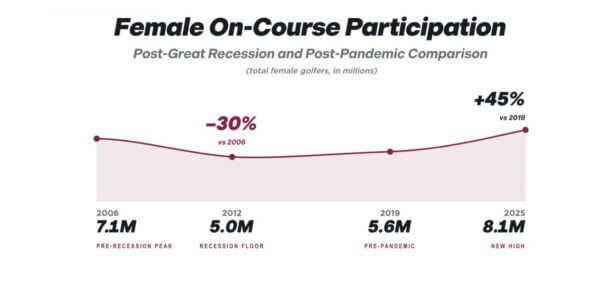
As you will see in the chart above, female golf participation took a massive hit in the late 2000s and early 2010s. It didn’t grow much at all until this recent huge spike.
The NGF makes the point that the economic downturn of 2008-2009 hit women’s leisure time spending even harder than men.
“More married women entered the U.S. workforce (per the Bureau of Labor Statistics) as many households sought to compensate for lost income, and females disproportionately absorb a greater share of family responsibilities, whether household or childcare, during times of economic stress.”
Then came COVID-19. Obviously, the impact of pandemic on the golf industry has been well documented. We don’t need to rehash that discussion here.
But why has female golf participation in particular grown so rapidly? Even with the pandemic-aided boost, the numbers we are seeing are highly impressive.
The data is unclear on this but there is anecdotal evidence that golf has become less intimidating.
The barrier to entry is lower and there is less of a stigma around getting into the game.
One example of this is off-course golf options that have become more readily available. Everything from Top Golf to Five Iron to Popstroke is getting more women and girls introduced to the game in a much less formal environment.
“Women and girls not only make up a higher proportion of new golfers, including beginners and returners, they also have greater representation among off-course only participants and among non-golfers who are interested in playing on a course,” the NGF states.
Translation: There is even more opportunity for on-course growth.
We these off-course golf options, there are no dress code restrictions. There isn’t a foursome of angry old guys waiting on the tee box, pressuring you into to hurrying up. And some of the other classic barriers like time, cost and difficulty are greatly mitigated.
It makes golf seem more approachable. The on-course game seems more attainable from there.
Prior to all these off-course options popping up, entering the golf ecosystem was a much larger leap of faith. Now there are baby steps to get introduced to it.
Women are historically more driven by the social/community aspect of leisure. Golf as a whole has been catering to those community goals since the pandemic because that is a huge value for everyone entering the game.
People don’t just want to show up and play—they want to play with like-minded people.
The bottom line
Women’s golf is booming and there’s no sign of it stopping soon.
I’m interested to see if the LPGA Tour can capitalize on this growth. It seems like there is space to run there with audience development and rallying around athletes like Nelly Korda.
But on an even bigger scale, I think there is more opportunity.
We can set up more golf courses where the forward tees aren’t asking women to carry large hazards. We can set them up to be at the appropriate yardage at appropriate angles with appropriate tee box conditions—not just a marker placed on an uneven fairway.
We can offer even more social/community elements at public courses that are used to having a men’s league but not a women’s league.
Hopefully, one day, the female participation passes 30 percent and heads north from there.
I wouldn’t bet against it.








HardcoreLooper
4 months ago
Sean – Thanks for covering this. As the father of two young-adult female golfers, I’m glad to hear that more women are getting involved with golf. I’d like my girls to have more women to play with.