


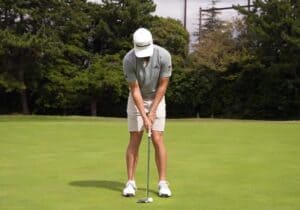
I love finding advice that feels less conventional. The guys who dominate the PGA Tour didn’t get there by following a “Golf 101” book. There are quirky, interesting, completely outside-the-box things that help them become who they are. This recent video from TaylorMade where Jacob Bridgeman shared some of his putting technique is no exception.
Bridgeman is statistically the best putter on the PGA Tour in 2026. He’s first in Strokes Gained: Putting, first in average distance of putts made per round and third in three-putt avoidance. He has two wins this season and when he explains how he does it, almost none of it sounds like what you’ve already heard.
Here are three things he does that stood out to me.
1. He lines up with his thumbs, not the putter face
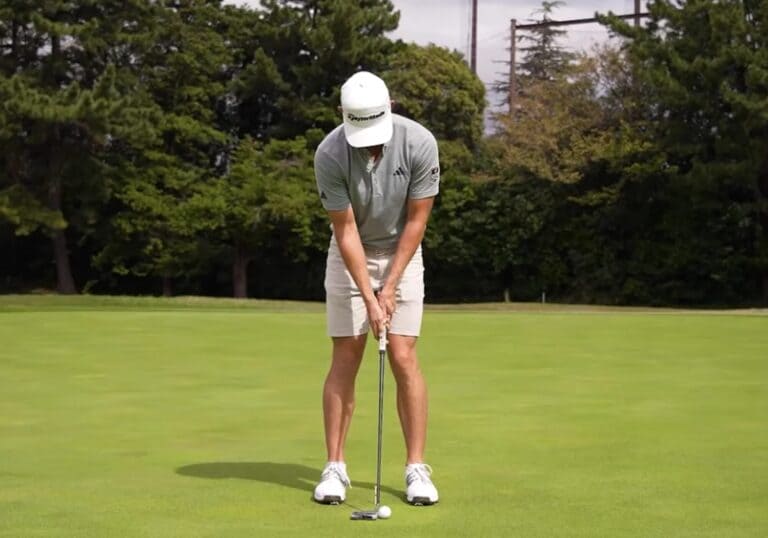
Bridgeman doesn’t use a line on his putter. He uses the face a little but he says he lines up more with his thumbs. His grip is flat on the front. Instead of squaring the face to a line, he envisions a line running into the hole and matches it to how his thumbs feel.
He says he could take the head off the putter or make it invisible and still line up well with just his thumbs.
That’s also where nearly all of his grip pressure lives. He describes it as “very intentional pressure” in the thumbs with the rest of his fingers just kind of there. He says he could pretty much take the other fingers off the club. To reinforce the feel, he regularly does a drill where he putts with flat palms and presses only his thumbs down.
The idea that alignment and pressure can come from one simple repeatable feel, instead of from lines and face angles, is worth trying regardless of your skill level.
2. He never thinks about his stroke
Bridgeman never thinks about his stroke and he admits he wouldn’t be able to identify it in a video.
“If there’s an event where I’m thinking about my stroke, it’s probably the ones where I’ve missed the cut,” he says. He never watches the putter go back and he never grinds on arcs or gate drills. The only things on his mind are the read and the speed.
Amateurs do the opposite. They watch the putter head, following it back, working on a stroke they’ve been told is correct.
“It’s never really worked for me,” he says. His theory is that if you’re as reactive as possible and worried about only one thing (making the ball roll correctly), you eliminate every other variable.
That carries through to how he finishes the putt. He doesn’t hold his head down and look up later. His eyes and then his head follow the ball immediately because he wants to see it roll on the line he envisioned. “I’m not an aim-at-something-and-hit-it guy. I’m following the path.”
Bridgeman’s warm-up routine is worth copying.
He starts with a dead-straight uphill four-footer and a putting plate and he tries to make about 10 in a row before working around the hole. The goal is to have 30 putts inside six feet before he reaches the first green.
3. He doesn’t practice green reading. He collects putts.
Most golfers chase a system for reading greens. Bridgeman was told that the more putts you see go in, the better you’ll read. He watches his own putts and his playing partners’. When a partner lines one up, he walks by, takes a peek, compares it to his own read and then watches the ball to see who was right.
His process is simple. He walks around the putt picturing a line from the marker to the hole, checks the slope from the side to gauge speed and goes back behind the ball to see if the line still matches. Over the ball, he takes two practice strokes; the first watching the ball leave on the line and the second dialing in speed.
The takeaway
I wouldn’t copy any of this and expect to become the best putter ever. But the common themes here of keeping it simple, paying attention to one thing and letting feel play a part are good things to bring to your own game.





Leave A Reply