



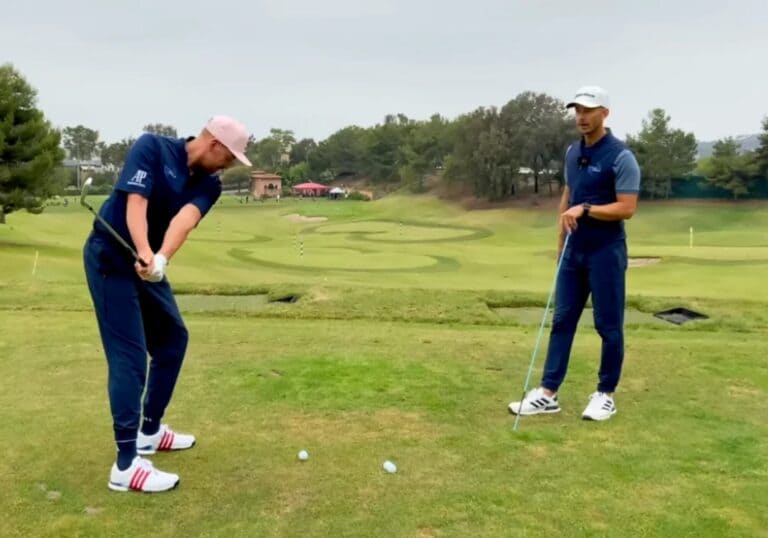
Golfers love checkpoints. Where should the clubface be here? What should my hands look like there? It’s a natural way to practice because it gives you something visual. This week’s drill is a good example of that kind of checkpoint. It’s simple but I think it’s one worth knowing. If you’d rather watch how it works, the video from Me and My Golf is below.
How it works
This drill needs a club, a tee and a spot where you can see your swing such as a mirror or phone camera.
- Swing back to waist height and stop. Check that the clubface matches your spine angle. It will probably feel like the face is looking down at the ground. That’s the exaggeration and it’s what a square face feels like when you’re used to opening it. The purpose of this drill is to exaggerate the feel so that you do it correctly in real time.
- Continue to the top of your backswing and pause. The leading edge of the club should match your forearm. It should feel like the face is pointing slightly up at the sky.
- Hit the shot. Use a tee to keep it simple and easy until you get the hang of it.
- Find the feel. Check the position and then look away and ask yourself what it feels like. A square face often feels heavier because the toe isn’t sitting on top of the heel anymore. If it feels heavy, you’re probably in a good spot. Confirm with a camera if you can.
- Once that’s comfortable, shorten the swing. Swing back to waist height, pause and hit from there.
Why it’s worth your time
I like this drill for a few reasons. First, it organizes your swing a bit. If you step onto the driving range and you are struggling with tempo or rotation, the drill sort of puts you into a better spot to start out your practice session.
In addition, you’ll work on things like:
- Face awareness: The face has the most influence on where the ball starts and this shows you where yours is early in the swing.
- Simple checkpoints: You check two positions so there’s nothing to memorize and it keeps the concept as simple as possible.
- Feel: Checking the position and then looking away helps you learn what a square face feels like, not just what it looks like.
- Over-the-top fixes: An open face in the takeaway often leads to a steep downswing. Squaring it up lets the club shallow out more naturally.
- Course-friendly: The waist-high version is quick enough to use between shots.
Mistakes to watch for
The main problem with this is rotating the club too closed. You’ll know it if you start hitting shots left (right-handed golfer) or you start having a hard time getting the ball up in the air. Make sure you’re using a mirror or your phone to get a good look at where your club is and whether your feel is producing that square clubface.
Who it’s for
This drill works for every handicap level but it’s especially useful if you slice or swing over the top. An open face early in the swing can send the club over the top. Fixing the face first often helps the path follow without you thinking about it.
My take
What I like about this drill is that it gives you a checkpoint that matters. It’s easy to chase positions that don’t do much for your ball flight but the face is a good one to know. It’s simple and worth knowing if you’re looking for ways to improve your range sessions.







Leave A Reply