




You move the ball for every club in your bag. Except your putter.
Ben Crenshaw is one of the best putters golf has ever seen. His two Masters wins, in 1984 and 1995, were built on a touch on the greens that players still talk about. When he explains anything about putting, I listen.
When his putting went sideways, Crenshaw didn’t rebuild his stroke. In his words, changing your stroke is what gets people in trouble. The one thing he adjusted was ball position, “imperceptibly,” a little up or a little back, until the ball left the face with the roll he wanted to see.
Most golfers struggling with their putting stroke start by overhauling their stroke. They switch grips, buy a new putter and pay no attention to the ball position.
Keep the stroke you can repeat
Putting is personal and repeatability is everything. A new stroke you can’t reproduce under pressure isn’t a fix; it’s a new problem. Crenshaw’s approach holds the stroke constant and adjusts the variables around it.
He also pointed out that ball position isn’t only forward and back. Too far up in the stance was wrong for him and getting too close to the ball inhibited his stroke which he described as freer than most. A free-flowing stroke needs room.
What ball position changes
If you are curious about what ball position in putting can look like, how it changes and what might be ideal for you, I put together this table. This isn’t taken directly from Crenshaw. It’s more of a golf mechanics breakdown to give you a little awareness of this concept.
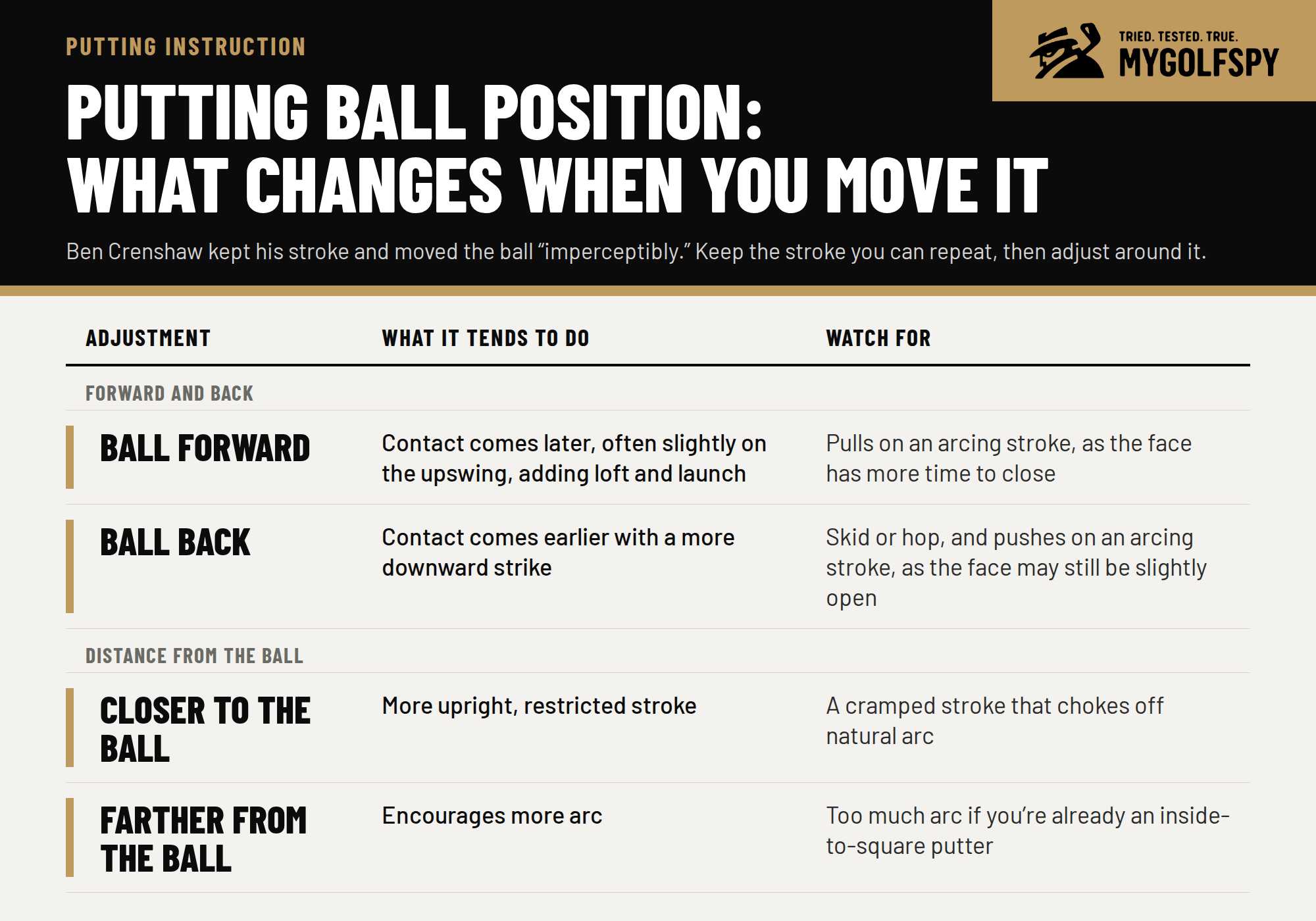
When to move it
Crenshaw’s answer was essentially to move it until the roll looks right. That’s honest but here are some starting points.
- Ball skidding or hopping: try moving it slightly forward.
- Pulling putts or launching high and bouncing: try moving it slightly back.
- Stroke feels cramped: check your distance from the ball, not just forward and back.
He also stressed that greens change all the time. His routine was to hit longer putts early and watch what the ball does. Make ball position part of that warm-up.
A drill to try
- Pick a flat 10- to 15-foot putt.
- Hit five putts from three positions: your normal spot, one ball forward, half a ball back.
- Watch how quickly the ball rolls end over end, whether it hops, and where it starts relative to your line. A line drawn on the ball makes this much easier to see.
- Keep the position that gives the cleanest roll and the most comfortable stroke.
Then stop thinking about it. Crenshaw believed that when you putt well, your mind is blank. Ball position is something you settle before the stroke so you don’t have to think about mechanics during it.







Leave A Reply