




Most avid golfers probably know their driver swing speed. But there’s another number that can change how far your shots go and most golfers have never checked it: attack angle.
Attack angle is simply whether the club is moving up or down as it hits the ball.
- Positive (+): the club is moving upward at impact.
- Negative (-): the club is moving downward at impact.
The key point is that the ideal attack angle is different for your driver and your irons. If you’re watching your launch monitor numbers and not fully understanding it, dig into these numbers to give yourself a better range.
The examples below are modeled scenarios provided by GOLFJOY to show how attack angle affects the shot.
Driver: Hit up on it
With a driver, we tee it up high and move the ball to the front of our stance so that it can be hit on an upward strike. Hitting up helps you in two ways with the driver. The ball launches higher and it spins less. High launch with low spin is a good way to get more distance.
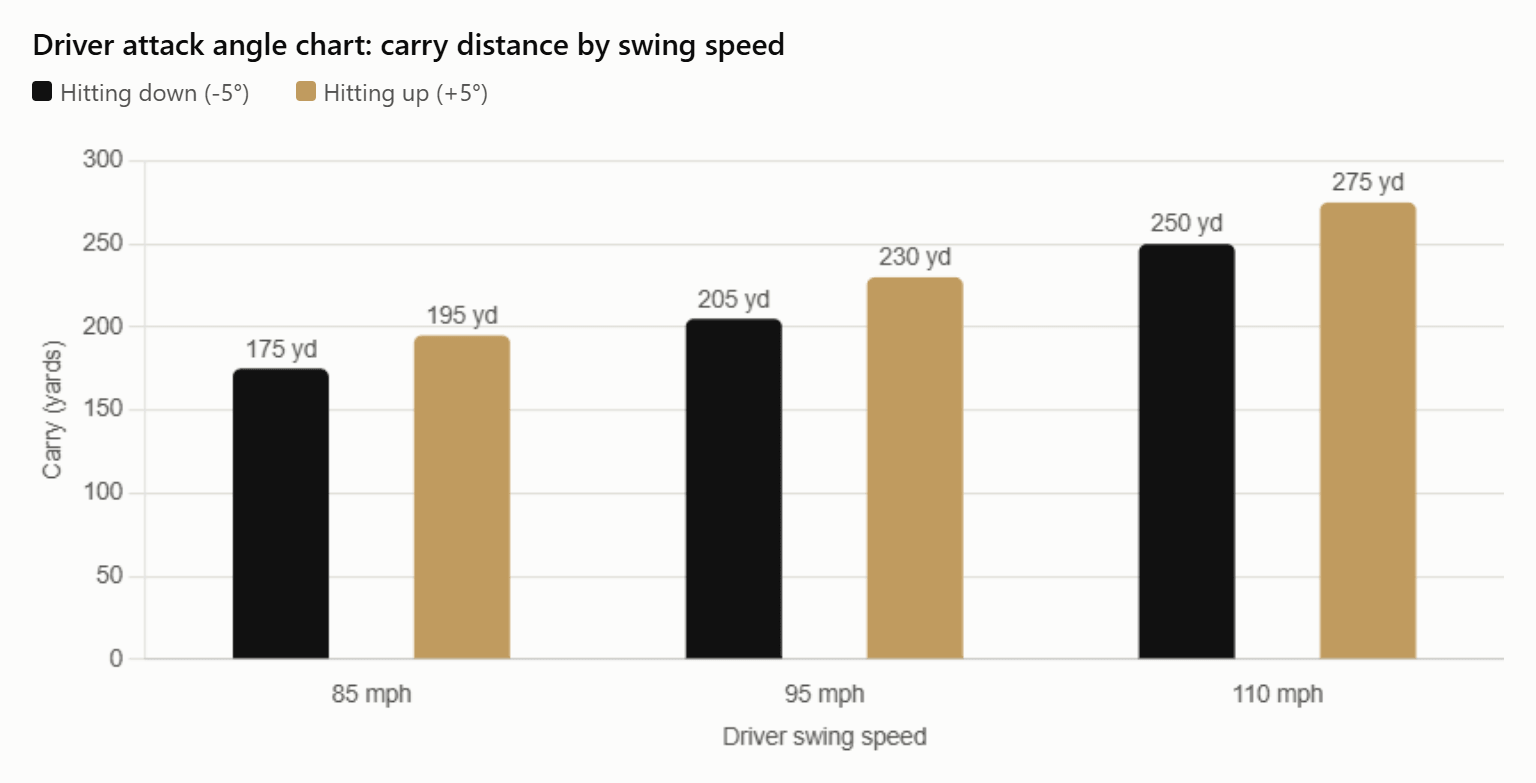
Here’s the same golfer hitting down on the ball (-5°) versus up on it (+5°) at three swing speeds.
Irons: A slight downward strike
Irons work the opposite way. The ball sits on the ground so you want the club to hit the ball first and then the turf. That’s what gives you clean contact, a nice launch and spin that holds the ball on the green.
For a 7-iron, a good starting range is about 2° to 5° downward. Too little or too much both cost you distance. Here’s an 80-mph swing with three different angles.
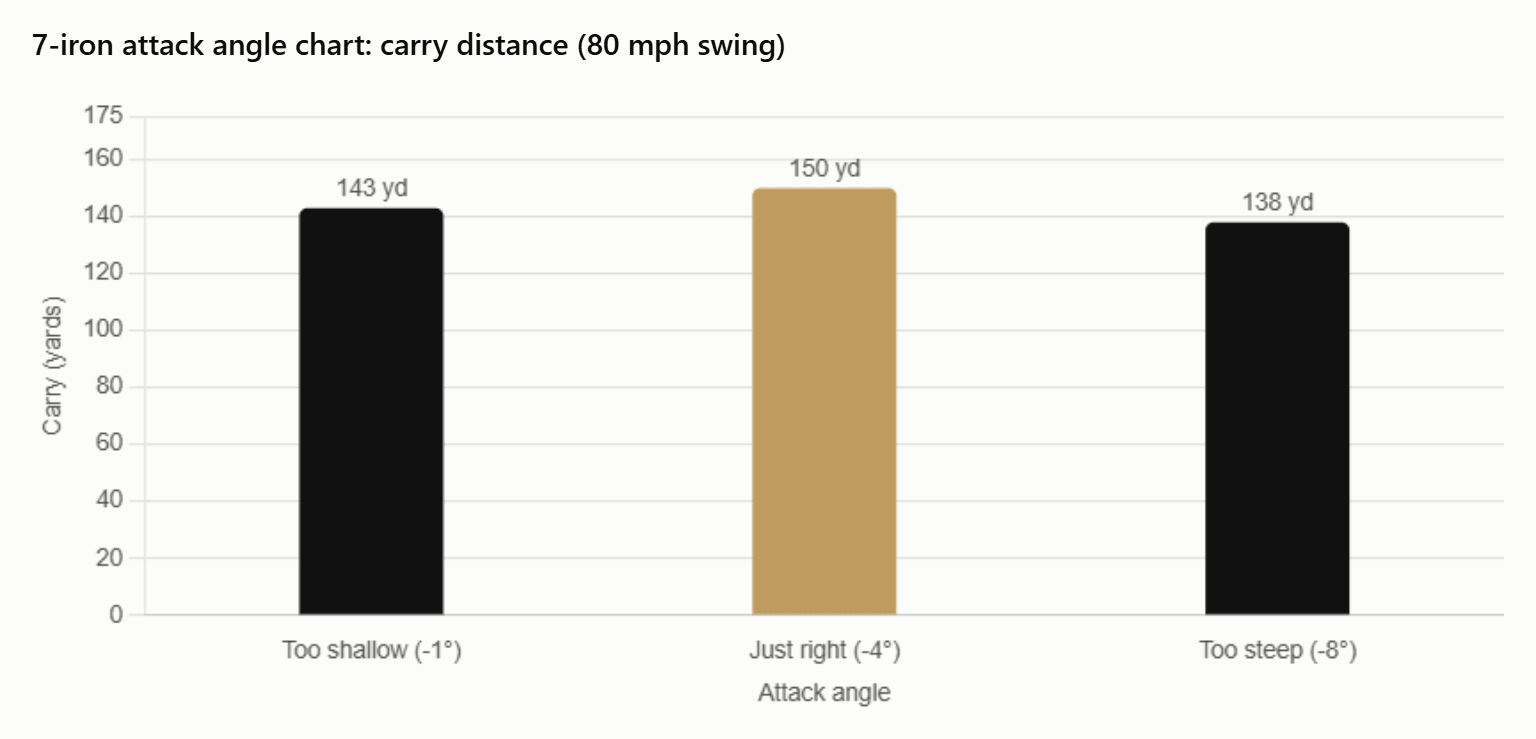
The middle option wins. At -4°, this golfer launches the ball at 18° with 6,300 rpm of spin and carries it 150 yards. Flatten the swing out to -1° and the ball launches a little higher with less spin but the carry drops to 143 yards. A club that is almost level at impact makes it easy to catch the ball thin or hit the ground first so the distance gets unpredictable.
If you go the other way to -8°, you’re driving down into the ball. The launch falls to 15°, the spin jumps to 7,300 rpm and the carry drops to 138 yards. That’s a 12-yard gap between the best and worst swings, with the same golfer and the same swing speed.
The catch: these are example numbers and your best angle depends on your club and your swing. What matters most is hitting the ball first and doing it the same way every time. You don’t need to hit a magic number. An attack angle of -4 is not perfect for all golfers with an 80-mph swing.
Consistency matters more than the perfect number
If you hit a 7-iron the same way every time, you’ll know how far it goes. Here are three example golfers, all swinging at the same speed.
| Handicap | How much your attack angle varies | Average carry | Shot-to-shot carry range |
|---|---|---|---|
| 0–9 | -3° to -5° | 150 yd | 146–154 yd |
| 10–19 | -1° to -6° | 145 yd | 136–155 yd |
| 20+ | +1° to -8° | 138 yd | 120–152 yd |
The lower-handicap golfer’s carry stays within about eight yards. The higher-handicap golfer’s can swing by over 30 yards. For irons, the goal is repeatable more than perfect.
How to find your attack angle
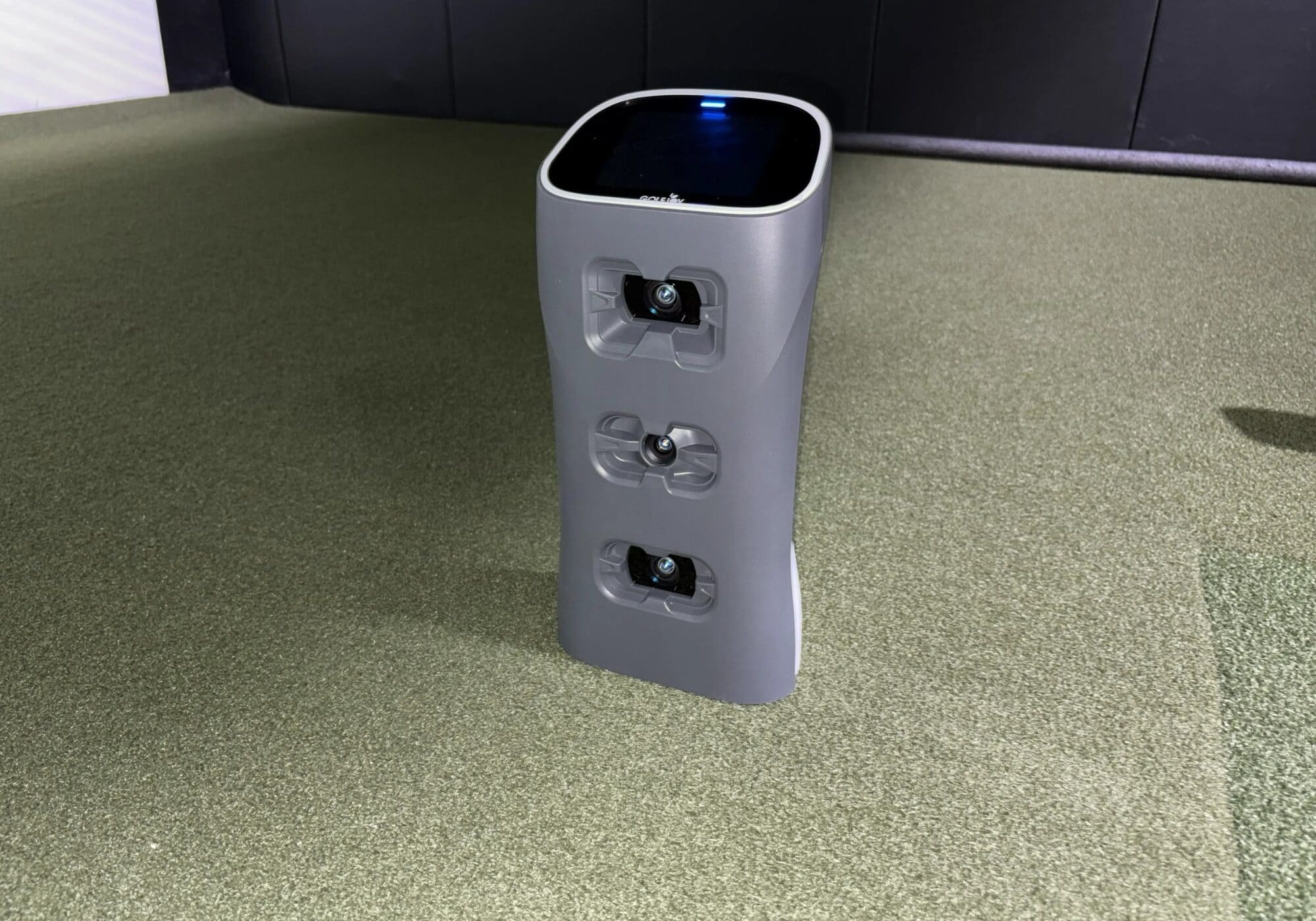
You can’t feel your attack angle so you need a launch monitor to measure it. GOLFJOY’s Spica 3 measures 27 data points on every shot. Their overhead monitors go further. The Rigel 3 Pro tracks up to 42, including extras like dynamic loft (how much loft the club actually has at impact), face angle and face-to-path.
Check both your driver and iron numbers across a full session because the average can give you more insight into your tendencies and what you’ll see on the course. In addition, try to get that angle of attack as consistent as possible so you have more predictable carry distance on the course.
What to take away
- Driver: Try to hit slightly up on the ball. It can mean higher launch, less spin and more carry.
- Irons: Aim for a small downward strike, around 2° to 5° with a 7-iron.
- Neither extreme works. Too shallow and too steep are both less efficient with irons.
- You don’t need a faster swing. Better delivery can add distance at any speed.
- Repeat it. A number you can hit every swing beats one great shot.









Leave A Reply