



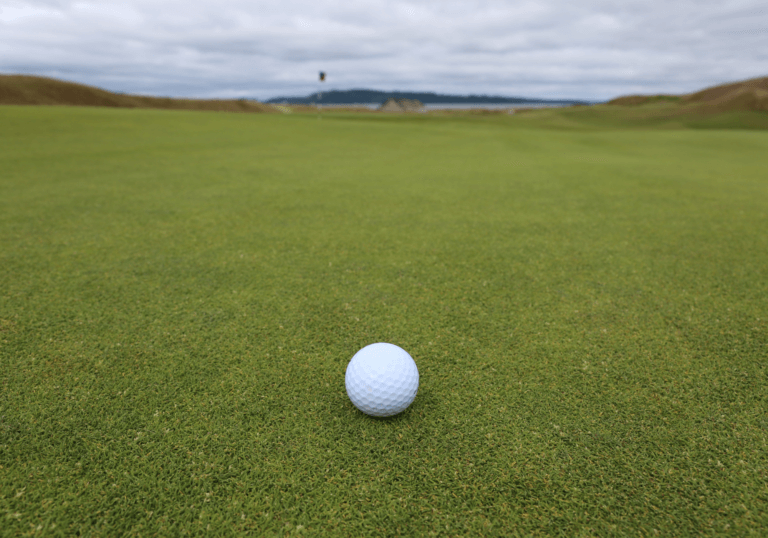
The next time you line up a putt, pay attention to the grass. Get down and look at it. Touch it. Smell it. Listen to it. Dare we say… taste it? All right, so we can’t actually recommend you do any of that but our point is that the type of grass on the green can affect how your ball rolls. Being able to identify what’s between your ball and the hole could be the advantage you need.
Generally, putting greens are covered by one of three grasses: Bermuda grass, bentgrass or Poa annua. Courses in warmer areas, like the southern United States, usually use Bermuda grass while those in cooler places typically plant either creeping bentgrass or Poa, says Jordan Booth, an agronomist and senior director of the US Golf Association’s Green Section.

“Without getting deep in the weeds about what the different grasses are and how to see them… if you knew which variety you had, it would impact your short game and putting the most,” Booth says, emphasizing that these impacts will be most pronounced at the highest levels of amateur play and in the professional game.
Just knowing which type of climate you’re playing in and asking the pro shop what kind of grass they use on their greens will go a long way toward helping you identify the turf you’re dealing with. That said, identification gets a little more complicated when you’re playing in Virginia, North Carolina or some other climate transition zone.
Bermuda grass

Bermuda grass (genus Cynodon if you want to drop that in casual conversation to psyche out your opponents with your enormous brain) is a tough, versatile plant native to Africa, Europe, Asia, and Australia, but not Bermuda. Its dense growth can recover from damage quickly and tolerate droughts, making it a top choice for golf courses and other professional athletic fields in warm locations like Florida and California.
On greens, you’re likely to see ultradwarf versions of this grass that have been bred specifically to withstand super-low mowing heights and regular traffic.
If you didn’t get a clear answer from the pro shop, Booth says you can identify Bermuda grass by looking at the edge of the hole. If you see frayed edges, it’s probably Bermuda. When playing on this turf, you may want to take a little power off your putt or land a chip or pitch a little shorter to let it roll across the relatively firm surface, he says.
The grain, or direction the grass is growing, might also affect your play—though Booth says its effects can be overhyped. If the green between you and the hole is somewhat shiny, you’re putting with the grain and the ball may travel faster. Dull-looking grass, meanwhile, means you’re against the grain and your putt may not go as far or as straight.
Bentgrass

While Bermuda grass will go dormant and turn brown when the temperatures regularly drop below 60 degrees Fahrenheit, bentgrass will keep its color in cooler weather. If it’s been chilly and you’re putting on a green, not a “brown”, it’s likely bentgrass. That said, bentgrass will also go dormant in very cold temperatures.
Bentgrass (genus Agrostis if you already used Cynodon to prove your intellect) is one of the most widespread grasses in the world. All you have to do is glance at its distribution map on the Royal Botanic Gardens’ website to see that the sun never sets on bentgrass. Despite its extensive range, it requires more water than Bermuda grass, making it less than ideal for warm areas.
Strategy-wise, all that water means greens can be somewhat soft during the summer so the first bounce might stick a little. Once you’re putting, though, you shouldn’t notice any differences between a bentgrass green and the other grasses, Booth says.
Poa annua

Unlike Bermuda grass or bentgrass, you may be more familiar with this plant’s scientific name, Poa annua, than its common one: annual bluegrass. Now when your golf partners try to preempt your mind games by announcing that they already know Poa, you can ask if they mean bluegrass, proving you are both worldly and refined.
Poa isn’t native to the Americas, grows well in cool weather and is more likely to appear in the same areas as bentgrass, not Bermuda grass. It’s also more common on the U.S. West Coast. Compared to bentgrass, Poa usually grows a little tighter but the differences aren’t enough to be concerned about, Booth says.
Still, if you really want to know what sets Poa apart, its fast-growing seed heads can make greens a little bumpy as more time passes since its last mowing. That means you might have to hit putts a little harder to keep them on line, Booth says. Proper grounds management can reduce seed head growth, though, and you may not have to worry about them at all.
With all this in mind, if you still want to lay down and become one with the course to experience the turf with all five senses, we can’t stop you. The groundskeepers might, though.









Jim
2 years ago
You forgot to talk about diamond zoysia. Yes it is a putting surface.
If a course has diamond zoysia greens – stay as far away from them as you can! It can make a good putter look bad.