


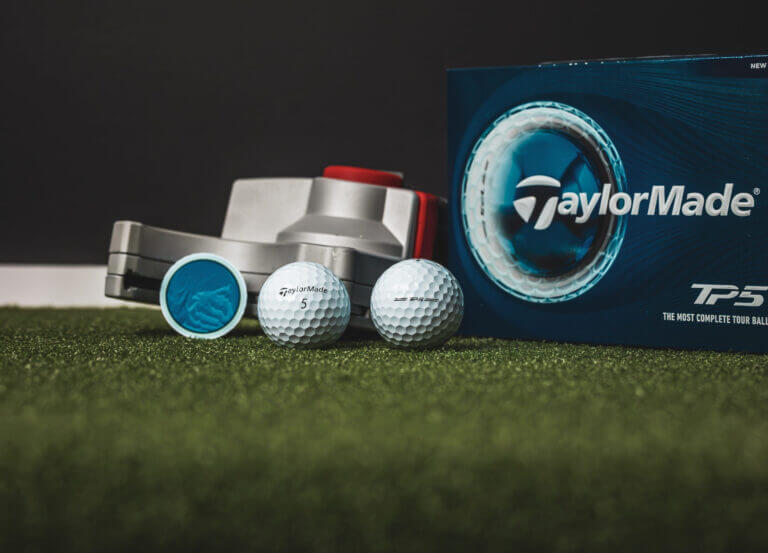
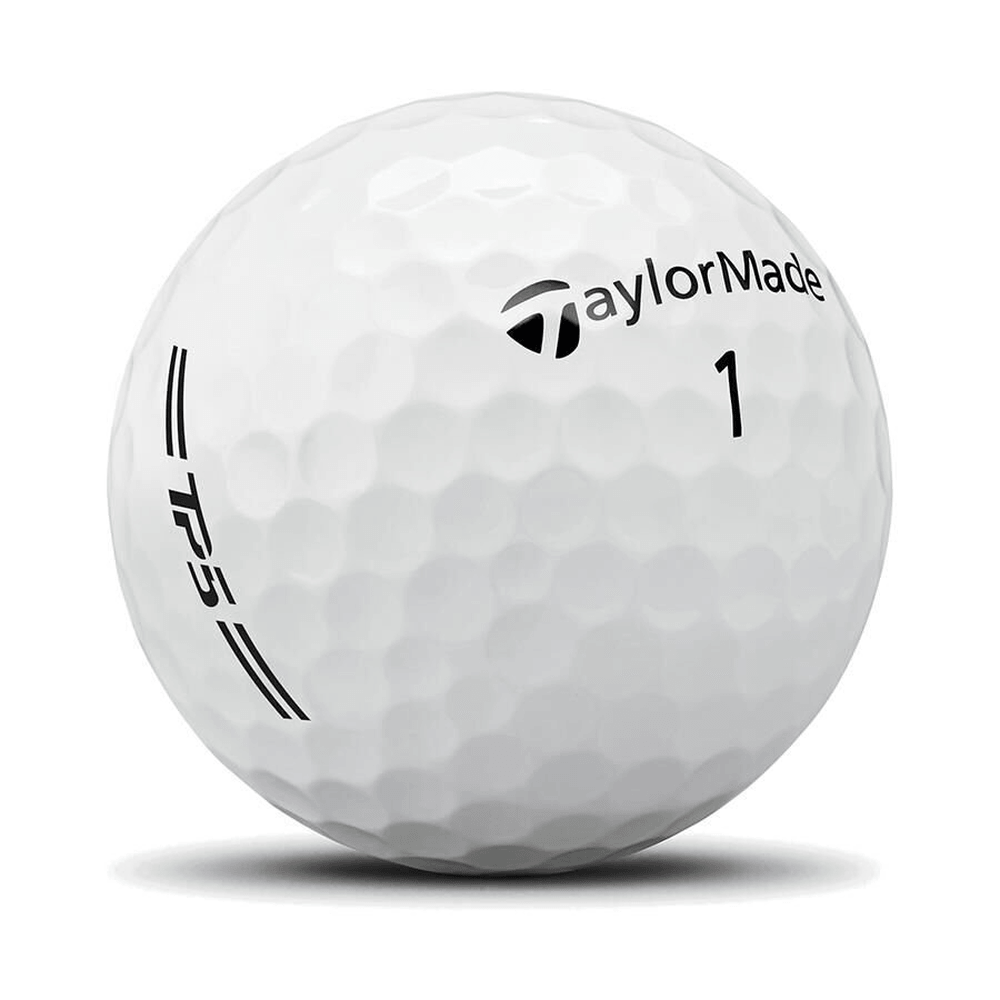
The TaylorMade TP5 has built a loyal following among serious golfers with a tour pedigree and a five-piece construction that sets it apart from most of the competition. But how consistent is it where it counts? Ball Lab measures weight, diameter, compression, roundness and balance across 36 balls and three boxes to give you an objective look at what you’re getting when you buy the TaylorMade TP5.
Here’s what the 2026 TaylorMade TP5 looks like under the microscope.
TaylorMade TP5 (2026)
 Pros
Pros
 Pros
Pros - Perfect quality control — 100% good ball rate across all 36 balls, zero defects
- Excellent compression symmetry — IBCR median of 1.0 matches the best in the database
Cons
 Cons
Cons - Compression delta of 9.0 points is above the field average — firmness can vary more than some competitors
- Weight consistency grades out at average
Our Verdict
 Our Verdict
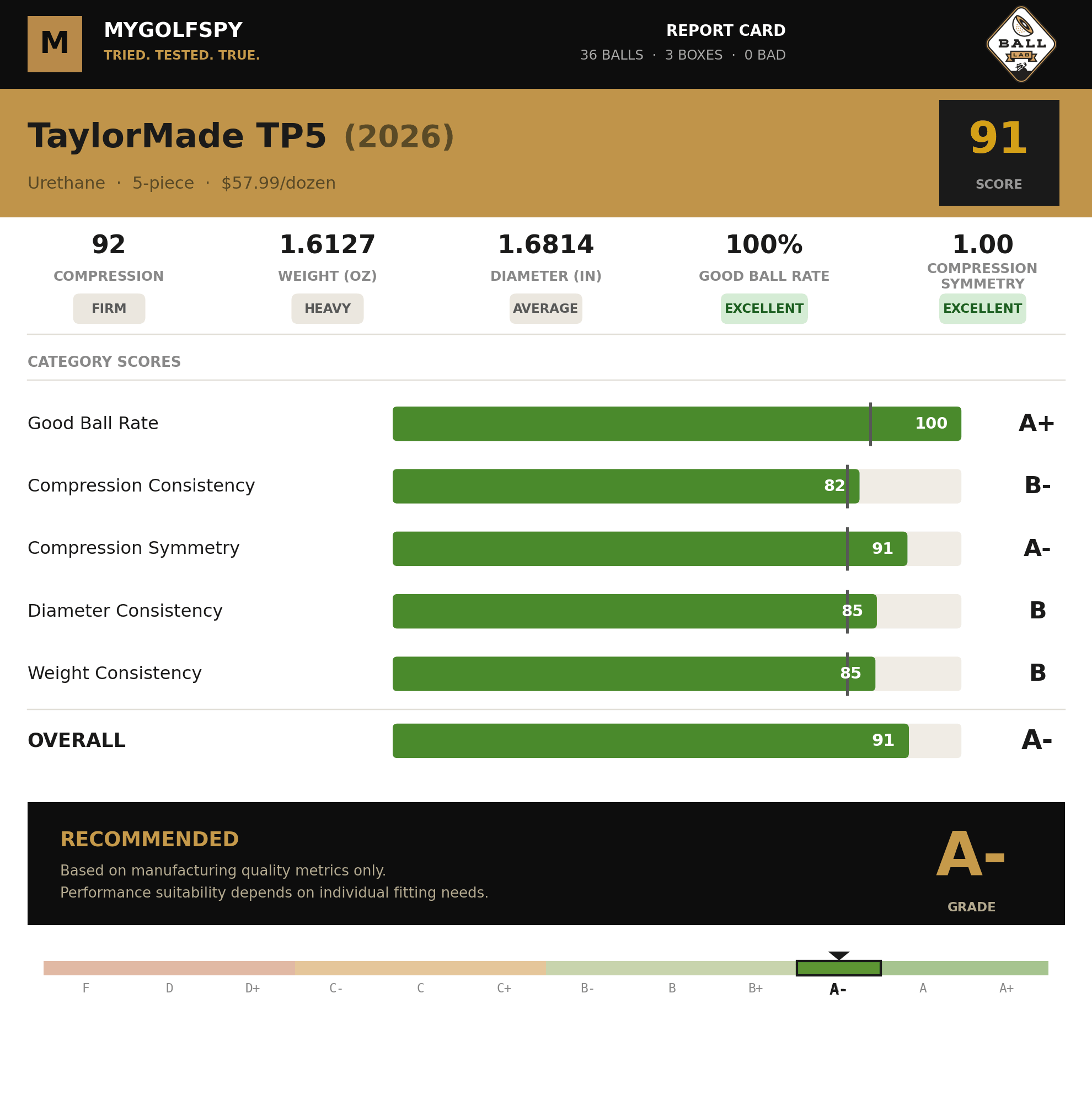
 The 2026 TaylorMade TP5 earns a Quality Score of 91 and a Ball Lab Quality Award. Its quality control is the standout: all 36 balls passed inspection with zero defects and a perfect good ball rate. Compression symmetry is excellent with an IBCR median of 1.0, matching the best in the database. Compression consistency grades out at B- and a delta of 9.0 points leaves a little more variation than you’d ideally want at this price.
Product details
- Price: $57.99/dozen
- Construction: 5-piece urethane
- Compression: 91.5 (Firm)
- Factory: TaylorMade Taiwan
- Diameter: 1.6814 in.
- Weight: 1.6127 oz.
- Bad Balls: 0
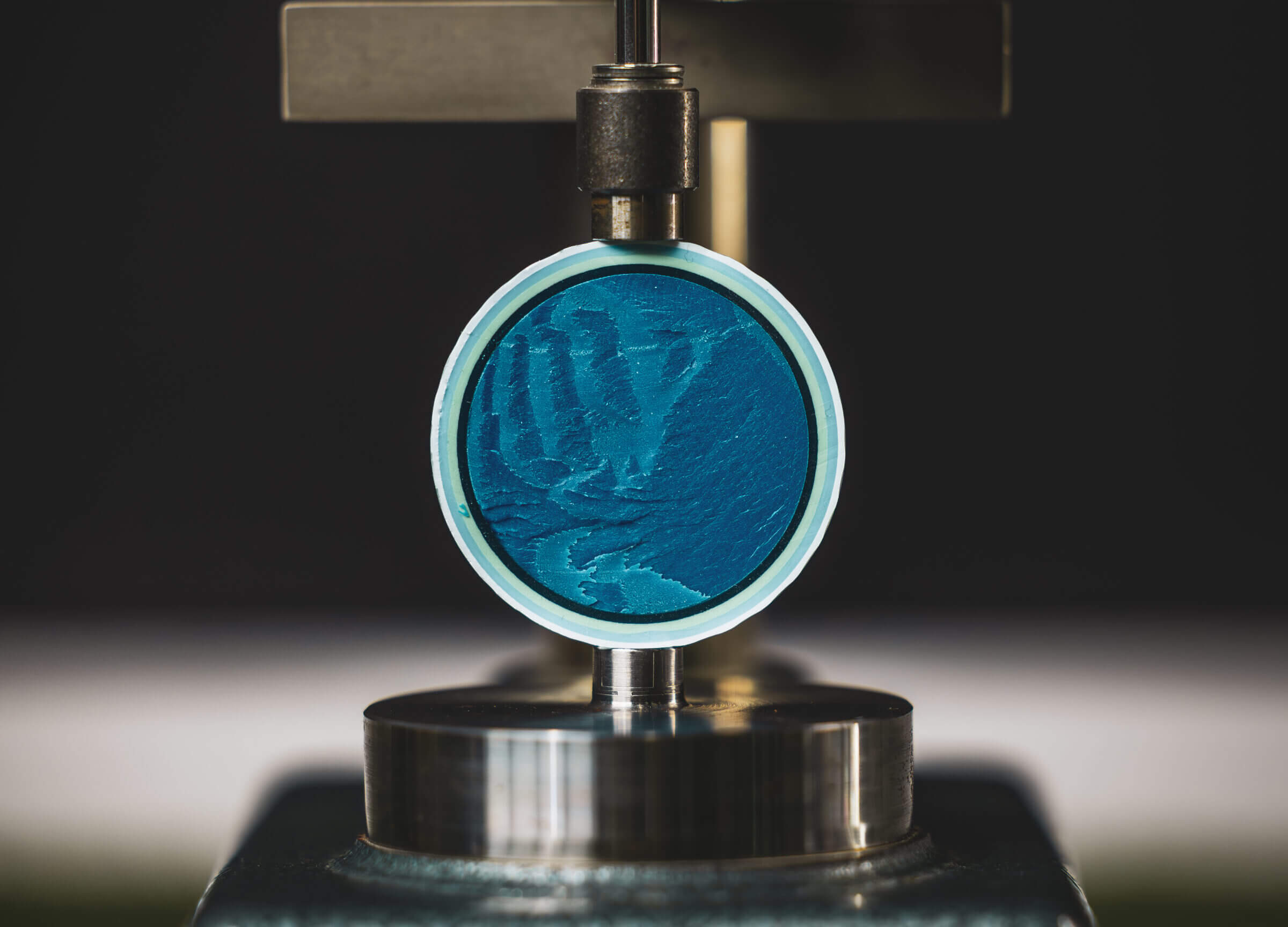
MyGolfSpy Ball Lab measures the quality and consistency of golf balls, giving golfers insight into what’s happening beneath the cover. Use Ball Lab as a starting point in your search for the right golf ball.
Quality Scores are based on five key metrics: defect rate, compression consistency, compression symmetry, diameter consistency and weight consistency. Scores are weighted toward the factors that most affect performance and defective balls reduce the final score to reflect real-world quality.
Test results
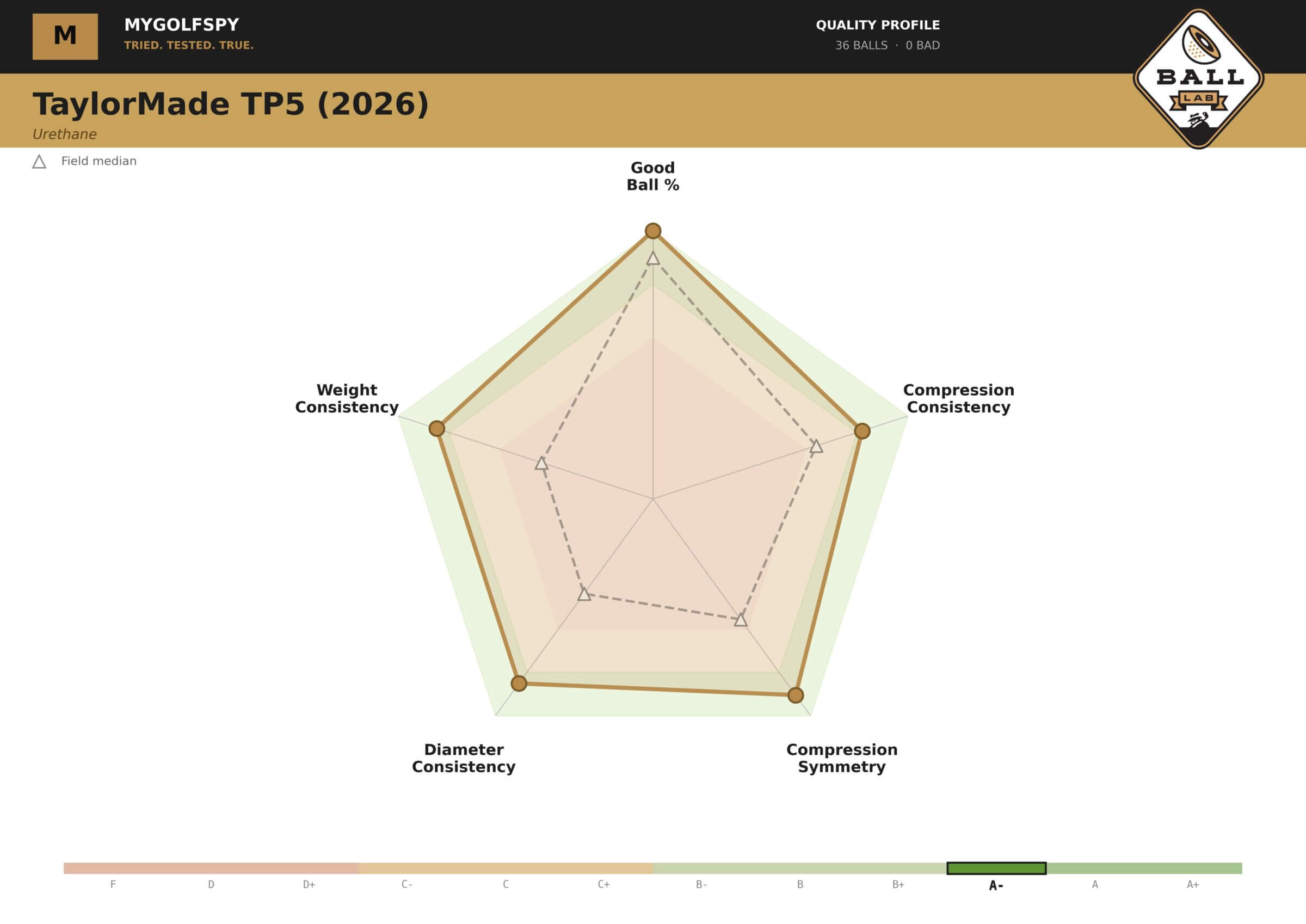
The 2026 TaylorMade TP5 scored 91 and earned a Ball Lab Quality Award. That score is built on a foundation of exceptional quality control paired with consistency metrics that are solid across most categories.
Of the categories measured, Good Ball Rate came in at 100 percent. Every one of the 36 balls tested passed with zero defects across cores, layers and covers.
Compression symmetry averaged 1.0 points, well below the field average of 1.9. That means compression is not only consistent across the sample but also within any given ball. While you’d think that would always be the case, some manufacturing defects manifest as inconsistent compression across the three points we measure on each ball. The TP5 has essentially none of that.
Where the score has room to grow is in compression consistency which graded out at B- with a delta of 9.0 points and a spread running from 86.5 to 95.5. Weight and diameter consistency came in at B. Those are the metrics that kept the TP5 from pushing higher up the leaderboard.
Still, a 100-percent good ball rate and excellent compression symmetry are hard to argue with. At 91, the TaylorMade TP5 comfortably clears the bar for a Quality Award.
Compression
Compression measures how much force is required to deform a golf ball. The more force required, the higher the compression value. Consistency in the compression value matters. A ball that compresses differently from shot to shot behaves differently from shot to shot. Ball Lab measures every ball individually and tracks the average and the spread across the sample.
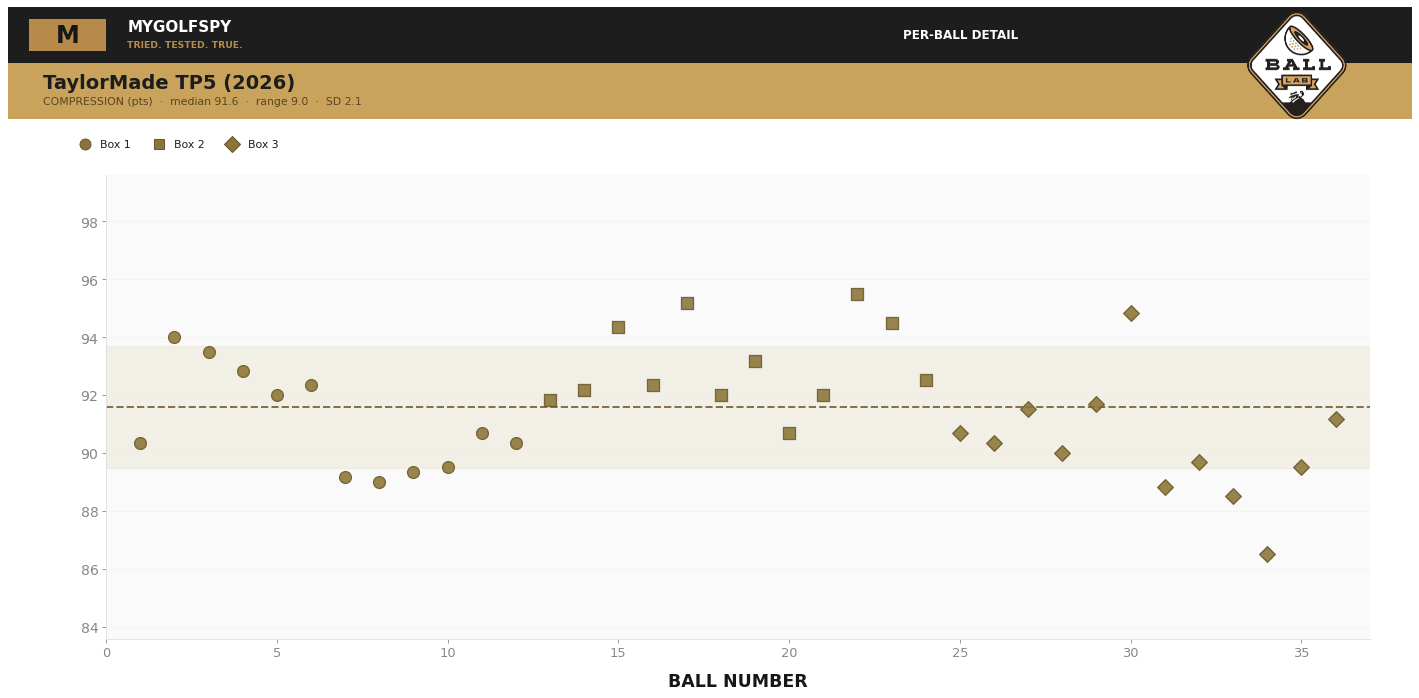
The 2026 TaylorMade TP5 averaged 92, putting it in the firm range of the database. Compression consistency graded out at B- with a delta of 9.0 points and a spread running from 86.5 to 95.5. A spread of 9.0 points across the sample means you could expect some small performance variation ball to ball.
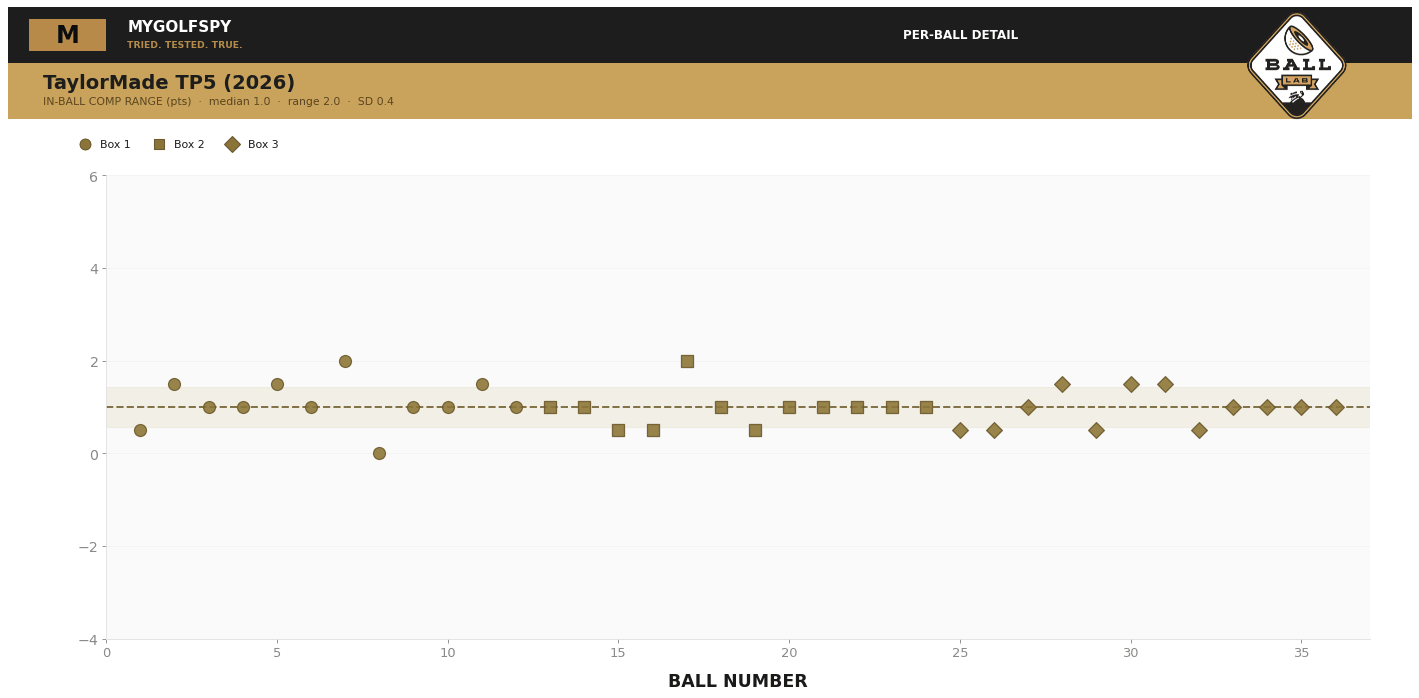
Ball Lab also measures compression symmetry which is distinct from the compression range measurement. Where the delta tracks variation across all 36 balls in the sample, symmetry tracks how evenly compression is distributed across three points on each individual ball. The TP5 averaged 1.0 points of symmetry deviation, well below the field average of 1.9.
The charts below detail the compression measurements in our sample.
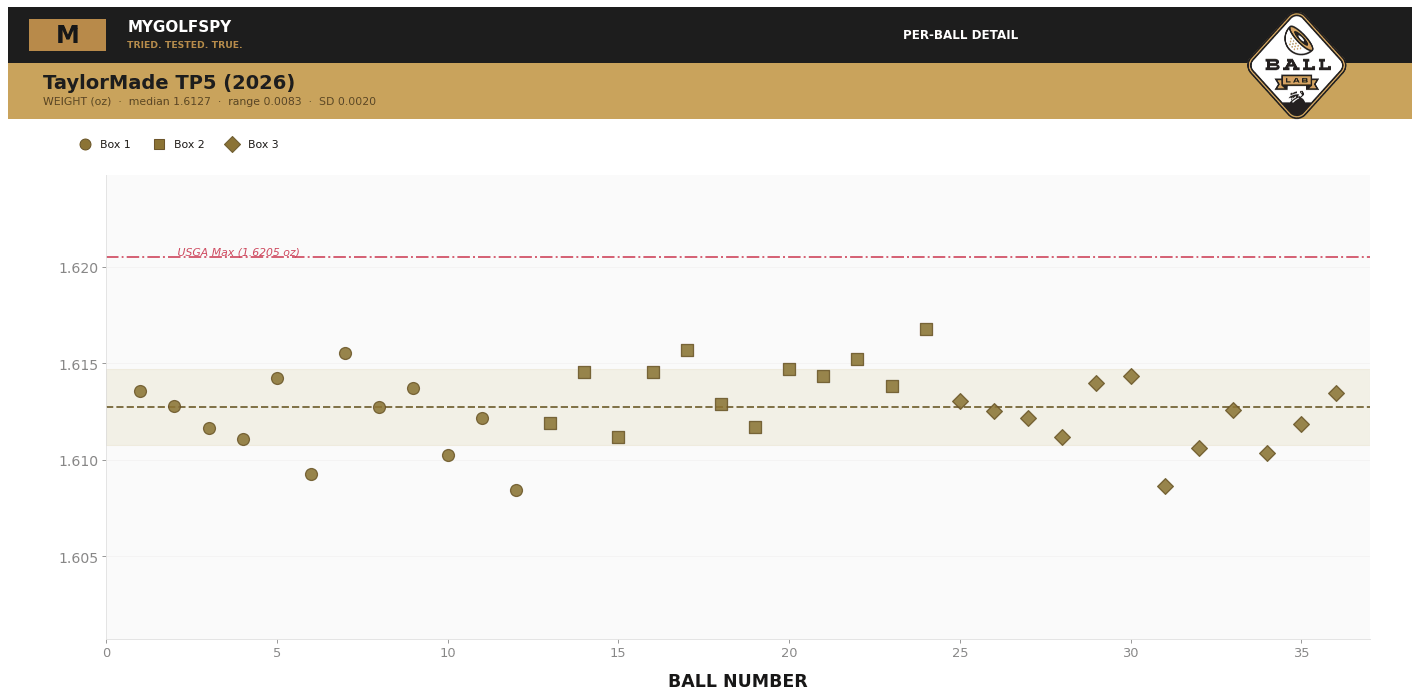
Weight
Weight doesn’t get much attention when golfers evaluate a ball but it matters more than most realize. Even small differences in weight across a dozen can translate to inconsistent ball flight. Ball Lab weighs every ball to four decimal places.
The 2026 TaylorMade TP5 averaged 1.6127 ounces across 36 balls, on the heavier end of the database. That’s worth noting: all else being equal, a heavier ball is a longer ball which is exactly why the USGA has a weight limit. By building a ball that runs heavier than market averages while still conforming, TaylorMade is maximizing performance opportunities within the rules. Every ball came in under the USGA maximum of 1.6205 ounces.
The charts below detail the weight measurements in our sample.
Diameter
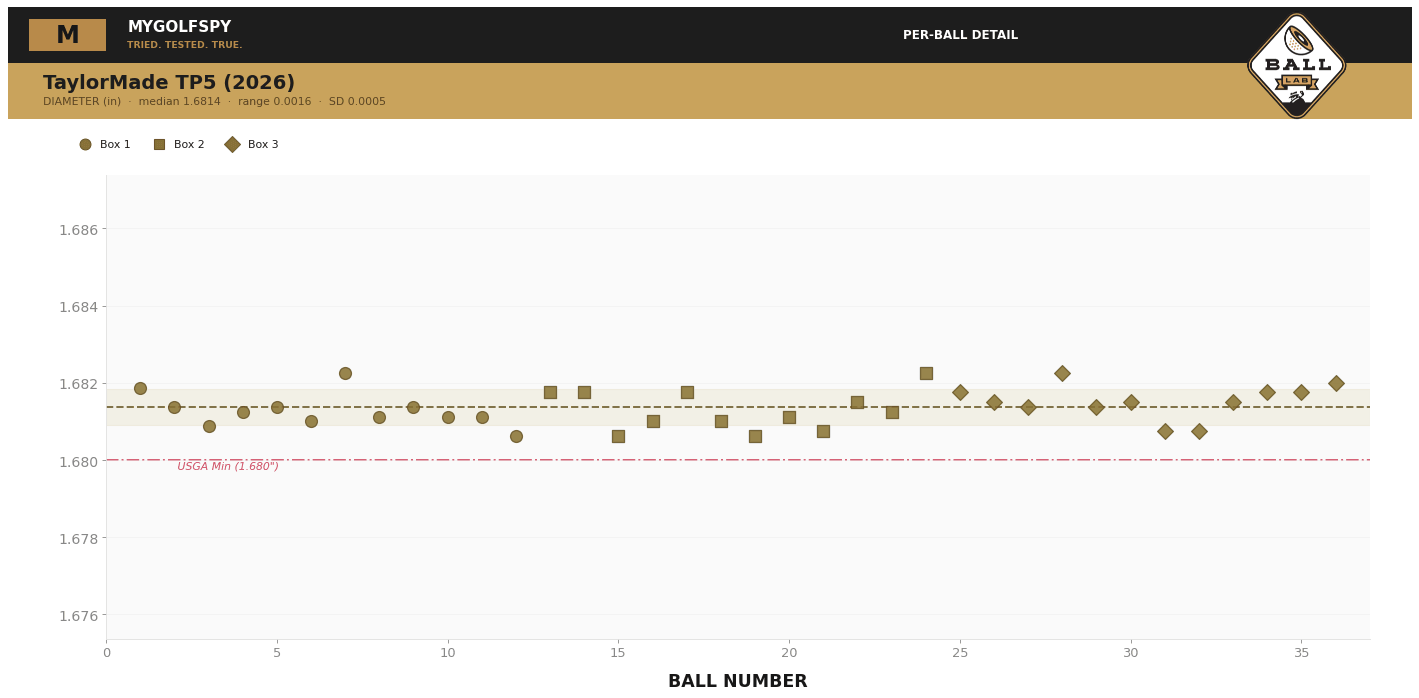
A golf ball that isn’t truly round is a problem waiting to happen. Off the putter face, an out-of-round ball can wobble. In the air, it can behave unpredictably. Ball Lab measures each ball across multiple axes to get a true picture of its shape.
The 2026 TaylorMade TP5 averaged 1.6814 inches, above the USGA minimum of 1.680, with a roundness deviation of just 0.0003 inches, essentially a perfect sphere on average. Every ball cleared the minimum with room to spare, measured within our roundness tolerances and no concerns were flagged. There was no consistent pole-versus-seam pattern across the sample. Diameter consistency graded out at B.
The charts below detail the diameter measurements in our sample.
Ball Lab report card
Each Quality Score is a weighted average of five grades: good ball rate, compression consistency, compression symmetry, diameter consistency, weight consistency. Our scoring system punishes defective balls more severely while giving greater weight to compression metrics than to weight and diameter. This is a reflection of how much compression variation actually matters to ball flight and feel.







WYBob
4 months ago
Good on TaylorMade for improving the TP5 quality score. Now it will be interesting to see how the TP5 does in next month’s performance testing. Hopefully they have made improvements over their 2025 Ball Test results as well.