


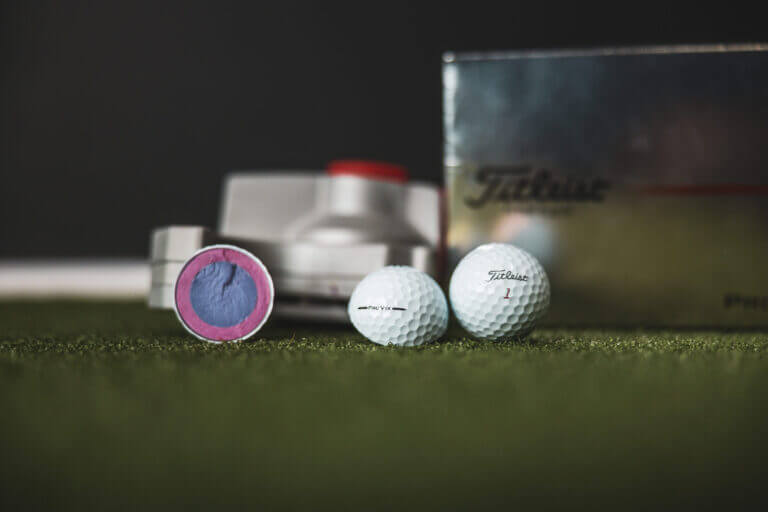
The Titleist Pro V1x is the higher-compression sibling to the Pro V1 — built for golfers who benefit from higher flight and more spin (relative to the standard Pro V1). It shares the same tour-level pedigree but plays differently enough that the choice between them is real. What Ball Lab can tell you is whether the manufacturing backs up the promise. We measured weight, diameter, compression, roundness and balance across 36 balls and three boxes to give you an objective look at what you’re getting when you buy the Pro V1x.
Here’s what the 2025 Titleist Pro V1x looks like under the microscope.
Pro V1x

 Pros
Pros
 Pros
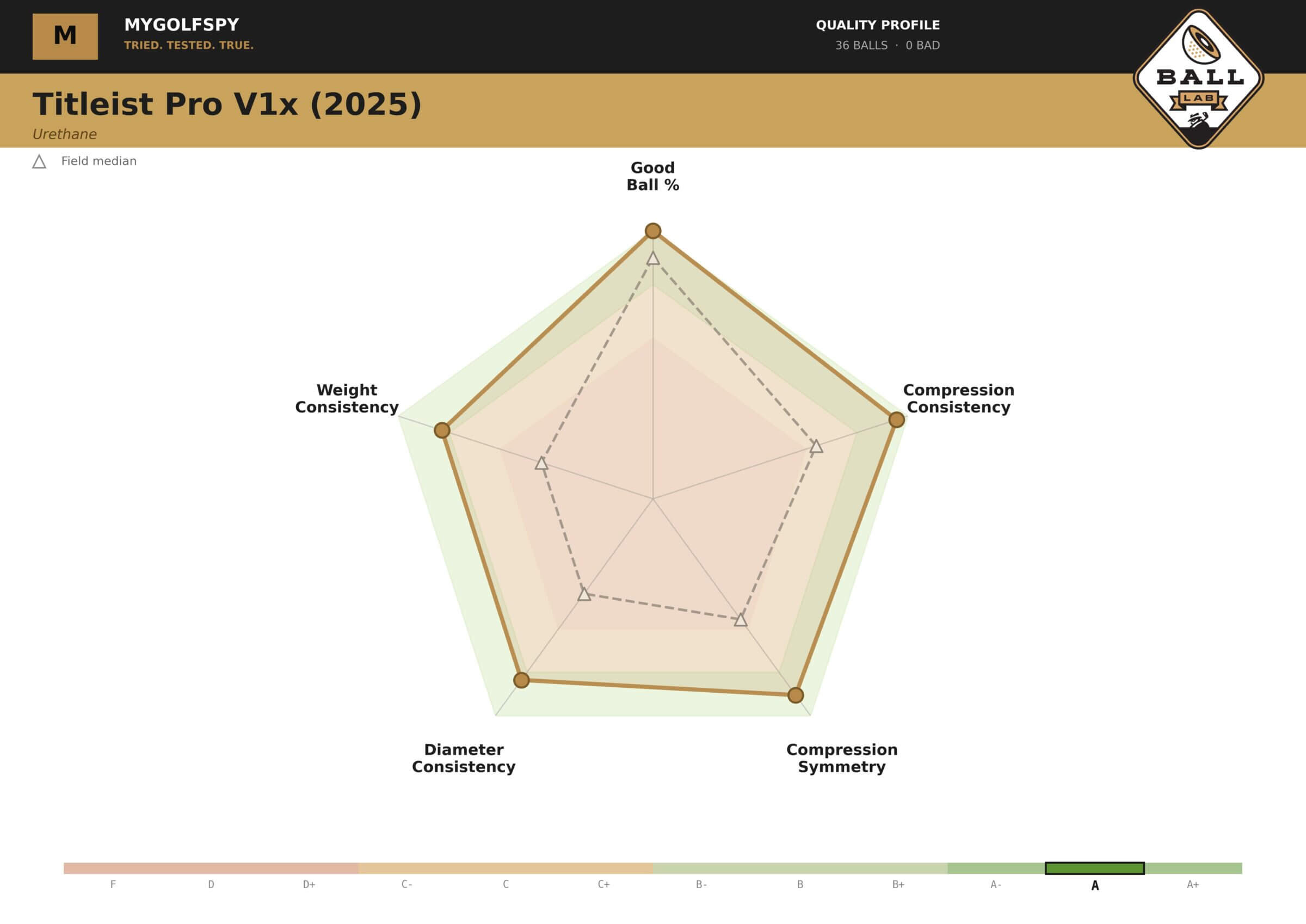
Pros - Exceptional compression consistency — a delta of just 3.3 points ranks in the top 10 of the entire database
- Perfect quality control — 100% good ball rate across all 36 balls, zero defects
Cons
 Cons
Cons - Weight consistency grades out at B
- Diameter consistency also grades at B — keeps the Pro V1x from matching its compression performance across every metric
Our Verdict
 Our Verdict
 The 2025 Titleist Pro V1x earns a Quality Score of 94 and a Ball Lab Quality Award. It’s built on a foundation of zero defects and compression consistency that ranks among the best in the database. Weight and diameter consistency both grade out at B, which brought the score down a bit from where it might have landed.
Product details
- Price: $57.99/dozen
- Construction: 4-piece urethane
- Compression: 101 (X-Firm)
- Factory: Titleist Ball Plant 3, New Bedford, Mass.
- Diameter: 1.6818 in.
- Weight: 1.6087 oz.
- Bad Balls: 0
MyGolfSpy Ball Lab measures the quality and consistency of golf balls, giving golfers insight into what’s happening beneath the cover. Use Ball Lab as a starting point in your search for the right golf ball. Quality Scores are based on five key metrics: defect rate, compression consistency, compression symmetry, diameter consistency and weight consistency. Scores are weighted toward the factors that most affect performance and defective balls reduce the final score to reflect real-world quality.
Test results
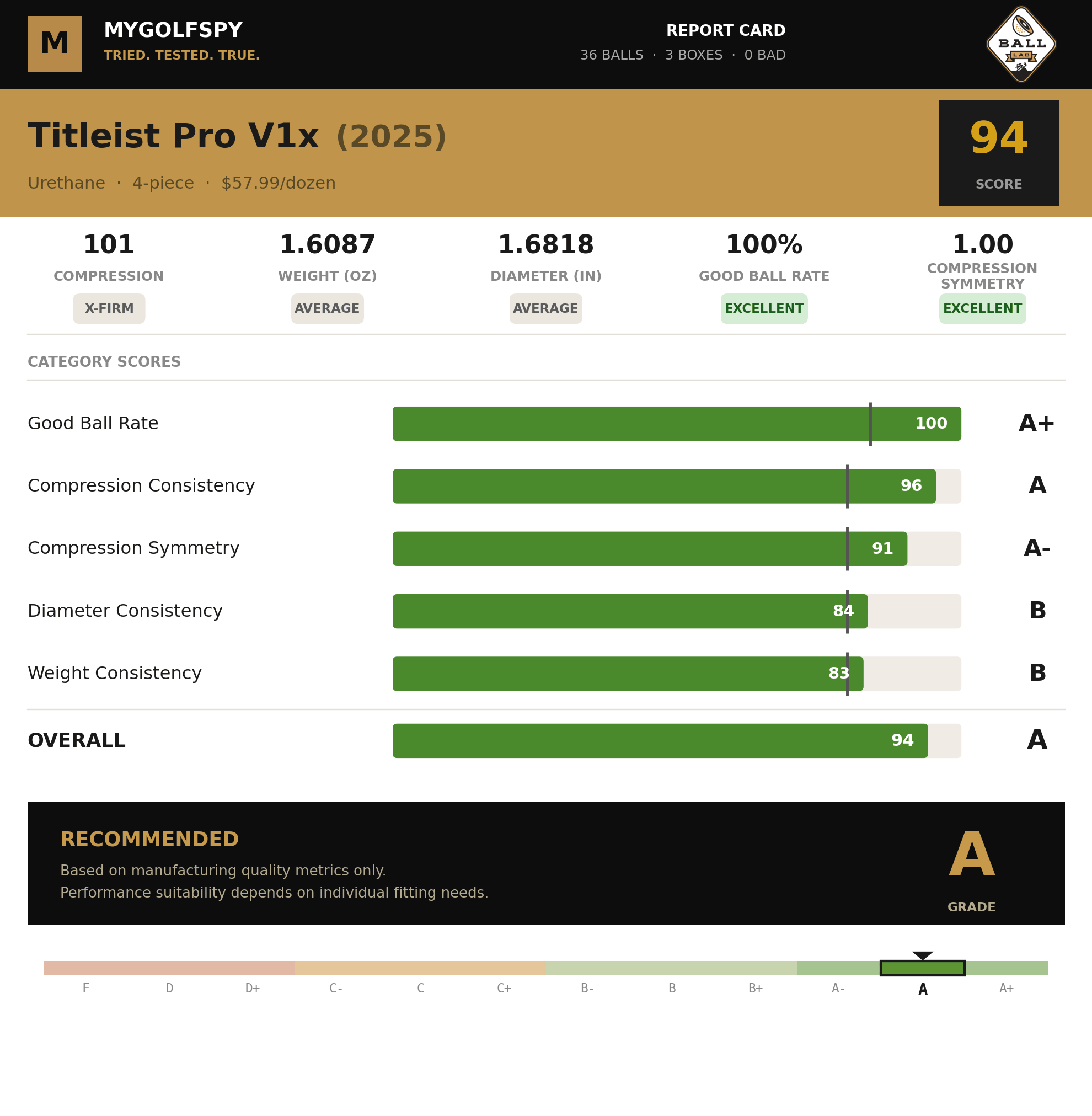
The 2025 Titleist Pro V1x scored 94 and earned a Ball Lab Quality Award. The headline number is built on a clean defect record and compression consistency that ranks among the best in the database. Weight and diameter consistency brought the score down a bit.
Good Ball Rate came in at 100 percent. All 36 balls passed inspection with zero flagged defects across cores, layers and covers. That’s the best possible outcome in this category and a meaningful data point.
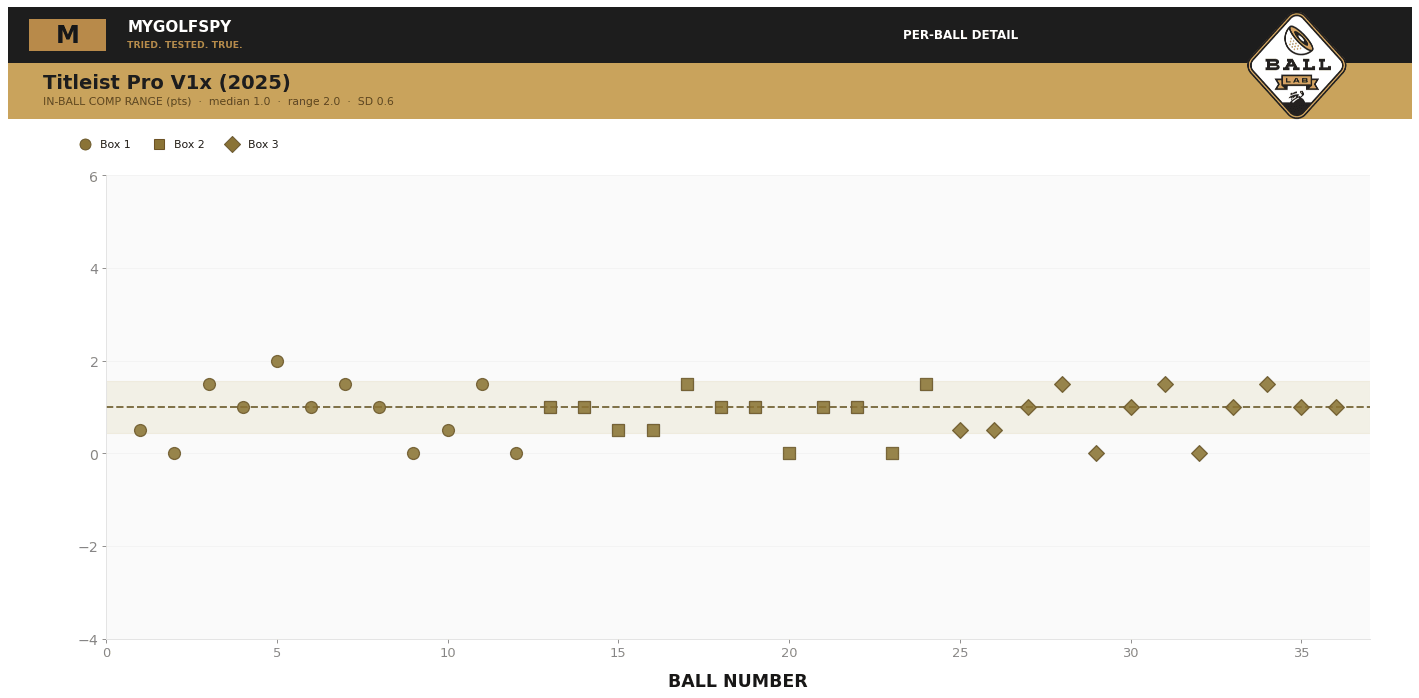
Compression symmetry averaged 1.0 points, well below the field average of 1.9. That means not only is compression consistent across the 36-ball sample but it’s evenly distributed across each individual ball.
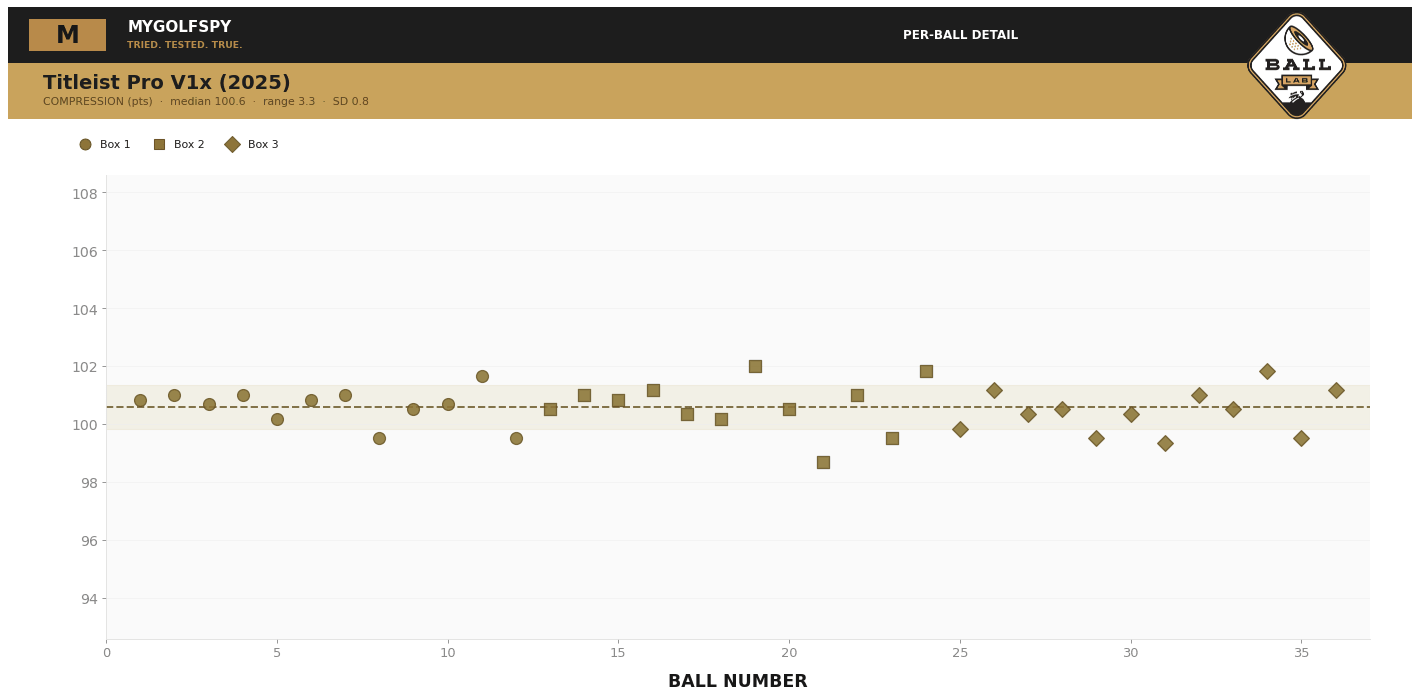
Where the Pro V1x stands out most is compression consistency which graded at A with a delta of just 3.3 points and a spread running from 98.7 to 102.0. For an X-firm ball, that’s a tight window. Ball to ball, you’re getting a very consistent product off the shelf. Weight and diameter consistency both graded at B, solid but not a standout relative to the rest of the profile.
At 94, the Titleist Pro V1x comfortably earns a Quality Award and delivers on the manufacturing quality you’d expect from a ball at this price.
Compression
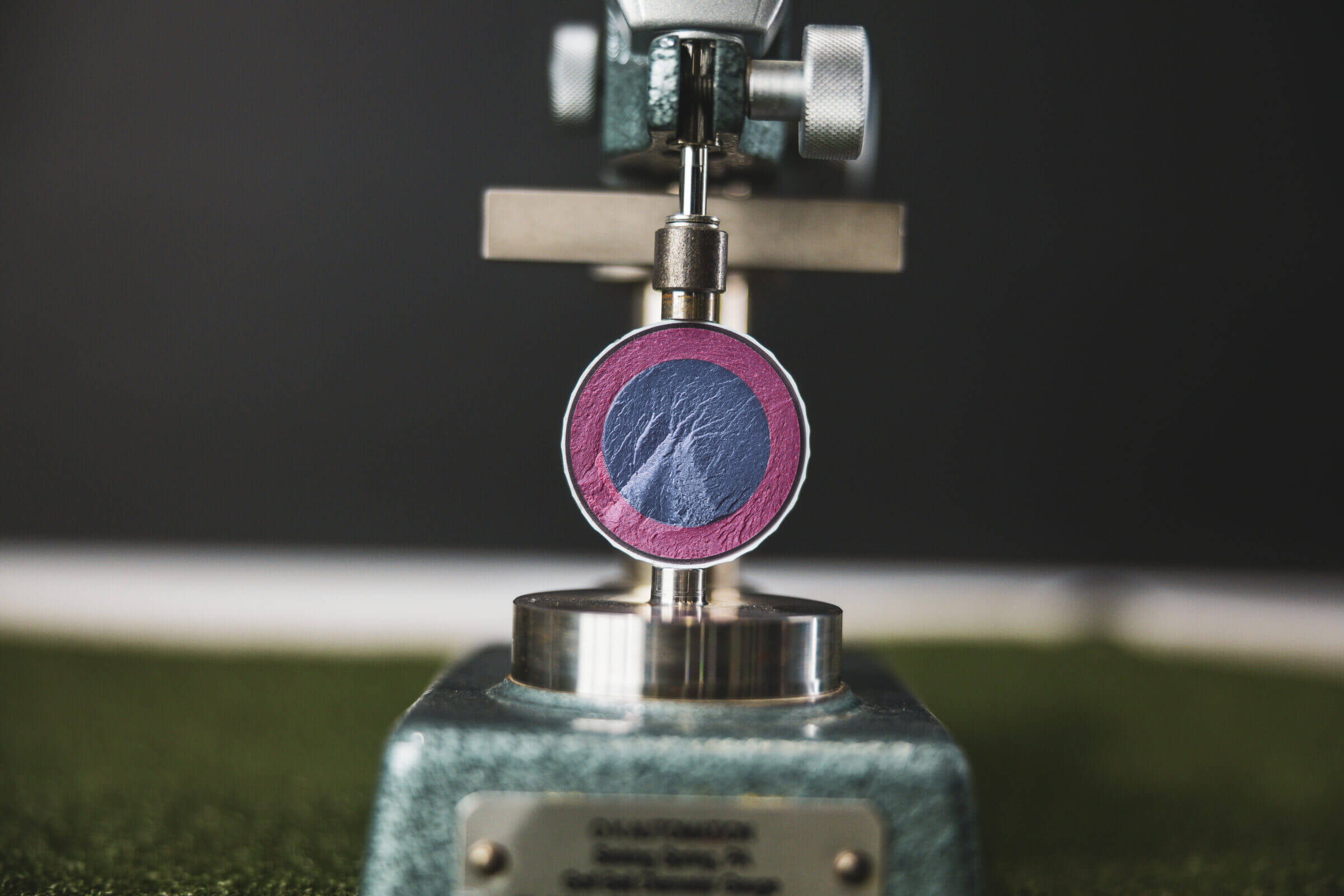
Compression is a measure of how much force is required to deform a golf ball. The higher the compression value, the more force required. Consistency in that value matters because a ball that compresses differently from shot to shot produces different results from shot to shot. Ball Lab measures every ball individually and tracks the average and the spread across the sample.
The 2025 Titleist Pro V1x averaged 101, putting it at the top of the extra-firm range in our database. Compression consistency graded out at A with a delta of just 3.3 points and a spread running from 98.7 to 102.0. A spread of 3.3 points means ball-to-ball speed variation is minimal; what you get out of the first sleeve should perform nearly identically to the last ball in the third box.
Ball Lab also measures compression symmetry which is distinct from the delta measurement. Where the delta tracks variation across all 36 balls, symmetry tracks how evenly compression is distributed across three points on each individual ball. The Pro V1x averaged 1.0 points of symmetry deviation, well below the field average of 1.9. Each ball is internally consistent which combined with the tight sample-wide spread makes for one of the stronger compression profiles in the database.
The charts below detail the compression measurements in our sample.
Weight
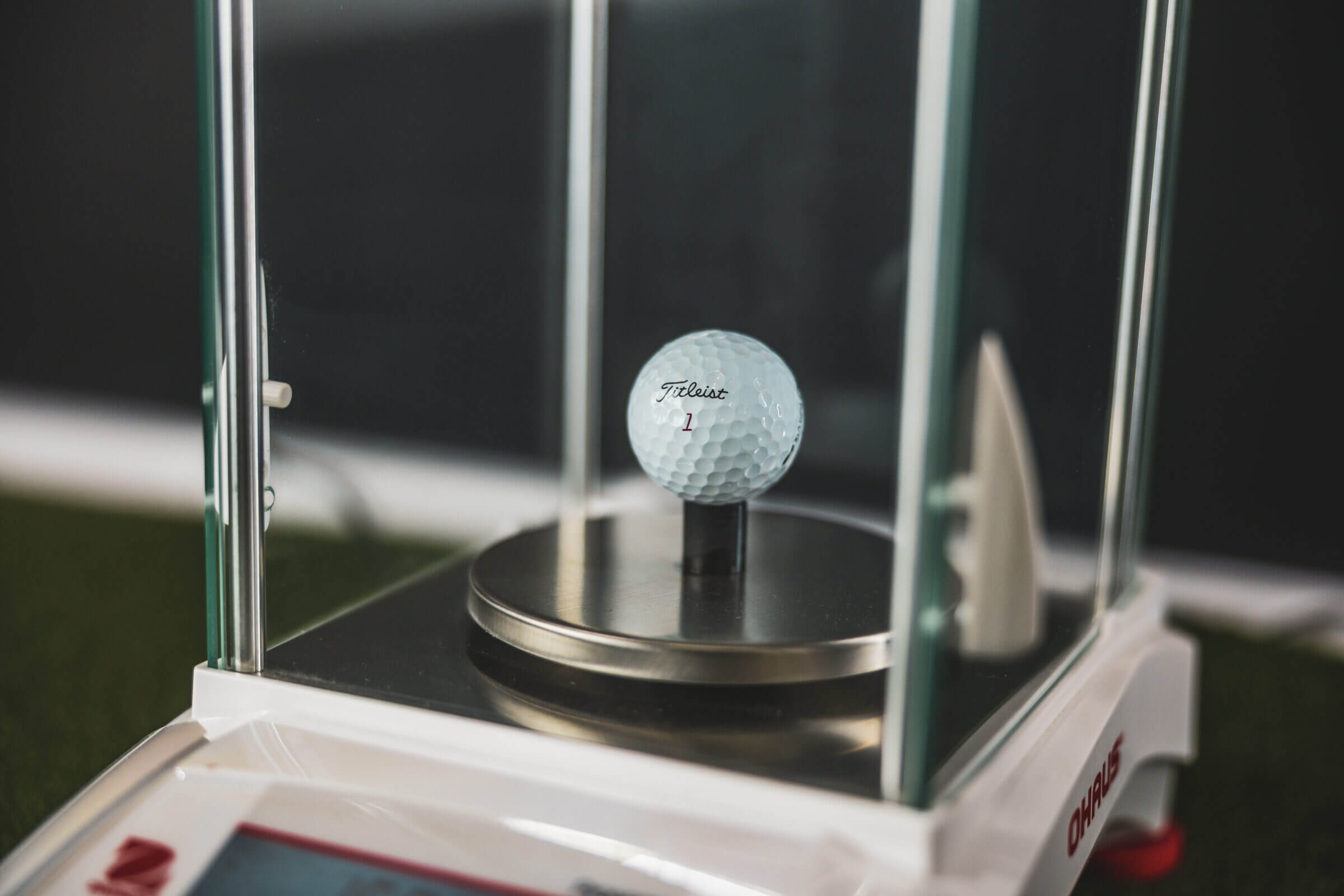
Weight is another metric we analyze in these Ball Lab tests. Even small differences in weight across a dozen can translate to inconsistent ball flight. Ball Lab weighs every ball to four decimal places.
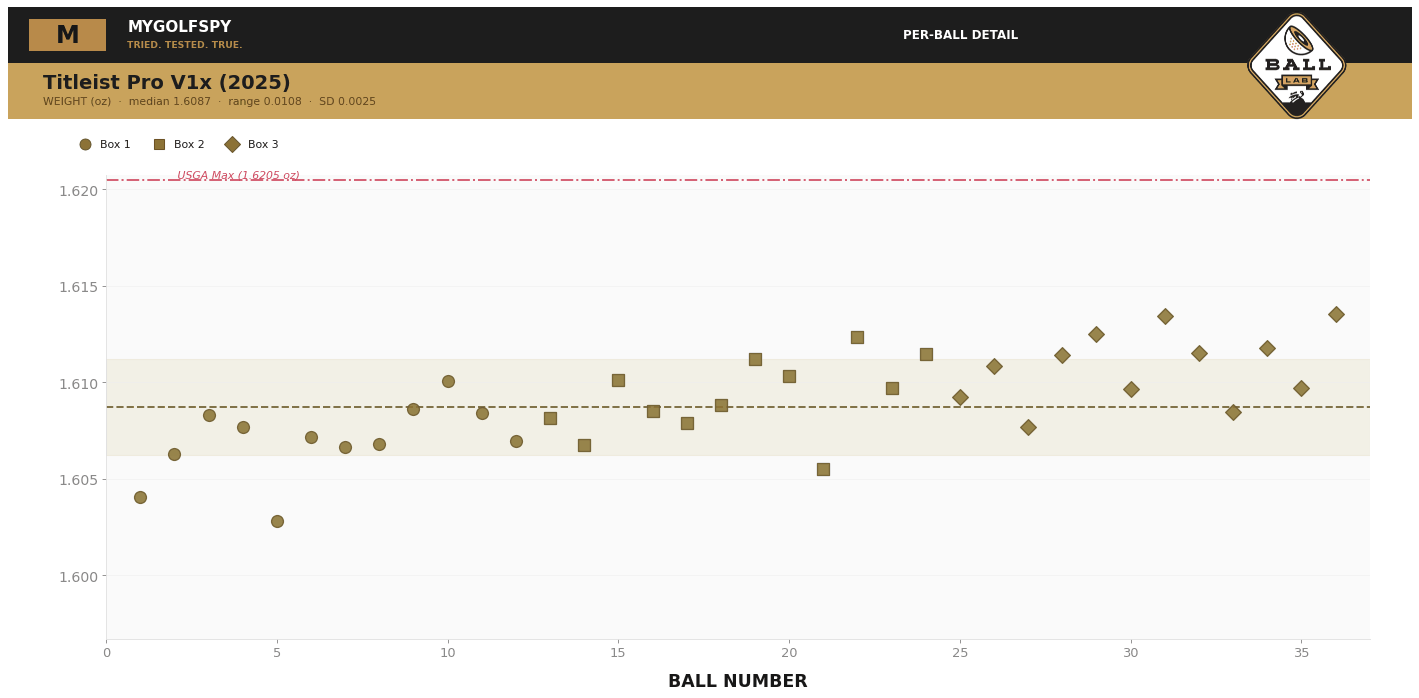
The 2025 Titleist Pro V1x averaged 1.6087 ounces across 36 balls, in the average range of the database. Every ball came in under the USGA maximum of 1.6205 ounces, with a range running from 1.6028 to 1.6136 and a standard deviation of 0.0025. No individual ball was flagged as an outlier.
Weight consistency grades out at B.
The charts below detail the weight measurements in our sample.
Diameter
Roundness matters more than most golfers realize. A ball that isn’t truly uniform in shape can track off line on the putting green or produce inconsistent flight patterns in the air. Ball Lab measures each ball across multiple axes to get a true picture of its shape.
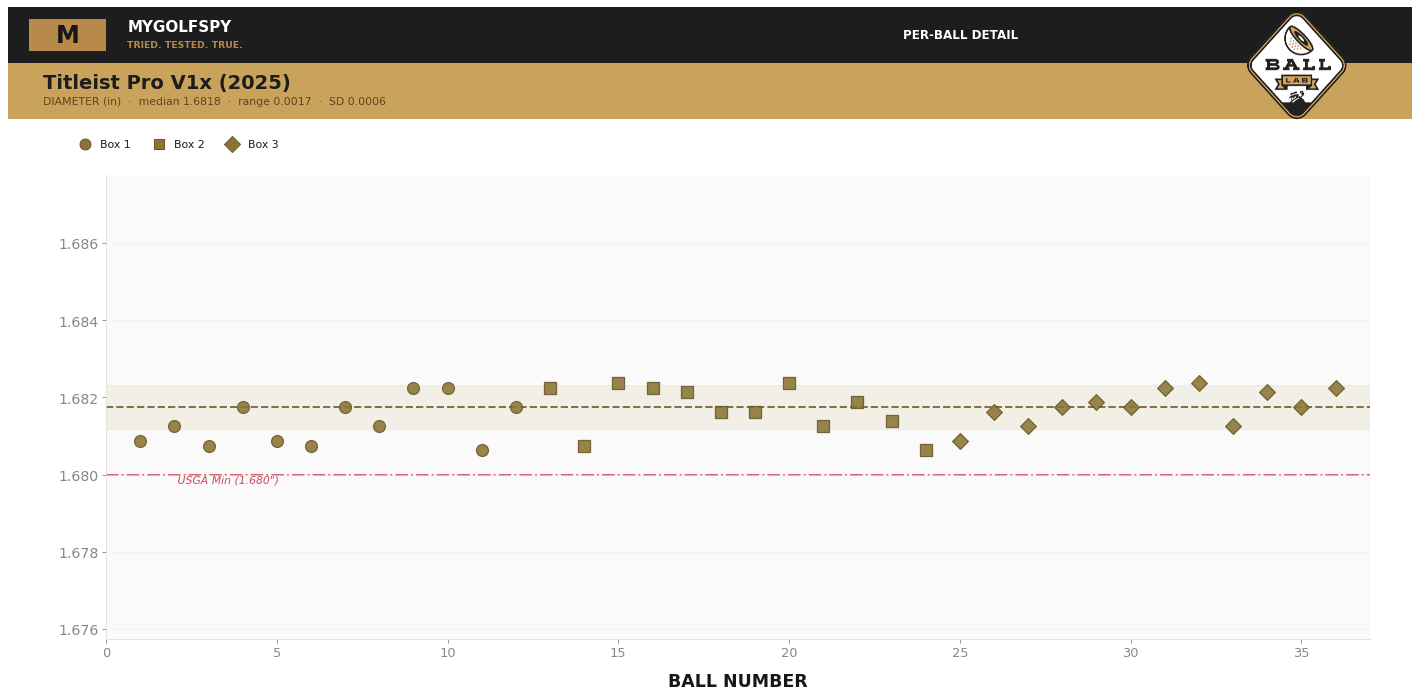
The 2025 Titleist Pro V1x averaged 1.6818 inches, above the USGA minimum of 1.680, with a roundness deviation of 0.0004 inches. Every ball cleared the minimum and there was no consistent pole-versus-seam pattern across the sample: 31 of 36 balls came in within gauge noise on that measurement.
Diameter consistency graded out at B, one of two categories where the Pro V1x left a little score on the table.
The charts below detail the diameter measurements in our sample.
Ball Lab report card
Each Quality Score is a weighted average of five grades: good ball rate, compression consistency, compression symmetry, diameter consistency, weight consistency. Our scoring system punishes defective balls more severely while giving greater weight to compression metrics than to weight and diameter. This is a reflection of how much compression variation actually matters to ball flight and feel.






Jim R
4 months ago
I’d love to see how ball performance is changed by 1 compression unit. Please share the ball flight data.
I couldn’t find the data behind your statement; “ Even small differences in weight across a dozen can translate to inconsistent ball flight.” Please reshare this data on ball flight. Thanks!