




There are lots of differences between professional and amateur golfers. They include things like swing speed, consistency and course management, but one of the biggest is knowledge. Pros live and breathe the game. They study, test, question, and constantly refine.
That’s why many long-standing golf myths still linger among amateur golfers, even though pros have left them behind.
Here are some of the most common myths that pros don’t believe but amateurs still do.
Real golfers use the overlap grip
Somewhere along the line, golfers were told that the overlap grip (also called the Vardon grip) is what “real golfers” use. The 10-finger (or “baseball”) grip in particular gets mocked, especially among adult beginners.
Professional golfers don’t care how your grip looks or what it’s called. They care how it works.
All three major grip styles—overlap, interlock, 10-finger—have been used successfully by high-level players. Scott Piercy and Bob Estes have both used the 10-finger grip on the PGA Tour. Some junior golfers and female professionals (with smaller hands or less strength) use it for more leverage and hand activation.
Here’s what you should believe about the golf grip:
- Grip pressure matters more than grip type.
- The hands must function as a unit, regardless of finger configuration.
- You can only square the face at impact with a grip that lets you reproduce it under pressure.

Fire the hips on the downswing
The phrase “fire the hips” has been drilled into amateur golfers for decades. The idea is that if you aggressively rotate your hips to start the downswing, you’ll create more power, better lag and that pro-style impact position.
What the professionals understand is that it’s not about how fast the hips move. The more important factor is when and how they move in relation to the rest of the body.
Great ball strikers use ground reaction forces and proper sequencing to start the downswing. That sequencing looks more like this:
- Pressure shifts into the lead foot (not just rotation, but weight shift).
- Lead leg firms up, creating a stable post for rotation.
- Torso begins to unwind, pulling the arms and club into the slot.
- Club shallows naturally behind the body as the arms drop into position.
- Hips rotate, but in rhythm, not as an isolated or overpowered motion (aka “firing”).
In slow motion, this sequence appears smooth, connected, almost effortless. When amateur golfers try to lead the downswing with an aggressive hip turn, they are often faced with issues like early extension, loss of connection and even balance issues.
The bottom line here is that sequencing is more important than speed.
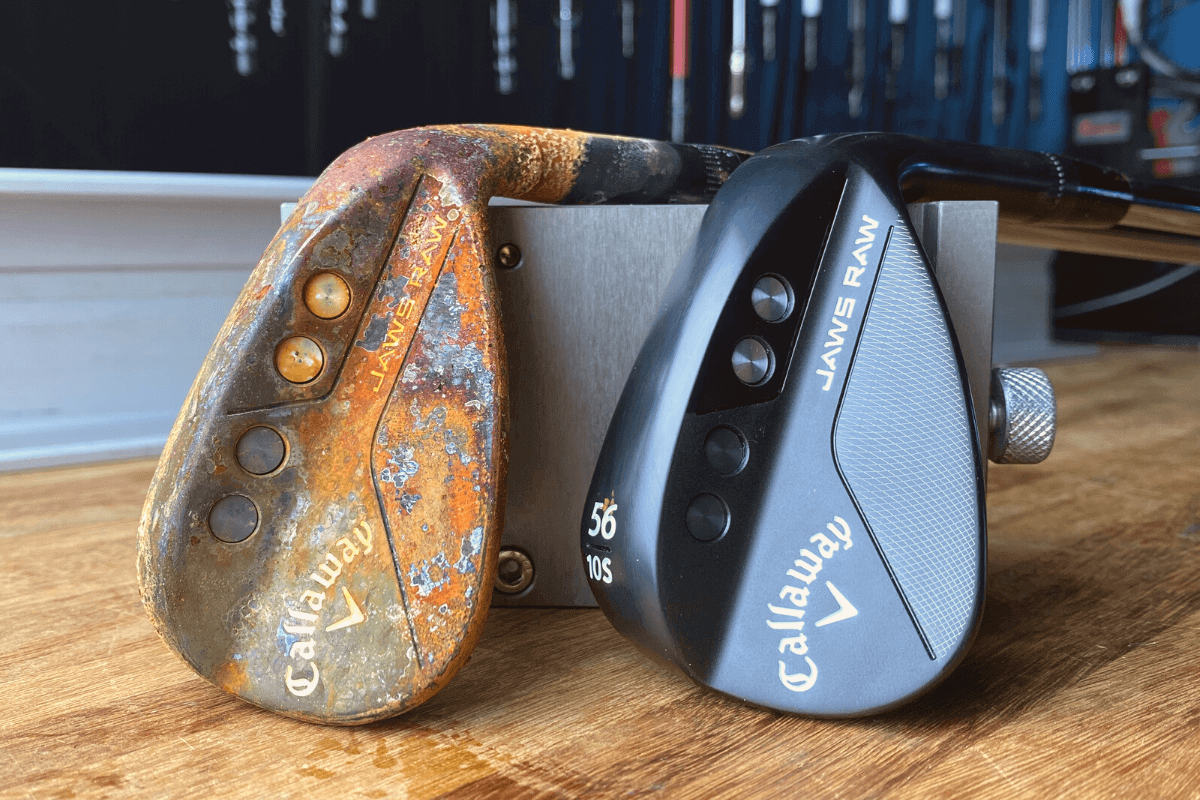
Rusty wedges create more spin
This one refuses to die. Tour players use raw wedges and then amateurs assume it’s to create more spin around the greens. You’ll even hear people say things like, “rust helps the ball grab the face.”
Not true.
Multiple independent tests, including one that we did in-house, have shown zero measurable increase in spin when comparing rusty wedges to clean, non-rusted versions of the same club. In some cases, spin slightly decreased.
Here’s why:
- Rust is surface texture, not groove geometry. The grooves are what generate spin by channeling debris and gripping the ball. Rust doesn’t sharpen the grooves.
- Rust can retain moisture, especially on humid or wet days, which reduces friction and makes it harder to spin the ball.
- Raw wedges (which rust) are not “spinnier” by design. They’re just preferred by some pros for feel and appearance.
The lead arm should stay perfectly straight in the backswing
This myth often comes from oversimplified advice: “Keep your left arm straight!” (for right-handed players). The problem is that golfers interpret this as locking the lead arm completely, treating any bend as a flaw.
Professional golfers generally maintain width and structure in the backswing, but that doesn’t mean their lead arm is rigidly bolt-straight. Many Tour players have a slight natural bend at the top of the backswing.
- Tiger Woods, in his prime, had a noticeable softness in the lead arm at the top.
- Jordan Spieth plays with a lead arm bend of up to 15 degrees, depending on the shot.
- Jon Rahm and Tony Finau have abbreviated backswings with compact lead arm positioning.
These players still maintain radius, they avoid collapsing or folding their arm excessively and they can preserve tempo and control throughout the swing.
Pros just use “feel” to dial in wedge distance
You’ll often hear that wedge play is all about feel. According to this myth, the best players just eyeball a distance, make a smooth swing and hope it lands close. That’s not how it works at the professional level.
Pros build systems to control wedge distance, especially in the scoring zone from 30 to 120 yards. The professionals train specific swing lengths, track carry distances and use one model of golf ball consistently to keep spin and launch predictable.
The confidence professionals have in these shots comes from data. They’ve tested and trained, and they know what clubs and swing length they need to hit a 96-yard shot versus a 65-yard shot.
At impact, the hands should be way ahead of the lead leg
It’s easy to misinterpret what elite ball strikers do at impact, especially when viewing slow-motion swings or still photos. One of the most common misunderstandings is that the hands should be dramatically ahead of the lead leg.
Professional golfers have a forward shaft lean at impact, particularly with irons. But that doesn’t mean their hands are way out in front of their lead thigh or hip.
Too much forward lean often leads to:
- Low-launch, low-spin “knuckleballs” that don’t hold greens
- Thin or delofted shots with long irons
- Shut clubfaces and left misses (especially for better players)
Instead of trying to “get their hands forward,” pros train for proper dynamic loft, controlling low point and a neutral face angle.
Their hands are slightly ahead of the ball but it’s not excessive.

Final thoughts
Don’t let the knowledge gap between amateur and professional golf cost you strokes. The myths might sound convincing to amateurs, but pros know better because they’ve tested, trained and live it.









MarkM
1 year ago
You guys REALLY need to take a break on the rusty wedge thing – it’s just irritating now.