



6 Insights from the Arccos Driver Distance Report
News

6 Insights from the Arccos Driver Distance Report

Support our Mission. We independently test each product we recommend. When you buy through our links, we may earn a commission.

6 Insights from the Arccos Driver Distance Report

Every year, the debate around distance in golf heats up, fueled by governing bodies, pro tours, and pundits convinced that golfers are hitting the ball too far.

 It’s gotta be the ball (or some such nonsense).

Data collected by Arccos tells a different story.

About the Arccos annual driving distance report

Now in its seventh year, the just-released annual Arccos Driving Distance Report draws from more than 6.5 million driver shots captured across 4 million rounds played in 2024. This year’s report offers the most detailed look yet at how real golfers perform off the tee. The findings? They cut straight through the noise, challenging assumptions, exposing trends, and reminding us that distance isn’t the villain some have made it out to be.

So with that said, let’s look at six key insights from the most recent report.

Average golfers aren’t hitting the ball too far

Over 7 years of Arccos distance insights, men’s average driving distance has been largely flat, ranging from just under 222 to 225 even.

For women, distance is also mostly flat, ranging from a low of just over 176 to just under 180.

This stagnation suggests that fears about distance increases at the recreational level are entirely unfounded. If anything, women have seen a slight decline.

Remind me again why we need to roll back the golf ball?

Oh, that’s right. We don’t.

Distance and handicap are closely correlated
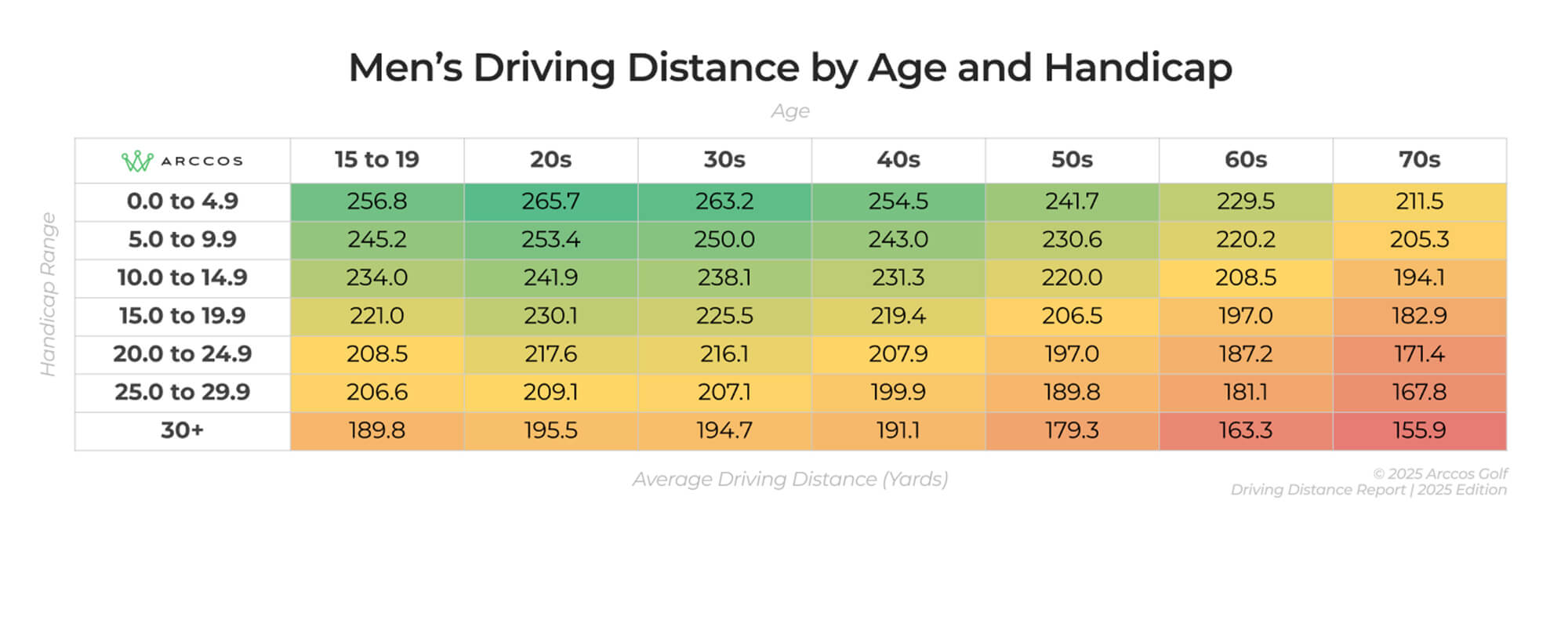
Across all age groups, the lowest handicap golfers are, on average, the longest off the tee.

While we’ve all heard the adage, drive for show, putt for dough, the fact is that your tee shot sets the tone for the hole.

Longer drives mean shorter approach shots, which translates to more greens hit (and shorter putts when you do manage to hit the green).

Average distance decreases with age

While I suppose this isn’t particularly surprising, average driving distance decreases with age. Male golfers in their 20s are, on average, a bit longer than those in their teens, but it’s downhill from there.

As we move from decade to decade (30s-40s, 40s-50s, etc.), distance losses become increasingly significant. Again, this isn’t surprising, but I’m still unhappy about it.

For men in their 70s, the average driving distance is 211.5. For women in their 60s, the data suggest the average driving distance is likely less than 150 yards.

Accuracy increases with age

If there’s a silver lining that comes from diminished distance, I suppose it’s increased accuracy. Male golfers in their 20s hit the fewest fairways (42.9%), while golfers in their 70s hit 60%.

The math is pretty simple on this one. All things being otherwise equal, the shorter the ball travels, the more likely it is to stay in the fairway. For what it’s worth, the biggest jump in accuracy occurs between 40 and 50, but I’m guessing that’s not universally true, as I’ve yet to experience it.

Low-Handicap golfers aren’t just longer, they’re straighter too

We often talk about distance vs. accuracy as if it’s a choice, and you only get to pick one. As it turns out, the best golfers are, on average, longer and straighter than less accomplished players.

Factoring all age groups, low-handicap golfers (0–4.9) average 250.0 yards and hit 49.3% of fairways, while high-handicap golfers (30+) average 184.9 yards and hit just 40.6% of fairways.

I’ll save you that math; that’s a 65.1-yard difference in distance coupled with an 8.7 percentage point advantage for the better player.

While not as severe, even average golfers (golfers with handicaps between 10 and 14.9) trail better players in both distance and accuracy. They average 224.7 yards and hit 45.3% of fairways.

This suggests that increased distance doesn’t mean diminished accuracy, especially when paired with skill.

High-Handicappers hit more “wayward” tee shots

It’s not just about fairways hit. Arccos looked at “wayward” drives—those leading to penalties or recovery shots—as well.

High-handicap players are significantly more likely to hit a tee shot that results in a punch-out, drop, or worse.

30+ handicap golfers hit 1 in 4 drives into some kind of trouble. That’s 1.5x the rate of the low handicap golfers.

Golfers in the 10-14.9 handicap range are over 50% more likely to hit their drive into a penalty area than low handicappers. They also hit nearly 1 in 5 tee shots into trouble areas. That’s roughly 30% more than low-handicap players.

Distance inarguably has value, but there’s something to be said for painting between the lines and staying out of trouble.

The Takeaway

While distance may dominate headlines, the Arccos report shows that skill, not power  (although they often go hand-in-hand), is the true differentiator. Low-handicap golfers aren’t just longer; they’re straighter and smarter with their misses. Meanwhile, the average recreational player isn’t gaining yardage; they’re just trying to stay in play.

For those interested in diving deeper, the full report breaks down performance by age, gender, and handicap with enough insight to keep both data nerds and golf nerds satisfied. You can explore the full Arccos 2025 Driving Distance Report here.

For You

For You

News
Jun 5, 2026
Three Reasons Your Handicap Is Lower Than It Should Be
First Look
Jun 4, 2026
How Much Larger Is The New TaylorMade Spider ZT Max?
First Look
Jun 4, 2026
Can The New Odyssey Ai-DUAL Jailbird Cruiser Fix Your Putting Problems?
Tony Covey

Tony Covey

Tony Covey

Tony is the Editor of MyGolfSpy where his job is to bring fresh and innovative content to the site. In addition to his editorial responsibilities, he was instrumental in developing MyGolfSpy's data-driven testing methodologies and continues to sift through our data to find the insights that can help improve your game. Tony believes that golfers deserve to know what's real and what's not, and that means MyGolfSpy's equipment coverage must extend beyond the so-called facts as dictated by the same companies that created them. Most of all Tony believes in performance over hype and #PowerToThePlayer.

Tony Covey

Tony Covey

Tony Covey

Tony Covey

Tony Covey


    This site is protected by reCAPTCHA and the Google Privacy Policy and Terms of Service apply.

      HikingMike

      1 year ago

      “Low-Handicap golfers aren’t just longer, they’re straighter too”
      “High-handicap players are significantly more likely to hit a tee shot that results in a punch-out, drop, or worse.”
      “Distance inarguably has value, but there’s something to be said for painting between the lines and staying out of trouble.”
      Everything keeps saying more distance is better, strokes gained and similar articles. But hey, maybe not. Maybe they should ride along with me to see if more distance is better. You need to be in play still. It’s like they assume you are always safe off the tee and not taking a penalty and not behind some trees. Because guess what? Longer isn’t better if it gets you a few penalties. The many articles referring to distance and current thinking do not seem to consider this. So I’m glad it is tangentially mentioned here.

      And as for the rollback, wow, Tony needs to have a read of the forum thread that is probably up to 100 pages of posts by now. It’s subjective whether it’s needed or not, and whether it should be a bifurcation. These new stats from Arccos et al do not shed any light on the distance changes from advances in metal woods and the changes in the golf ball, because they were not around collecting data back then.

      Reply

      Gerry Teigrob

      1 year ago

      I played virtual golf over the winter, and finished with a 14.5 universal handicap. It is interesting to note that my best handicap in my early 30s was 17. I can honestly say that I’m playing the best golf of my life in my early 60s. A lot of it is the improvement and quality of game improvement irons and my ability to focus on my game more. I’m not sure about the distance factor. I have a feeling that my younger days of playing with no fear will be back. Statistics say one thing, but playability says another. My dad started slowing down in his 80s, so there’s still time for me to improve!

      Reply

      Scott S

      1 year ago

      Shotscope.tracks pretty well, when it picks up the sensor and when I remember to make sure it did. I have been making this same argument since the discussion started. The only people who think that the ball needs to be “rolled back” are those that are unwilling to look at data objectively or those who think only they won’t be impacted and “rolling the ball back” give them some advantage back over the longer/younger players. They are the same people who deny physical training doesn’t help increase or maintain distance as we age; flexibility and strength training are elemental to a golf swing.

      Reply

      Bryan Reynolds

      1 year ago

      As a 55 yr old scratch player who isn’t getting any longer, I’m not looking forward to a roll back! It feels like we are being punished when we didn’t do anything wrong. Come on USGA, R&A, PGA Tour, if you want to protect the integrity of these courses for tour players and top amateurs, the answer is simple – bifurcation!

      Reply

      Dick Read

      10 months ago

      From gps.gov, Performance

      It depends. GPS satellites broadcast their signals in space with a certain accuracy, but what you receive depends on additional factors, including satellite geometry, signal blockage, atmospheric conditions, and receiver design features/quality.

      For example, GPS-enabled smartphones are typically accurate to within a 4.9 m (16 ft.) radius under open sky (view source at ION.org). However, their accuracy worsens near buildings, bridges, and trees.

      Another AI overview of “GPS accuracy” on Google, shows typically ranges from 5 to 15 meters.

      There are many factors listed that may affect what results you get.

      I use GPS with grain of salt, laser range finder for distances that are important. Then adjust my perfectly managed swing/equipment to hit perfect shots every time.

      Wind, temperature, etc will never affect my shot, because GPS told me so, “TRUST ME”

      Reply

      mackdaddy

      1 year ago

      I used the Arccos system until I tested it against the range finder. I shot the flag on the first hole at my course and it was playing 309 yards. I hit my drive and arccos said it was 228 yards. I shot the distance to the hole and was 27 yards away. Arccos was 54 yards off. I did the same on the second hole 314 yards to the flag from the tee. Arccos said I hit it 232 and I was 24 yards away. Arccos was 54 yards off. I removed the arccos after that and keep track on the card with the range finder. I will turn 70 in two months. I average between 230 and 245, total distance, with the driver. I am a single digit handicap. In my 40’s and 50’s I averaged about 270 and could optimize at near 300 yards. I need an 8 iron to play my old pitching wedge yardages. Par 5’s were where I used to score now it is short par 4’s and Par 3’s. My distance losses took their biggest loses in my 60’s.

      Reply

      dick erdmann

      1 year ago

      Regardless of the exact accuracy by individual, I’m sure it presents a comprehensive overview that is more data driven than I could ever try to assemble. In my personal case, I’m 71, 5 handicap, my driving distance on carry is 200, 215 with rollout. Fairways accuracy currently is 69% and GIR at 55%. I’d say it sounds pretty reliable.

      Reply

      Luis

      1 year ago

      IF you ever used Arcoss you know it’s very unreliable on shot recording and needs a lot of post round work to be accurate. I bet 90% of the users never check if the data is correct.

      Reply

      Andrew the Great!

      1 year ago

      Making that same point on Lou Stagner’s Twitter account caused him to block me. I’m guessing he’s paid by Arccos to pitch their goods, and my questioning whether their consumer-grade GPS devices have EVER been tested for accuracy and reliability was more than he could handle. Wouldn’t answer, and instead blocked me.

      But your point is well-taken, as I see it from the Shot Scope side (I have their X5 and previously their V3 GPS watches, which I love). I have to spend 10-15 minutes after every round to fine-tune their data, which I have no problem with. I know these things aren’t rocket-science-precise. But we’d do well to remember that, and to not treat Arccos’ or SS’ data as incontrovertible and precise.

      After all, the difference between hitting a shot to 10′ vs. 30′ is just 7 yards, and do we really think these inexpensive devices are precise to the yard, let alone to the foot? We shouldn’t, anyway, at least not until and unless they’re proved by an independent testing agency to be that precise. (I’m talking to you, again, Lou Stagner.)

      Reply

      Phill

      1 year ago

      Since I switched to the Arccos Link with the belt clip and the Smart Grips, the accuracy has increased, and post-round editing is limited to adding penalty shots and gimme putts. (I am too lazy to record panaties during the round)

      Reply

      Will

      1 year ago

      I know I have to watch it like a hawk to catch when it randomly changes my number of putts after I leave the green. My lob wedge and 3w sensors are also haunted and will register shots while upside down in the bag, which they swear is impossible. Other than that, the distances all match up to what I see on sims.

      Reply

    Leave A Reply

    required
    required
    required (your email address will not be published)

    This site uses Akismet to reduce spam. Learn how your comment data is processed.

    News
    Jun 5, 2026
    Three Reasons Your Handicap Is Lower Than It Should Be
    First Look
    Jun 4, 2026
    How Much Larger Is The New TaylorMade Spider ZT Max?
    First Look
    Jun 4, 2026
    Can The New Odyssey Ai-DUAL Jailbird Cruiser Fix Your Putting Problems?