


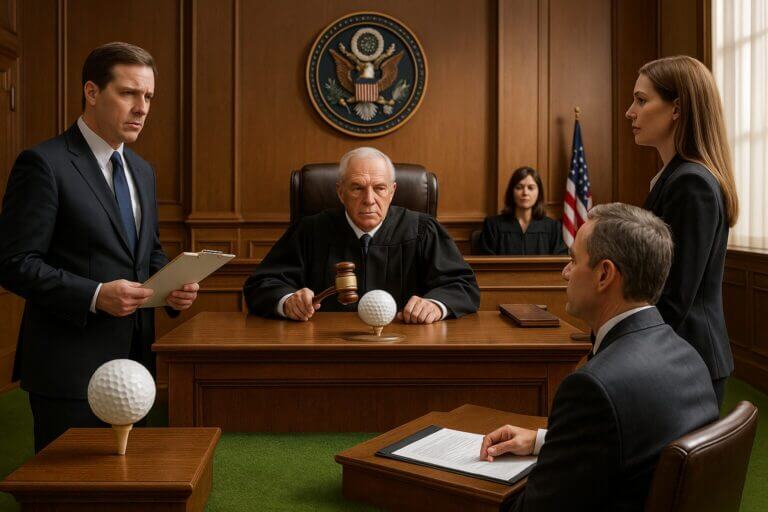
If you missed it, there’s a new class-action suit against Titleist over “mixed boxes” of Pro V1 and Pro V1x On the surface, it’s another entry in the long tradition of golf’s legal theater. Some of these suits are legit, some are laughable, and some make you wonder if legal departments exist for any reason other than justifying their own existence.
I’m certainly no stranger to the kind of letters that ping-pong around Carlsbad and beyond. Half of them feel like boilerplate threats written just so someone in legal can prove they still have toner in the printer. But, every now and again, one of these battles actually reshapes the equipment landscape.
Here are a few of the lawsuits that really mattered.
PING v. USGA (Eye 2 Groove Wars)
- The fight: In 1989, Karsten Solheim sued the USGA and PGA Tour for $100 million after officials moved to ban the square grooves found on the Eye 2 wedges.
- The settlement: A 1990 deal clarified groove specs but grandfathered every pre-April 1990 Eye 2. Those wedges were legal forever.
- The fallout: That’s why Phil Mickelson was still gaming Eye 2s in 2010. It set the precedent: the USGA can tighten specs, but not without risking legal bloodshed.
- Why it still matters: The Eye 2 case could serve as a blueprint for any brand that decides to challenge the USGA’s proposed ball rollback. The rollback isn’t finalized and there are still cards left to play. If someone does decide to fight, expect arguments that look a lot like the ones Karsten made in 1989.
Bridgestone v. Acushnet (Multilayer Ball Patents)
- The fight: Bridgestone said Titleist’s Pro V1 was trampling its multilayer patents.
- The settlement: In 2007, the companies agreed to a royalty-bearing license plus cross-licenses.
- The fallout: This was the birth of the patent royalty stack. If you’ve ever wondered why premium OEM balls start at $50 a dozen, this case is at least part of the answer.
- Why it still matters: With every manufacturer about to navigate the rollback era, patent minefields around ball construction won’t be cleared anytime soon. If anything, they’ll get more important as brands look to squeeze every ounce of performance inside a significantly tighter window.
Callaway v. Acushnet (The Pro V1 War)
- The fight: Callaway inherited Top-Flite’s patent portfolio and immediately went after Titleist. At one point, courts briefly barred the company from selling Pro V1s.
- The settlement: After six years of back-and-forth, they settled in 2012. Pro V1s stayed on shelves.
- The fallout: The industry realized that sometimes more benefit comes from cross-licensing than taking the No. 1 ball in golf off shelves.
- Why it still matters: A reminder that pulling the plug on the most popular product in the game is the nuclear option. It probably won’t happen again, but the threat of it still drives settlements.
Acushnet v. Vice et al. (The “DimpleGate” Lawsuits, 2015)

- The fight: In April 2015, Acushnet filed a federal lawsuit in Boston against 10 direct-to-consumer ball companies, including Vice, 3 Up Golf, Dixon, Kick X, Lightning, Monsta, Rife, Nexen, Ariva and Vail Roberts (I Need The Ball). The complaint alleged infringement of Acushnet’s patented 318-dimple triangular dipyramid pattern. Not surprisingly, every one of the brands named in the suit was sourcing its golf balls from the Foremost factory in Taiwan.
- The settlement/result: With no independent R&D and little leverage against Acushnet, most of these brands folded or quietly exited the category. One (3 Up) publicly announced it was shutting down within weeks of the filing. Vice, however, weathered the storm and continued to expand, ultimately becoming one of the world’s most recognizable DTC ball companies.
- The short-term fallout: The lawsuits immediately thinned the herd of small challengers. For a while, it looked like Acushnet had slammed the door on the first DTC boom.
- Why it still matters: Longer term, the opposite happened. The suits effectively raised the bar, forcing any serious DTC entrant to either develop its own IP, license technology or be prepared to fight. The space didn’t die. Arguably, it matured. Today’s leading DTC brands (Vice, Maxfli, Snell, OnCore, Seed and others) are proof that competition wasn’t discouraged; it was reshaped.
Costco v. Titleist (The K-Sig Saga)
- The fight: Costco launched a four-piece Kirkland Signature that looked suspiciously “tour-like” at $15. Acushnet threatened; Costco sued.
- The settlement: The case was quietly settled in 2018. The OG K-Sig vanished, while newer versions have been sourced from alternative factories.
- The fallout: The case again proved DTC businesses aren’t lawsuit-proof. It also suggests that “factory overruns” theories don’t hold up when the lawyers get involved.
“Horse Trading” in Golf
In the golf world, lawsuits almost never end with a knockout. Instead, they end in horse trading—settlements, cross-licenses and royalty checks.
Translation: You can sell yours if I can sell mine.
Horse trading keeps product on shelves, protects both sides’ IP and quietly bakes extra cost into the MSRP you and I end up paying.
PXG v. TaylorMade (Hollow-Body Iron Tech)
- The fight: PXG accused TaylorMade’s P790 irons of ripping off its hollow-body foam tech. TaylorMade countersued.
- The settlement: In 2019, the parties reached a cross-licensing agreement. Everyone went back to selling irons.
- The fallout: Why does everyone have a hollow-body iron today? It’s partly because PXG and TaylorMade cut a deal instead of burning the category down.
- Why it still matters: TaylorMade’s current lawsuit against Costco’s Kirkland irons (see below) is basically PXG versus TaylorMade all over again. If history repeats, expect another quiet license that opens the door for more “budget” hollow bodies.
Trackman v. FlightScope (Radar Wars)
- The fight: Years of European litigation over radar-based spin measurement.
- The result: A collection of mixed rulings. Nobody knocked out. Both still sell.
- The fallout: The legal wrangling forced each company to differentiate. TrackMan cemented itself as the PGA Tour’s standard radar tech while FlightScope has leaned a bit more into the consumer space.
Foresight v. Uneekor (Camera-Based Monitors)
- The fight: Foresight sued Uneekor for infringing camera-based launch monitor patents.
- The settlement: In 2024, they signed a license deal. Uneekor kept selling; Foresight got paid.
- The fallout: The at-home sim market didn’t implode. Instead, one competitor cut the other a check for the privilege of competing.
- Why it still matters: As golf sims go mainstream, this case (and to a smaller extent, Trackman versus FlightScope) set the precedent: new entrants either license tech or spend years in court. It’s one reason you’ll keep seeing semi-affordable launch monitor options multiply rather than vanish.
TaylorMade v. Costco (Hollow-Body Irons, Round Two)
- The fight: TaylorMade claims Costco’s Kirkland irons (and Indi Golf) infringe P790 patents.
- The status: Still active.
- The fallout (potential): If history repeats, this ends in another license. Costco keeps selling, TaylorMade cashes checks.
The Bigger Picture
The common thread is obvious. There’s little benefit from the Pro V1 disappearing, P790s vanishing mid-cycle or Uneekor folding. So, these cases end in settlements. Cross-licenses. Royalties. The quiet kind of horse trading that lets everyone keep playing.
And while legal departments may love firing off letters to remind everyone they’re still around, the real legacy of these fights is economic. They don’t change whether golfers get tech. They change what it costs to put that tech in your bag.







Hlammi
1 year ago
Love these types of golf history articles! Very interesting