



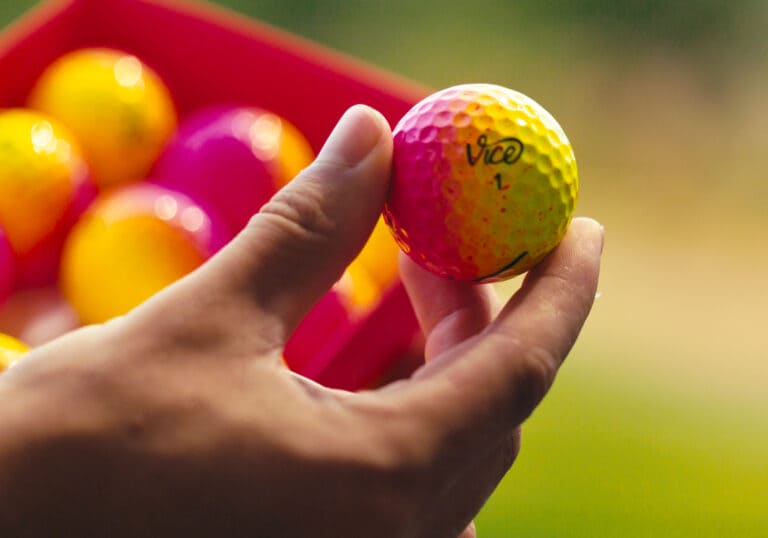
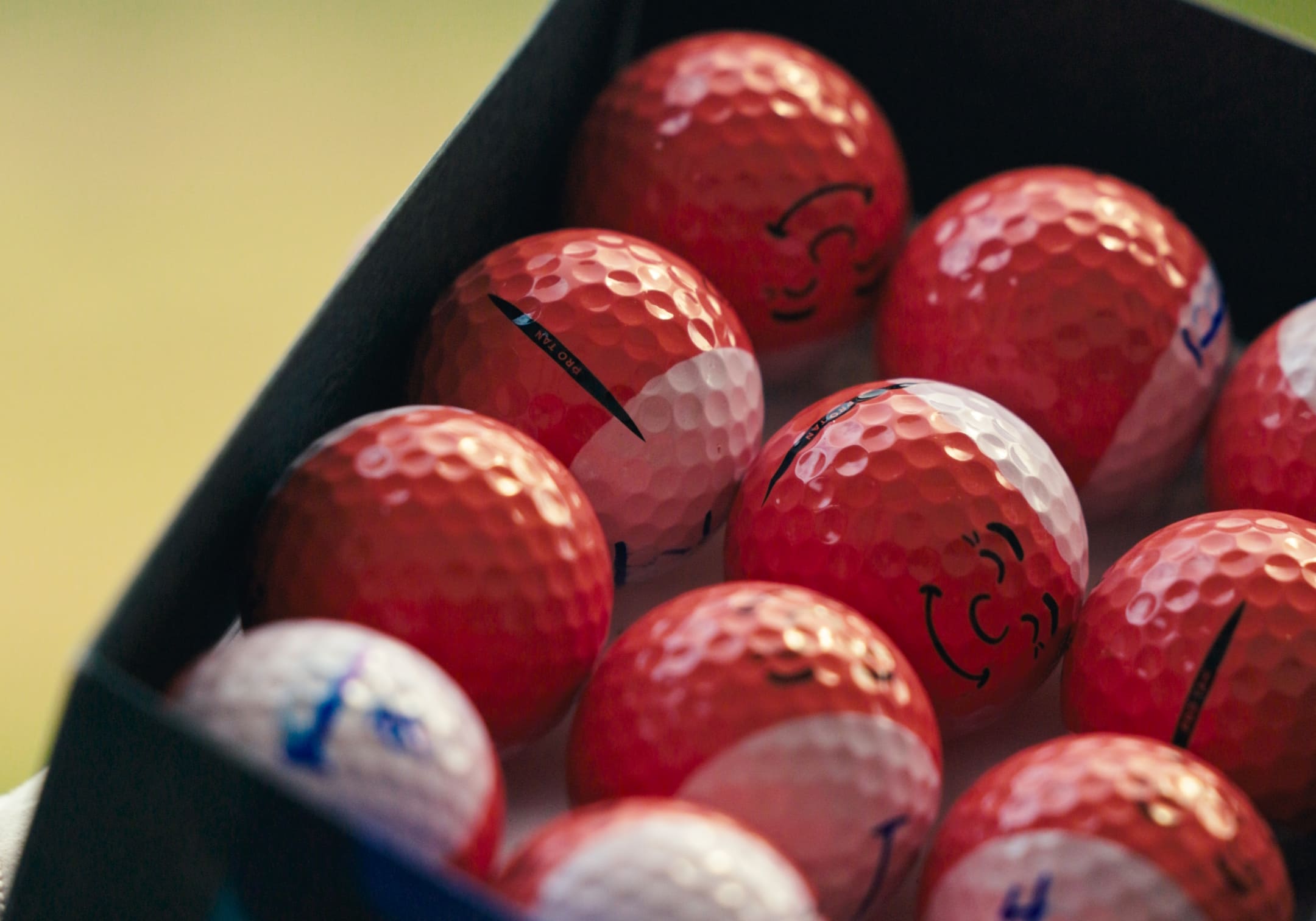
We robot-tested Vice’s two-tone Pro Neon Sunset and Pro Tan in four orientations. Turn the paint 180 degrees and the shot shape changes with it.
At the start of the 2026 season, paint became an oddly hot topic in golf ball circles. Callaway and TaylorMade touted refined paint processes that promised more consistent flight and TaylorMade sued Callaway over demonstrations that used blacklight to show paint inconsistencies. For what it’s worth, Titleist stood by its paint process while Bridgestone was quick to point out that it doesn’t paint its golf balls at all (the pigment is part of its urethane formulation).
You could easily chalk all of that up to the usual industry bluster that arrives every January but it’s an incontrovertible fact that paint or, more specifically uneven paint, can meaningfully influence how a golf ball flies. When paint is applied unevenly, dimple depth (a key factor in a ball’s lift and drag properties) can become inconsistent. To an extent, the ball ends up fighting itself as it tries to produce its designed flight.
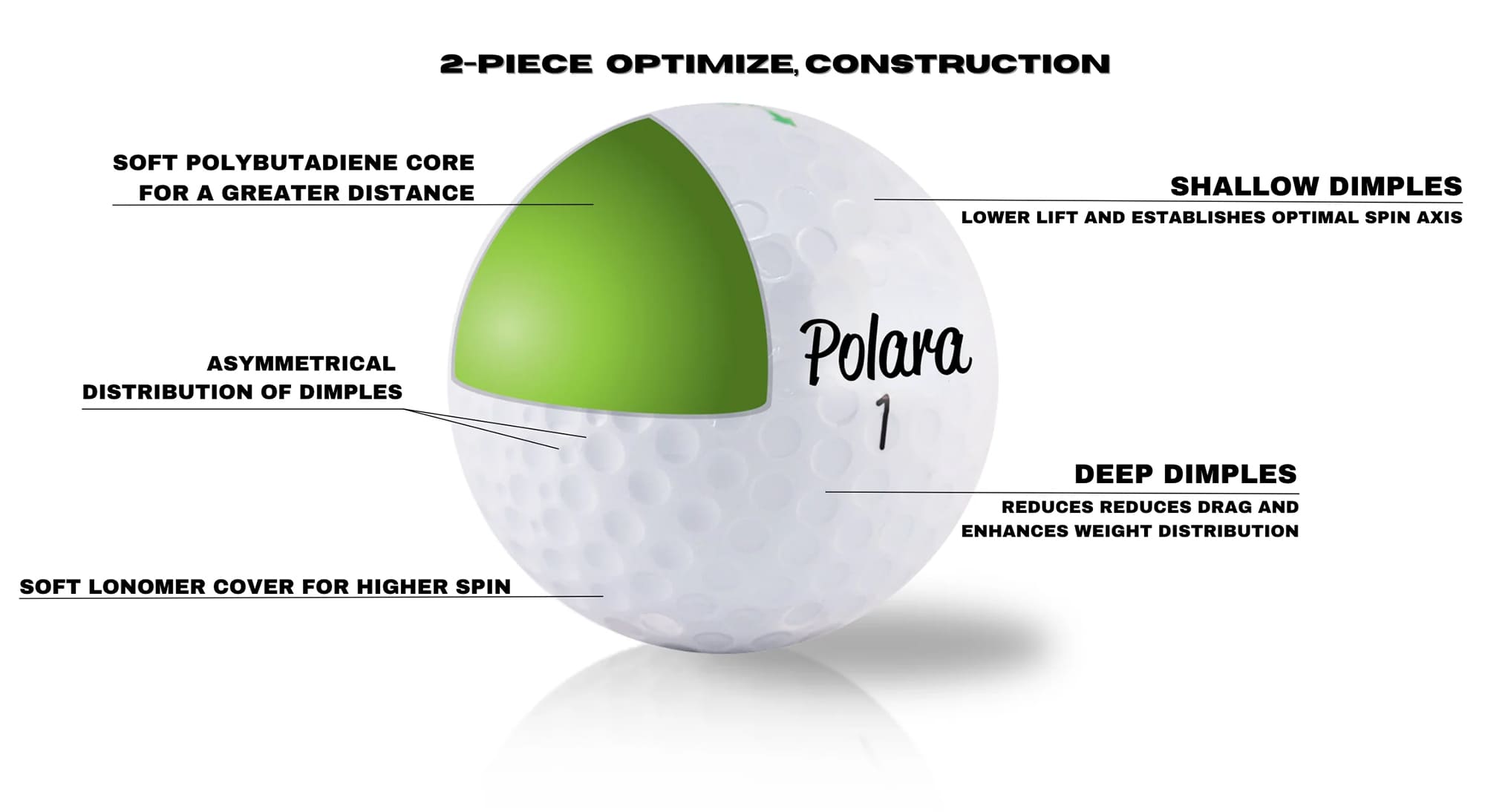
Functionally, that type of manufacturing defect mirrors the intentional design of the Polara golf ball (we tested it more than a decade ago). For those unaware, Polara is a non-conforming ball that uses asymmetrical dimples (shallow on one portion of the ball, deep on the other) to help golfers correct a slice. To work, a Polara ball needs to be teed in a specific orientation.
Simply put, Polara is perhaps the strongest commercially available example of how uneven dimples can alter ball flight. We’ll come back to it because it’s a critical piece of this conversation but, for now, file all of that away as background.
The idea
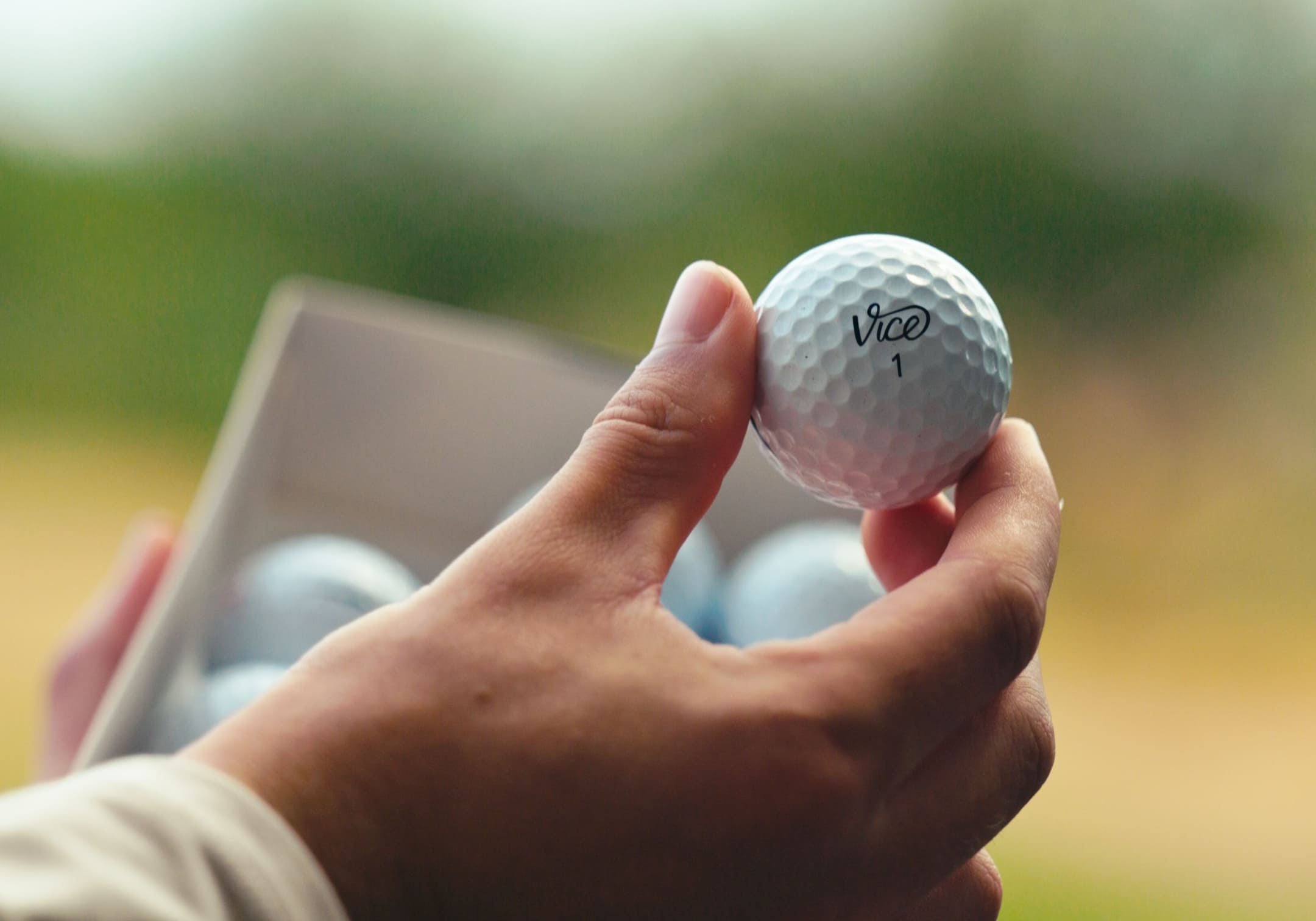
As we were putting together orders for the 2026 golf ball test, we stumbled across the Vice Pro Neon and Vice Pro Tan. “Stumbled” probably isn’t the right word. We knew they existed (I wrote about the Pro Tan when it launched) but with all the paint talk still occupying space in my brain, I started thinking about the potential implications of Vice’s paint strategy.
Everything we’ve learned from industry insiders, and from our own years of testing, suggests painting a golf ball one color with near-absolute precision is tricky enough. Layering multiple colors evenly and getting consistent fill in every dimple without introducing any downrange impact? The more I thought about it, the more it seemed nearly impossible.
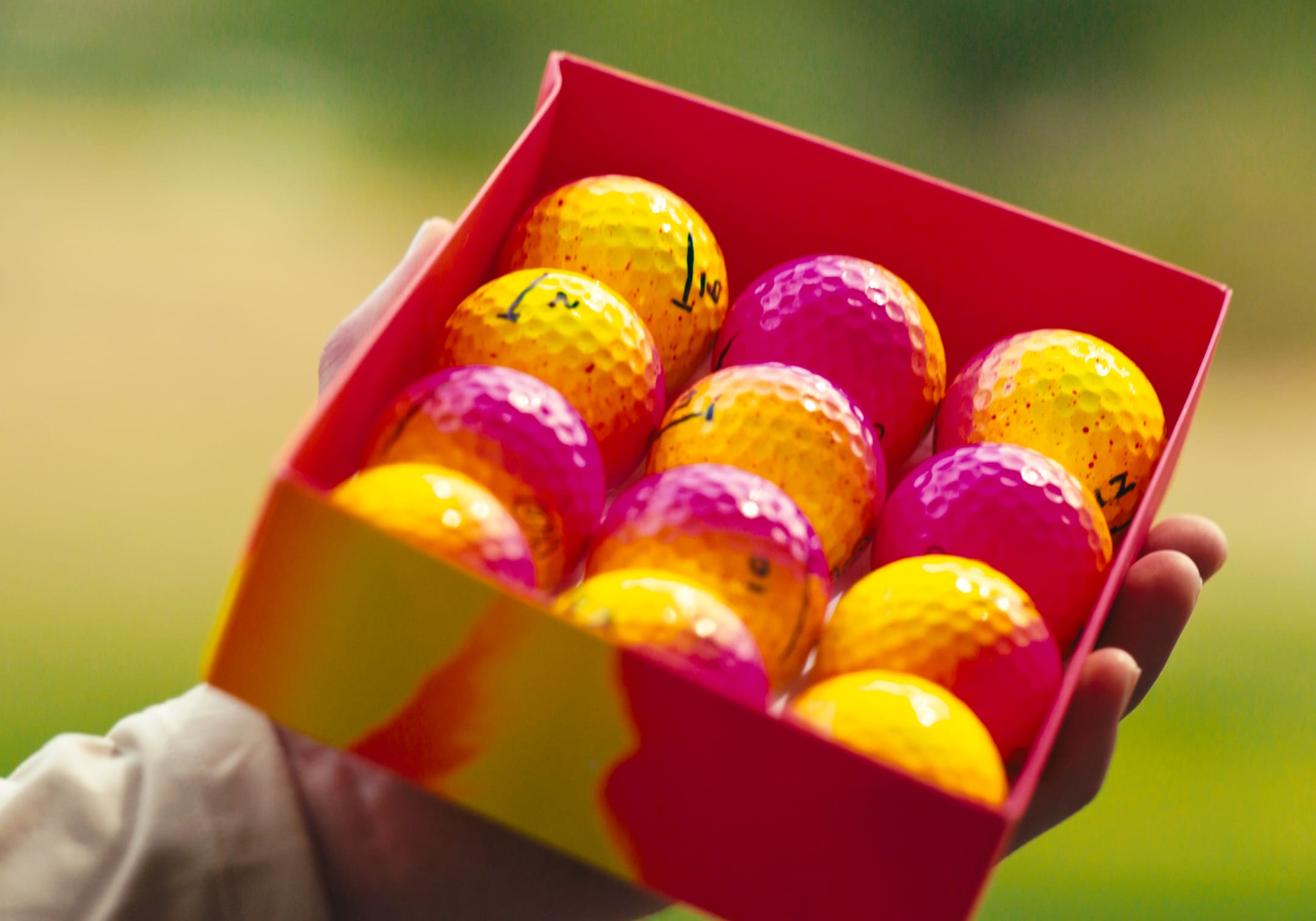
And so, alongside the 120-something dozen white balls, we added Vice Pro Neon Sunset (pink and yellow) and Vice Pro Tan to the mix.
The fundamental question we wanted to answer is this: Do Vice’s aggressively bold designs fly meaningfully differently depending on the orientation of the paint?
About the test
To find out, we hit 12 Vice Pro Tan and 12 Vice Pro Neon Sunset balls in four orientations. As a control of sorts, we also included 12 standard white Vice Pro balls. Testing took place in Scottsdale, Ariz., after the primary portion of the 2026 golf ball test. We set the robot to swing driver at approximately 100 mph with a slightly positive angle of attack.
Balls were hit in four-shot bursts, moving to the next model (or, more accurately, the next paint design) after every four shots. Once all 12 balls of each design had been hit, we retrieved them and moved to the next orientation.
The dashboard below uses language like “facing the wall” and “facing the robot.” For clarity, we started with the most prominent color (pink for Neon Sunset, tan for Pro Tan) facing the wall opposite the robot. The second orientation turned the prominent color toward the robot. The third placed it up (toward the ceiling) and the fourth pointed it down. For the white ball, we used the side stamp as the reference mark.
Eyeball observations
To be clear, there are often differences between what you see (or think you see) and what the data shows. To the naked eye, Neon Sunset appeared to fade almost every time the pink side faced the wall. Pro Tan did the opposite: With the tan side toward the wall, it drew.
Rotated 180 degrees, the patterns flipped. Neon Sunset appeared to draw while Pro Tan faded. Notably, the shift looked more pronounced with Neon Sunset.
In the up and down orientations, nothing jumped out at me. As you’ll see, the data tells a slightly different story for Pro Tan.
Key Insights
- Rotating the ball 180 degrees moved Neon Sunset’s average landing spot 8.5 yards. With the pink side facing the wall, it faded 5.6 yards more than the white ball. Rotated so the pink side faced the robot, it drew 3.8 yards more.
- It wasn’t a few odd balls. When rotated, 11 of 12 Neon Sunset balls shifted the same way. The solid white balls, rotated the same way, split eight of 12, close to a coin flip.
- Pro Tan shifted 4.8 yards, in the opposite direction from Neon Sunset. With the tan side facing the robot, it faded 3.8 yards more than the white ball. Ten of 12 Pro Tan balls shifted the same way.
- The start line didn’t change; the curve did. Launch direction was the same in every orientation but curve changed significantly. The balls started on the same line and bent differently.
- The paint didn’t make the balls less consistent. In any one orientation, shot-to-shot sideways scatter was 4.0 yards for Neon Sunset, 4.3 yards for Pro Tan and 4.3 yards for white.
- There’s no distance cost. Average carry was within 1.2 yards across the three finishes (250.2, 249.8 and 249.0 yards) and ball speed was within 0.3 mph.
- Pro Tan’s flight also depended on whether the tan side was up or down. Tan side up, it spun 143 rpm less, peaked 3.9 feet lower, stayed in the air 0.21 seconds less and landed 2.6 mph faster, with no change in carry. We didn’t see the same behavior with Neon Sunset.
- The gaps we measured were inside the USGA symmetry test’s limits. Our largest carry gap was 2.8 yards (the limit is 4.0) and our largest hang-time gap was 0.22 seconds (the limit is 0.40). The test has no sideways measure so the 8.5-yard shift is something it never looks at.
To give all of this some additional context (and to give you something to do at work), we’ve built a dashboard with summary findings, dispersion patterns and a whole lot of additional data. It also includes an overview of the relevant USGA rules and a brief rundown of how we tested.
Should these balls be non-conforming?
The data suggests the Vice Pro Neon Sunset and Vice Pro Tan produce different but repeatable downrange results depending on orientation. Said another way: there’s a case to be made that, oriented a specific way, Neon Sunset (and, to a lesser extent, Pro Tan) could be considered a draw-biased golf ball. Rotate it 180 degrees and it’s fade-biased.
And that brings us back to Polara.
The original Polara launched in 1977, marketed as cutting hooks and slices by up to 75 percent when teed in the proper orientation. At the time, the USGA didn’t have a specific rule against such designs but it refused to approve the ball anyway. In 1981, as it loves to do, the USGA created a new rule. The symmetry rule says a ball “must not be designed, manufactured or intentionally modified to have properties which differ from those of a spherically symmetrical ball.”
Polara sued. The USGA settled for about $1.4 million. The rule is still on the books today.
So how does the symmetry test apply to the Vice balls? By the letter, the test measures only carry and hang time. Polara’s benefit was sideways so, arguably, the test doesn’t measure what the rule was written to stop. What we observed with Neon Sunset and, to a lesser extent, Pro Tan falls into the same gap. Both are inside the limits on carry and hang time while curving differently depending on orientation.
Worth a quick note: The USGA’s conforming list isn’t always specific about product names but we found an entry that matches Neon Sunset. We couldn’t find a confident match for Pro Tan.
As with many things in the USGA rulebook, the wording of the symmetry rule is ambiguous and open to interpretation (and reinterpretation). Vice could reasonably argue that the shot-shape bias is an unintended side effect of the paint, not a design goal, whereas an anti-slice bias was irrefutably the design goal behind Polara. The answer to the conformance question lies somewhere between accident and intent.
The reality is that, intentionally or otherwise (mostly intentionally), golf equipment manufacturers have made a habit of exploiting the gap between the letter of the law and its spirit. Within that context, the Neon Sunset and Pro Tan are doing what countless other products do. That said, shot shape-biased golf balls aren’t just against the spirit of the symmetry rule; they’re exactly what it was written to prevent. One might argue that if the Vice balls conform, the Polara should, too. Functionally, they do the same thing.
What matters more: result or intent?
Whether these Vice balls conform is ultimately a question for the USGA. As of now, they do, and if nothing else, I’d suggest it’s yet another example of the USGA failing to fully enforce the spirit of the rules already on the books while it spends its time looking to create new ones.
Have your say
What do you think? Should Vice Pro Tan and Neon Sunset be deemed non-conforming? Is the USGA enforcing its existing equipment rules the way it should?






KJC
6 seconds ago
Very interesting (disappointing) that USGA deems these conforming. But this also raises the question about Maxfli golf balls which claim to identify and mark their balls after examining center of gravity (CG). I have wondered whether this type of production works. Certainly Bryson DeChambeau talks about Epson salt water baths. Is there any quantitative evidence around this Maxfli claim for either putting or full shots?