




Scottie Scheffler’s 50- and 56-degree wedges are still Titleist Vokey SM8s, a model that came out in 2020.
If PGA Tour pros are supposed to burn through multiple wedges in a season, how does the same model keep showing up in his bag six years later?
It’s a question we got a few times recently following this story about how often Tour pros replace wedges, so I wanted to take a moment to answer it.
Scheffler has explained that he could go more than a year between changes with those two wedges. He wanted predictable spin on shots to his stock yardages and rarely asked either club for extra zip.
He puts a fresh one in play every month or two to keep as much spin as possible around the greens. That is more frequent than Tour average.
The SM8 stamp tells us which design he’s using but how many times he’s replaced those particular heads is harder to pin down.
So how does he keep getting them? Titleist still makes them for him.
What the Tour truck has to match
If the Tour team has an unused head in the player’s preferred model and grind, it can build a fresh club to the player’s specs.
That means matching the shaft, length and swingweight, checking the actual loft and lie and accounting for any custom work on the sole.
Sometimes, the shape a player loves comes back on a newer head. Jordan Spieth brought Vokey Tour rep Aaron Dill an old SM7 prototype while working on a lob wedge. That prototype helped inform the custom SM10 lob wedge Dill built for him. For Spieth, the old wedge gave Dill a reference for what he wanted to feel through the turf.
That’s the appeal of a like-for-like replacement. A pro can get fresh grooves and keep the sole they already know how to use out of a bunker, off a tight lie or with the face wide open. And the next time you see a six-year-old wedge model in a Sunday winner’s bag, the face might have seen its first bunker shot that week.
How do manufacturers keep so many old models on hand?
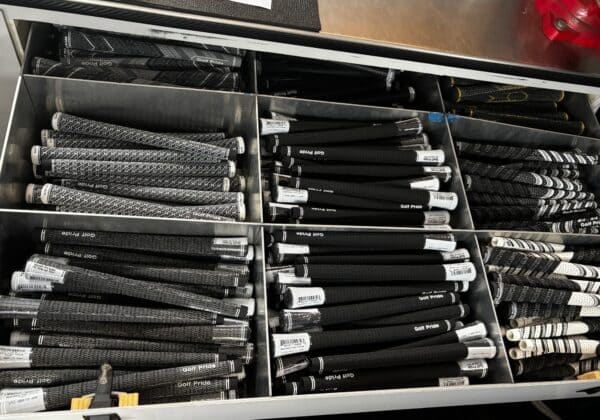
A Tour truck can carry hundreds of wedges and wedge heads. Callaway’s truck has about 350 on board across different models, grinds and finishes.
For a player who wants to stick with an older wedge, the useful inventory might be a handful of heads in the exact loft and grind they play. The builder can pull one and assemble it to the player’s specs.
A decade ago, NIKE took that kind of planning a step further. When it announced it was getting out of the club business in 2016, Mike Taylor and the team at The Oven (their test facility in Fort Worth, Texas) spent the next six months building backups, especially irons and wedges, for players who wanted to keep using them. By 2018, some former NIKE players were already running through those reserves, so you can see how
In many cases, the manufacturer will build new versions of the old model rather than relying on its stockpile. I used Hideki Matsuyama as an example in the original article: Cleveland makes him RTX4 wedges specifically for him, even though that model is from 2018.
So it’s a pretty simple answer at the end of the day: if a pro likes an old wedge model, manufacturers will find a way to keep it in his bag and/or use that model to build him something new.
Top Photo Caption: Scottie Scheffler poses with his SM8 wedge at the Olympics. (GETTY IMAGES)







Leave A Reply