
Tour Pros Frequently Replace Their Wedges. How Often Should You?
News

Tour Pros Frequently Replace Their Wedges. How Often Should You?

Support our Mission. We independently test each product we recommend. When you buy through our links, we may earn a commission.

Tour Pros Frequently Replace Their Wedges. How Often Should You?

Hideki Matsuyama replaces his Cleveland RTX4 Forged wedges—a nearly eight-year-old model—every two months.

Cleveland has continued producing the model specifically for him, allowing him to preserve the design he trusts while regularly refreshing the hitting surface. And that distinction matters. Seeing an older wedge in a PGA Tour player’s bag doesn’t mean the physical club has survived thousands of practice shots. In fact, it virtually never does.

Many of us feel a tinge of guilt seeing pros replace their wedges more often than I replace my Brita filter. Meanwhile, I’ve kept the same wedges for several seasons now. Average Janes and Joes don’t typically have the bandwidth (budget) to replace our wedges so frequently.

But is that guilt meaningful? Every two months is unreasonable but should recreational golfers follow a more aggressive replacement schedule than we do?

The answer might surprise you.

How often do Tour players replace their wedges?

It’s worth starting out by saying that even Tour pros have replacement schedules that vary by player and by club, to say the least.

Adam Scott has described replacing all of his wedges four times per year, timed around the majors. He wants fresh grooves heading into those four events. So he sometimes goes just one month between replacements.

Jordan Spieth changes his 60-degree wedge every few tournaments with his other wedges lasting a couple of months. Given some of the increased demands on a 60-degree, it shows that replacing every wedge simultaneously isn’t necessarily the best approach.

Justin Thomas displays another route. He replaces approximately one pitching wedge per year, two gap wedges, three sand wedges and four (or more) lob wedges. Vokey rep Aaron Dill calls it the 1-2-3-4 method.

I just wanted to show how there is certainly no consensus among the best players in the world.

These golfers practice extensively including in bunkers where a wedge face can really take a beating. They also have equipment support readily available and don’t have to factor in how much a club costs.

Their replacement frequency reflects that workload and the control they demand.

But back to the question at hand: Does a pro golfer’s habits have any relationship to what a weekend hacker should be doing?

What our testing found

In our most recent groove-wear test, our Director of Testing Phillip Bishop collected baseline data with a new 56-degree Vokey SM10 and then repeated the measurements after 300 and 500 bunker shots.

Titleist supplied the wear simulation as it was decided that 500 bunker shots represented approximately 75 rounds. Performance measurements came from shots off grass toward a 50-yard target.

MeasurementNew wedgeAfter 500 bunker shots
Average backspin7,021 rpm3,737 rpm
Average launch angle27°35°
Carry-distance standard deviationJust under 3 yardsApproximately 6 yards

The worn wedge lost almost 47 percent of its average spin. Spin variability also increased substantially.

The takeaway here is that it’s not solely about stopping the ball. Many golfers associate wedge freshness with clipping a pitch shot and seeing the ball take two hops and magically come to rest. In reality, distance control and launch angle are even more important.

The worn wedge produced considerably less predictable results. 

This was an accelerated wear test using one wedge rather than a universal prediction for every golfer’s 75th round. But obviously it demonstrates what substantial wear can do while leaving room for differences in practice habits, conditions and wedge construction.

Two big keys here? Understanding how much golf you play and monitoring your wedge’s performance.

Playing 20 rounds a year is a lot different than playing 100 rounds per year. Do you practice a lot or not at all? Do you notice any difference in the feel of a pitch shot?

Those answers contain a lot of information for what each golfer should do.

Can groove sharpening replace buying a wedge?

We get this question a lot so I wanted to address it.

Cleaning a wedge removes dirt and debris from existing grooves. You should do that before and after each shot or at least as often as reasonably possible (yes, it does make a difference).

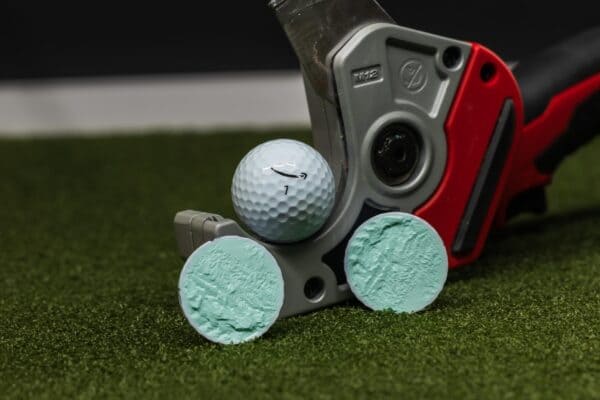
Sharpening grooves removes metal to alter the groove edges or geometry. The process can’t put worn metal back into place and working inside the grooves does not recreate the original milling or texture across the entire face.

What I’m saying is that sharpening is a repair attempt with a different scope from replacement. In our groove-sharpening testing, it was determined that the process is unreliable. Sometimes sharpened wedges produce more spin, sometimes less.

A new wedge provides fresh grooves and face texture plus an unworn sole and leading edge. It also creates an opportunity to check your loft, bounce and grind.

There is a rules consideration, too. Equipment standards restrict groove dimensions and edge sharpness. Cutting grooves wider, deeper or sharper can make a previously conforming wedge nonconforming.

Sharper is not automatically better or permissible. It might help … but it might also leave you worse off than before.

For a heavily worn scoring club, replacement offers a far more predictable starting point than a handheld tool.

When should you replace yours?

So what is the final consensus here?

Treat rounds played as a prompt to inspect your wedges, rather than an automatic expiration date.

This is more like checking your car’s oil than it is checking the milk in your fridge. When you hit a certain mileage, it’s time to assess where you are at—but that doesn’t automatically mean you have to replace your wedges.

Titleist recommends evaluating groove performance around 75 rounds and checking physical condition earlier. Your practice sessions count toward wear, too. As I mentioned, repeated bunker shots and sandy lies can accelerate deterioration. 

If you suspect a problem, compare your current wedge with a fresh one of similar specs using the same ball and comparable shots. Look at launch, spin, carry consistency and rollout. If you have historic wedge performance data, that will make this comparison even easier.

Start with your most-used wedge. You may need a new sand or lob wedge while your gap wedge still performs well. What do you use most around the green? Are you a one-tool player who always reaches for a 56-degree? Do you play a wide variety of shots? That is all part of the equation.

And it’s worth remembering that fresh grooves don’t require purchasing the latest release. An unused previous-generation wedge can refresh the hitting surface without paying flagship prices as we see with Matsuyama using a wedge model that was introduced in 2018.

Tour players and our groove-wearing testing show why wedge condition deserves attention. Ultimately, your own workload and performance should determine when that attention turns into a purchase.

So, no, you don’t have to replace your wedges every couple of months.

The phrase “your mileage may vary” is the one to keep in mind.

Top Photo Caption: Hideki Matsuyama hits a wedge shot during the Arnold Palmer Invitational. (GETTY IMAGES/Brian Spurlock)


For You

For You

John Daly signs with Topgolf John Daly signs with Topgolf
News
Oct 22, 2026
John Daly Signing With Topgolf Is Nothing If Not Natural
News
Oct 22, 2026
Why Is Max Homa Selling Coterie Diapers?
Labs
Oct 21, 2026
Is Amazon’s $18 Golf Ball Any Good? Ball Lab Has The Answer
Preferred Source
Sean Fairholm

Sean Fairholm

Sean Fairholm

Sean is a longtime golf journalist and underachieving 10 handicap who enjoys the game in all forms. If he didn't have an official career writing about golf, Sean would spend most of his free time writing about it anyway. When he isn't playing golf, you can find Sean watching his beloved Florida Panthers hockey team, traveling to a national park or listening to music on his record player. He lives in Nashville with his wife, Anja, and dog, Hogan.

Sean Fairholm

Sean Fairholm

Sean Fairholm

 
Sean Fairholm

Sean Fairholm

Sean Fairholm


      Dick Molin

      2 weeks ago

      I use my older 56-degree Vokey as a true “sand” wedge, and the 56 degree Opus SP off of turf. It does mean I carry 14 clubs instead of the usual 13, but it should lengthen the life of my $200 Callaway wedge. I just can’t see buying new wedges more than every few years, which in my case is about 300 rounds.

      Reply

      Tom

      2 weeks ago

      Does Ball speed have something to do with it too? They hit the ball much faster/harder than the average amateur and therefore breakdown the grooves faster.

      Reply

      Fake

      2 weeks ago

      I am definitely someone who uses a 56 degree wedge more often than my other wedges. This year, I bought a cheap one off of Amazon. I frankly don’t have the funds to replace them with the top end clubs, but this $50 knockoff that I’m using is so close to the Cleveland it replaced, I can’t tell the difference. I am a higher handicapped player, and more skilled players may see the benefit from better clubs.

      Reply

      BigMal

      3 weeks ago

      Spot on my freind ,I too clean after every shot and round and often see other players with clubs with so .much dried mud on their clubs including woods ,these chaps all tend to talk a good game with a .multitude of information as to why they HAD A BAD DAY

      Reply

      burke lake pro

      3 weeks ago

      There’s no magic number. Are your chips and pitches running a bit further than usual (and are you sure the problem isn’t the player, and not the wedge? Then you may want to think about getting some new wedges (or play for a little more run out). I’ve had the same Cleveland RTX 4 60 deg. x-low wedge in my bag for what?–8 years now?–and it may not spin as much as it did brand new, but it still spins a lot–a ton if you nip it right.
      In the end, it’s not just about how many shots you’ve played with a club–just ask Tom Kite’s Wedge:
      https://www.facebook.com/GolfHallofFame/photos/heres-hoping-that-tom-kites-birthday-is-as-sweet-as-his-62-degree-ben-hogan-wedg/10153480928889335/

      Reply

      Big Mal

      3 weeks ago

      I’ve got some old vokey wedges 50,52,54,56. the first three are rusty the 4th is shiny steel all four wedges still perform very well considering they’re about 20 years old , but my latest wedges are SM 10s 50 ,54 they are brilliant bought them mid this year and coupled with bridgestone tour b ,xs ball they stop on a coin , my prior wedges were SM 7s again 50,54 all wedges F type with 10°&14° boun e on the SM10s and 8°,10° bounce on SM 7s in my opinion and as a titleist player for 25 years of my 50 odd golfing time vokeys outshine all others but I must say that as regards to changing wedges that regularly I.e. 4 times a year is totally beyond most club golfers ,if as i do you clean your clubs ,that is all clubs after every shot and then after every game your clubs will look after your game if you look after them and don’t be put off buying head covers for your irons to stop that infernal rattle you hear from the players that carry plus it protects them from club face damage .

      Reply

      birdie dancer

      3 weeks ago

      a week ago u had an article detailing a list of pros playing 5-6 year old wedges….so an internet site selling product is not gonna convince anyone they need 4 sets a year…..when 4 in a lifetime would be a lot

      Reply

      George

      3 weeks ago

      The *models* are several years old. Not the clubs. E.g., Hideki, or JT or whoever, like what they like, and have enough pull with their OEM to get them to make a bunch of extra clubs to accommodate their burn rate.

      That said, the “recommended” replacement rate here is pretty damned silly. If I notice shots not stopping like they should, OK, maybe I’ll look into getting the club sandblasted. ROFL at buying a new wedge at >$200 a pop every year.

      Reply

      andrew

      3 weeks ago

      why do grooves matter in the bunker if you are hitting the sand first and have no direct contact between club face and ball.

      Reply

      sean

      3 weeks ago

      Yawn, it’s the effect the sand has wearing down the clubface for OTHER shots.

      Reply

      Tom Wishon

      3 weeks ago

      I keep hoping that eventually the world of golf equipment journalism will learn that the grooves are NOT the source of backspin in a wedge or in any clubhead. Cochran and Stobbs first proved this 58 years ago in their milestone book, The Search for the Perfect Swing, when they had Dunlop make a lofted iron with no grooves whatsoever and watched pros who test hit the iron stop the ball easily on a green. It is the friction of the flat areas between the grooves that generates backspin. Only if the top edge of the grooves are left razor sharp can the grooves have any effect on the amount of backspin. And a condition of a sharp edge groove is non conforming since the USGA compelled there to be a radius on the groove edges. The grooves function to channel moisture away from the barrier of impact between the face and ball to help slightly reduce the chance of hitting a “flyer”.

      Iron and wedge faces are not sand blasted, virtually all companies choose to use silicon glass beads to blast the face area because glass beads leave a more cosmetically pleasing look for the face as opposed to the darker appearance of sand blasting. But a glass bead blast offers less friction than a sand blast and will wear quickly. Plus, for those playing forged carbon steel wedges which are nickel then chromium elctroplated, the bead blast is put on top of the nickel plating before the chromium is plated on the head which reduces the friction even more. Face blasting is not done on top of the chromium because that layer is so thin that blasting on top of it brings the risk of breaking through the chrome which will eventually trigger rust. If you want more consistent spin, either buy a milled face wedge(s) or have the faces of your wedges sand blasted frequently and if you do play forged wedges, simply live with the rust. It cleans off.

      Reply

      Ricky

      3 weeks ago

      Tom! You da-Man! But how do we know you’re the real Tom?

      Reply

      FEDUPCALIFORNIAN

      3 weeks ago

      Thank you sir!! I will stick with rusty.

      Reply

      PaulS

      3 weeks ago

      I’ve got a different take on practicing with a worn-out wedge and playing with a fresh one. It is like practicing your chips and pitches with range balls. The spin and launch are so different that I have a hard time knowing what to expect when I am playing. Clearly, I am not changing my wedges often enough, but I still think I want to practice with what I am going to use on the course.

      Reply

      Wad

      3 weeks ago

      I play over a 100 rounds a year.
      After reading this I figured out i better quit playing Vokey wedges and playing Kirkland wedges. Who could afford changing a set of Vokey wedges to every year

      Reply

      Dave

      3 weeks ago

      I just replaced my bunker & approach wedges & my fellow golfers remarked how my ball was now spinning back where previously it didn’t, so that seems to validate my decision in getting new wedges after about 3-4 seasons.

      Reply

      Carl

      3 weeks ago

      Not to nit pick, but 500 bunker shots in 75 rounds is 6 to 7 bunker shots per round, which my average for my last 77 rounds (thanks Golfpad app) is 1.5. I realize this factors in practice and other shots with the wedge, but based on my usage it would take me 330 rounds to put this much wear on my wedge, or about 2.5 years (hey, I’m retired and I play a fair amount). Just my 2 cents.

      Reply

      Duane Martin

      3 weeks ago

      Exactly what I was thinking.
      I can’t remember the last time I was in 6-7 bunkers in one round.
      After being in 3-4, strategy usually gets more attention.

      Reply

      sean

      3 weeks ago

      You may not, but good golfers PRACTICE bunker shots. It doesn’t take a lot of bunker practice to get to 500 shots does it?
      I might hit 40-50 bunker shots per session from various types of bunker shots.

      Reply

      Robert G

      3 weeks ago

      Do you really have to call recreational golfers “Hackers”? Quite a few of us have a fairly good understanding of the game, and are very skilled.

      Reply

      Mike

      3 weeks ago

      I agree. There’s a HUGE group of golfers who are not “pro’s” but are far from “weekend hackers”. In any case, I bet there are a lot of “weekend hackers (author’s words)” who keep MGS in business & the author writing for them.

      And BTW, I have a feeling that when most pros need a new wedge, they come free. I have to pay for mine…

      Reply

      sean

      3 weeks ago

      The vast, vast, vast majority of golfers ARE hackers.
      The average golf handicap is about 16 for men, which is a really LOW level of ability. I’d call anyone worse than 12 a hacker.

      Reply

      Mike

      3 weeks ago

      OK, I get it sport, you’re a REALLY good golfer w/ a nasty snob attitude

      BigMal

      3 weeks ago

      You must be the guy at your club sat in the corner on his own (Billy no mates) who doesn’t play with the majority of his co-members

      Sonoma Valley Tom

      3 weeks ago

      Agree with AlbatrossX4 and Erik. I don’t think the average (15 handicap) golfer lands in greenside bunkers 6 to 7 times per game. Personally, I’m a 15 handicap, at the very most my ball will land in sand twice per game at the higher priced golf courses that surround all the putting greens with bunkers. At my local municipals that don’t have many sand traps I don’t land in the bunkers at all.

      Reply

      EBM

      3 weeks ago

      My rule of thumb is to run my finger nail in the top grooves. Then move down to hitting area. Are the grooves shallower? Is the club face compressed / flattened in hitting area? If yes goes in spare bag. Purchase new discontinued or closeout replacement. Practice with spare. Play with new. Most used wedge lasts 75 rounds or more. Less used 100 or more depending on use. Cleveland CBX 4 46, 50, 54, RTX 6 58

      Reply

      Rupert

      3 weeks ago

      Bit of a dumb question – are you talking 9 hole rounds or 18 hole rounds?

      Reply

      Sean

      3 weeks ago

      9 holes isn’t a round

      Reply

      FrankW

      3 weeks ago

      500 bunker shots in 75 rounds? That’s nearly 7 bunkers per round. Comon man, if you hit 7 bunkers per round, you got bigger issues than wedge spin… Just saying.

      Reply

      steve

      3 weeks ago

      practice, you should try it.

      Reply

      sean

      3 weeks ago

      Ever heard of practicing? Might make you a better golfer.

      Reply

      Dave Shack

      3 weeks ago

      As I look at by bag containing 2017 Callaway 6 iron thru PW, I can’t help but wonder if the wedge performance loss translates to irons. I have always replaced my wedges every couple years due to a noticeable drop in spin. I haven’t noticed much of a drop in performance with my irons.

      Reply

      KC

      3 weeks ago

      Sure would be great if an OEM would come out with a replaceable wedge face. With 3D printing it might be a possible solution. The price of wedges is obscene. It seems like they were $129 a few years ago and now if you want any other shaft you are paying $229+. At the urging of my instructor, I recently went to a lighter wedge shaft and it has done wonders.

      Reply

      WYBob

      3 weeks ago

      TaylorMade did offer a wedge with a replaceable face insert. It was their TP xFT models from about 12+ years ago and they were really a pretty decent wedge. Not sure why they stopped but suspect revenue and profit were a primary motivation. There were 2 types of face replacement inserts (Pro conforming grooves (red), and recreational conforming grooves (black)- moot after 2024) that could be swapped out using a TM torque wrench. You still can find the TP xFT wedges used on sites like eBay and with a little additional research you can also find new face inserts offered on eBay and other sites on the internet.

      Reply

      Pat

      3 weeks ago

      If we need to replace wedges a couple times a year that’s a strong argument for using much cheaper ones. Or maybe they should come in a 3 pk like gloves, with all the same specs.

      Reply

      vito

      3 weeks ago

      Replace them when they stop working. I very rarely hit full wedge shots and maybe one or two sand shots a round(most public courses don’t have a lot of sand and many are reducing that number to to the maintenance cost). I’ve also sharpened grooves and seen spin improvement; never seen it get worse(at least according to trackman). I play 50 to 75 rounds a year. My wedges are 3 years old. I’m currently playing to a 9 handicap with a driver swing of 85-90mph.

      Reply

      Al Jamieson

      3 weeks ago

      A couple of years ago I was fitted properly for two Vokey wedges. I practice the wedge game far more than full shots on the range. Earlier this year I purchased a duplicate set which is call my “gamers”. Now I use the first set for practice.

      Reply

      A.D.

      3 weeks ago

      As my game has improved, I’ve noticed the importance of new wedges and fresh grooves. My short game and ability to get up and down anywhere greenside, is totally dependent upon my confidence in my 60, 54 and 48. I play atleast 100 rounds per year and practice 2x a week. So I’ve arrived at an annual replacement is best for my game and my wallet…timed with the release of each new Vokey.

      Reply

      Big V

      3 weeks ago

      Was just about to say this. Keep your older wedges when you replace them, and use them for practice.

      Reply

      Pete S

      3 weeks ago

      I do this too. I use my old wedges when I practice and have a new set for play.

      Reply

      Mike

      3 weeks ago

      I started doing that a few years ago also. But since I love my wedges, my hybrids & my iron set so much I actually have a full practice set of all of them, identical to my gamers (I found them here & there on ebay at very good prices). I use the practice ones all Winter & on the range. When you have no need (or interest) in buying a bunch of new clubs you can focus my golf spend on both playing & purchasing the occasional driver/putter.

      Reply

      albatrossx4

      3 weeks ago

      How many bunkers to you hit in a round, come on over 6 a round, really you must suck at hitting irons

      Reply

      Erik

      3 weeks ago

      Even if someone spent a good number of practice sessions only hitting bunker shots, that is too high. They would be warn out from all of those bunker shots. Lessons for iron shots or course management would be a better use of money than replacing wedges if you hit almost 7 bunker shots a round.

      Reply

      SJW

      3 weeks ago

      Can anyone translate this guy’s response ?

      Reply

      wcsg

      3 weeks ago

      If you read the article, the 500 shots was done to include practice time. If you never practice your wedge game is going to be awful no matter how new they are.

      Reply

      Kevin

      3 weeks ago

      Say it louder for the people in the back!!!

      Reply

      Mike

      3 weeks ago

      Based on what I see when I glance at my playing partners clubs (when I’m in a riding cart), most people would benefit simply by cleaning not just their wedges but all their clubs. In the military I cleaned my weapons every chance I got, so now I’m the guy that will clean his clubs after every round.

      Reply

      BigMal

      3 weeks ago

      Spot on my freind ,I too clean after every shot and round and often see other players with clubs with so .much dried mud on their clubs including woods ,these chaps all tend to talk a good game with a .multitude of information as to why they HAD A BAD DAY

      Reply

    Leave A Reply

    required
    required
    required (your email address will not be published)

    This site uses Akismet to reduce spam. Learn how your comment data is processed.

    John Daly signs with Topgolf John Daly signs with Topgolf
    News
    Oct 22, 2026
    John Daly Signing With Topgolf Is Nothing If Not Natural
    News
    Oct 22, 2026
    Why Is Max Homa Selling Coterie Diapers?
    Labs
    Oct 21, 2026
    Is Amazon’s $18 Golf Ball Any Good? Ball Lab Has The Answer