



In 2012 Callaway sold off the Ben Hogan brand but held onto various Hogan trademarks, including Apex. Two years later, Callaway revitalized the iconic name and launched the Apex irons – a model said to combine the beauty of a forged iron with the benefits of a distance-oriented face construction alongside the single-piece forged Apex Pro irons, which Callaway branded as “A high-tech forged players iron.”
Then, in 2016, Callaway updated both models adding Face Cup technology to the standard Apex, making it, according to Callaway, the longest forged iron on the market. That edition of Apex Pro integrated tungsten and air into the forged carbon steel body to optimize CG throughout the set and was marketed as “The Ultimate Forged Performance iron for skilled Players”.
This brief history tour is relevant because, for 2019, Callaway is billing the Apex as “The ultimate forged players distance iron” whereas the Apex Pro is “A Forged Tour Performance Iron With Advanced Distance Technologies”.
Hyperbole (and there’s plenty of it) aside, let’s unpack what’s changed, what hasn’t, and what it all means.

APEX
The first version of Apex teetered on the border between the GI (Game Improvement) and forgiving CB iron categories. With the addition of Face Cup technology in 2016 and various new technologies in 2019, Callaway is targeting better players (likely single-digit and lower) who want maximum distance and a soft, typical forged feel/sound.
Let’s not mince words; we’re talking about Callaway’s answer to TaylorMade’s hugely successful P790 (quick update – PXG’s legal battle with TaylorMade over P790 is ongoing).
Built on a 1025 forged carbon steel chassis, which Senior VP of R&D, Dr. Alan Hocknell, describes as exuding a “timeless, premium and precision look,” the intention of this iteration of Apex is to increase both ball speed and control, particularly in the short irons.

Callaway’s 360 Face Cup technology provides ample distance, but thin faces without some measure of internal support, often feel hollow and clicky, which is diametrically opposed to reasons engineers would use a soft forged carbon steel body. As such, Callaway injects urethane microspheres, which start as a liquid, into the cavity of the iron to improve the sound and feel of the club without limiting ball speed or face flex.
Though Callaway isn’t working with the same type of full hollow cavity, it’s conceptually similar to PXG’s COR2 and TaylorMade’s SpeedFoam technologies, though some OEM’s (Ping, Titleist, Mizuno) feel it’s best to leave the cavity entirely hollow.
Callaway also uses MIM (metal injection moldings) which first appeared in the 2017 Epic iron as well as last year’s Rogue release. Each piece is custom designed for shape, size, density (ratio of steel to tungsten) and location to push the CG lower in long irons and higher in short irons.
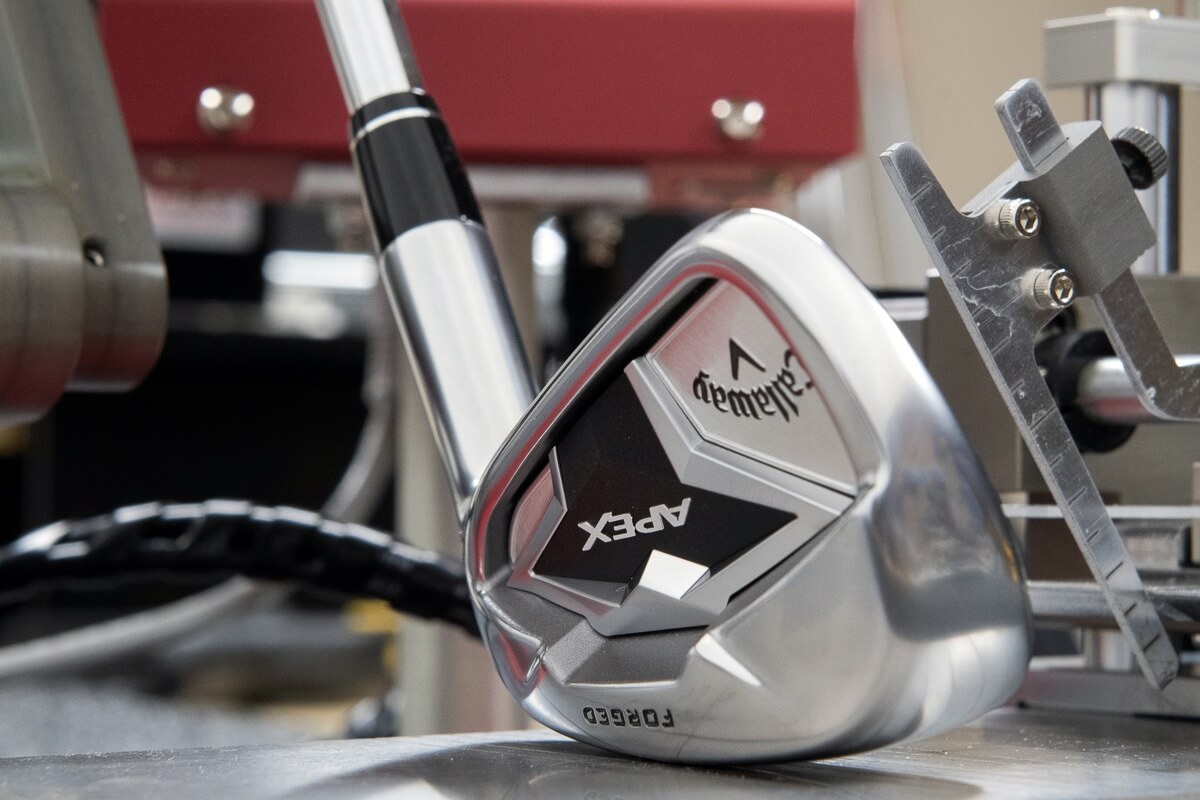
Paramount to the forged distance iron category are thin faces – and like many 2019 resolutions, the thinner, the better. However, if the faces flex too much, it can lead to super low spin rates, which is potentially a major problem. To that end, Callaway is adding Spin Control VFT (variable face thickness) to add spin back to shots which otherwise wouldn’t have enough spin to maintain proper distance.
Think of it this way – 360 Face Cup technology is what provides the distance boost, while VFT maintains the consistency of distance. Longer is better, only if it’s predictably and repeatedly longer.
The largest complaint Callaway received on the 2016 Apex irons were that the short irons didn’t fit the look of the rest of the set. As such, the shaping is more compact and player-ish on the short irons.
Pricing and Availability
The stock shaft is Elevate by True Temper
Pricing: $1,399 – steel, $1,499 – graphite
APEX PRO
As one would expect given the Pro designation, this iron distinguishes itself from the standard Apex primarily via size and shaping. What’s notable for Callaway, however, is the convergence of distance technologies it was able to fit in a smaller, tour-inspired canvas. Specifically, Callaway, via some super adroit engineering, is using every distance-oriented technology in its arsenal in this iron, including 360 Face Cup, VFT, urethane microspheres, and MIM.
It’s essentially packing for a 3-month vacation and getting everything in a carry-on bag.
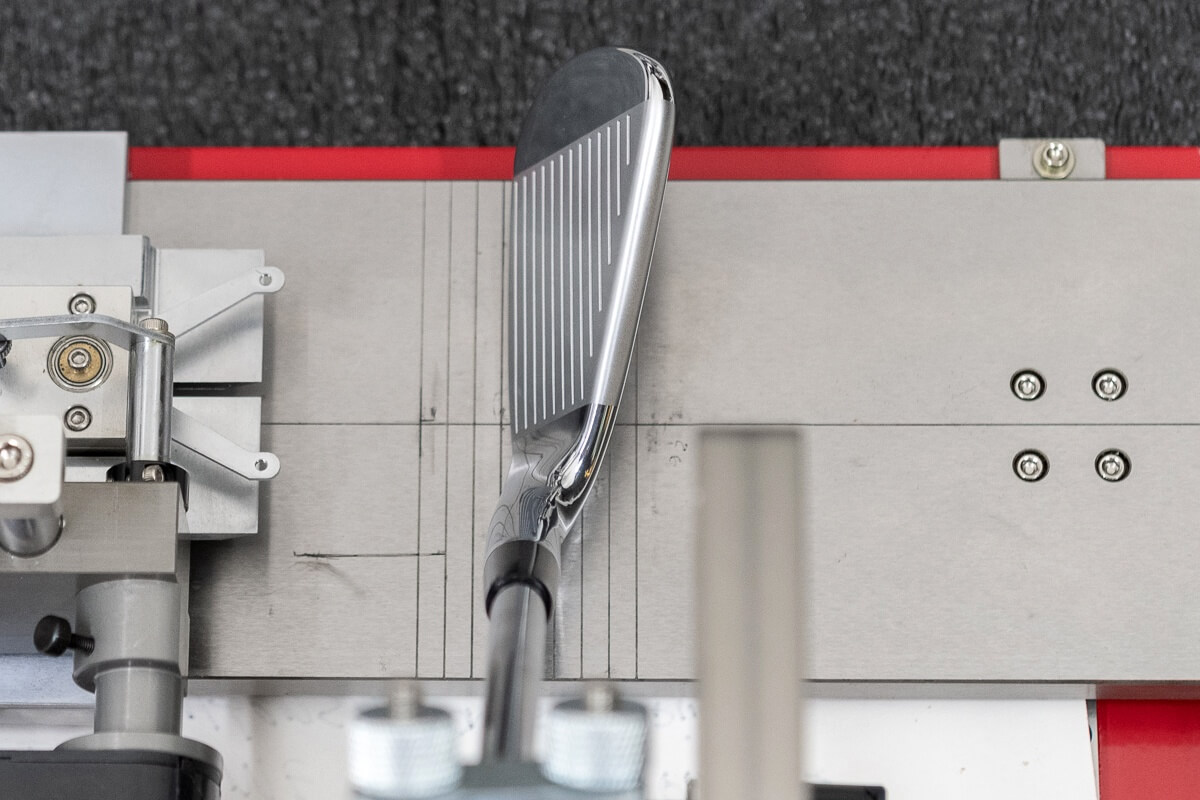
Again, MIM is used for precise CG location, and urethane microspheres work to support, but not limit face flex and thus ball speed. VFT pairs with 360 Face Cup for maximum ball speed in the 3-6 irons, but Callaway chose to use a slightly slower faceplate in the 8-P as distance becomes strictly a matter of loft, while accuracy and the ability to hit partial shots while controlling distance and trajectory is generally more important for tour players and competitive amateurs. The 7-iron remains the transition point of the Apex Pro and uses a toned-down version of Face Cup to effectively bridge the gap between the 6 iron and 8 iron.
Callaway is also releasing a designed combo set with Apex in 3-7 irons and Apex Pro in 8-wedge. This isn’t an a la carte style combo set where players can individually select irons as the Apex Pro have a different sole shape, camber and loft sequence to better match the turf interaction and distance gapping of the standard Apex.
With previous releases, Callaway would dangle a limited quantity Black edition several months down the line, but this time around a second finish – Apex Smoke – will be available on all Apex models (including the combo set) roughly 30 days after the initial launch. The upcharge will be $20/club and will include a smoke edition True Temper Elevate shaft as well as an Apex smoke medallion. As with the Big Bertha irons, the finish will be a black PVD which is highly questionable given how quickly it’s known to wear. At nearly $200/club consumers are asked to pay a premium, which isn’t an adjective anyone should use to describe this type of finish. In fact, our editor Tony Covey rightfully asserts “as soon as you put PVD on a product, you lose the right to call it premium.”

Specs, Pricing, and Availability

Pricing: $1,399 – steel
The likelihood is Callaway continues its run in 2019 as the #1 Iron brand (dollar share retail), largely on the back of Apex. The line has been, by any measure, tremendously successful and there doesn’t seem to be evidence to suggest the retail market is going to experience any seismic shifts.
If there’s a downside to the 2019 Apex and Apex Pro, it’s that it could be a victim of its own success. In 2017, Harry Arnett, Senior VP of Marketing described the $250/head Epic irons as “the highest performance products we know how to make.” If consumers are to believe the 2019 Apex line has surpassed what Epic offered two years ago and contains Callaway’s current best thinking, as advertised, it would make it rather difficult, if not disingenuous to bring to market an Epic replacement. This could resign any such uber-premium releases (see Epic Star) to overseas markets where dynamics and expectations are different. But for the time being, Apex and Apex Pro appear to offer enough change without deviating from the script which made them a staple of Callaway’s dominating iron lineup.
Retail availability for Apex and Apex Pro begins 1/25/19.
For more information, visit Callawaygolf.com.




Sean
8 years ago
So did callaway overtly admit that the 16s didn’t spin enough? That’s why all this verbiage about consistent spin and not too much flex in the face?