


Welcome back, fellow GolfSpies, to the eagerly anticipated next edition of History’s Mysteries. Our goal for this project has always been to examine the people, companies, products and events that helped shape our current golf world.
Today, we’re heading to the courtroom for a deep dive into an event that is singularly responsible for shaping the golf retail market as we know it today. It’s that significant.
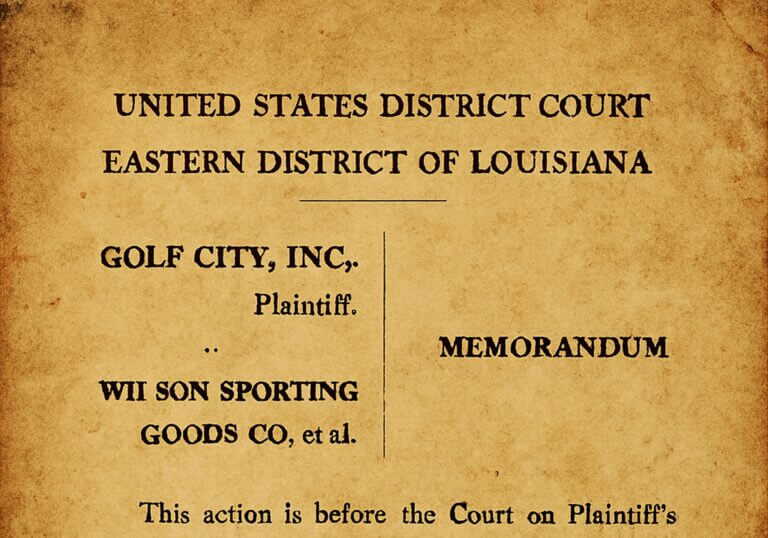
So hop into the Hot Tub Time Machine, my friends. Our destination is 1975 and the U.S. District Court in New Orleans, where we’ll examine the paradigm-shifting court case of Golf City, Inc. v. Wilson Sporting Goods, et al.
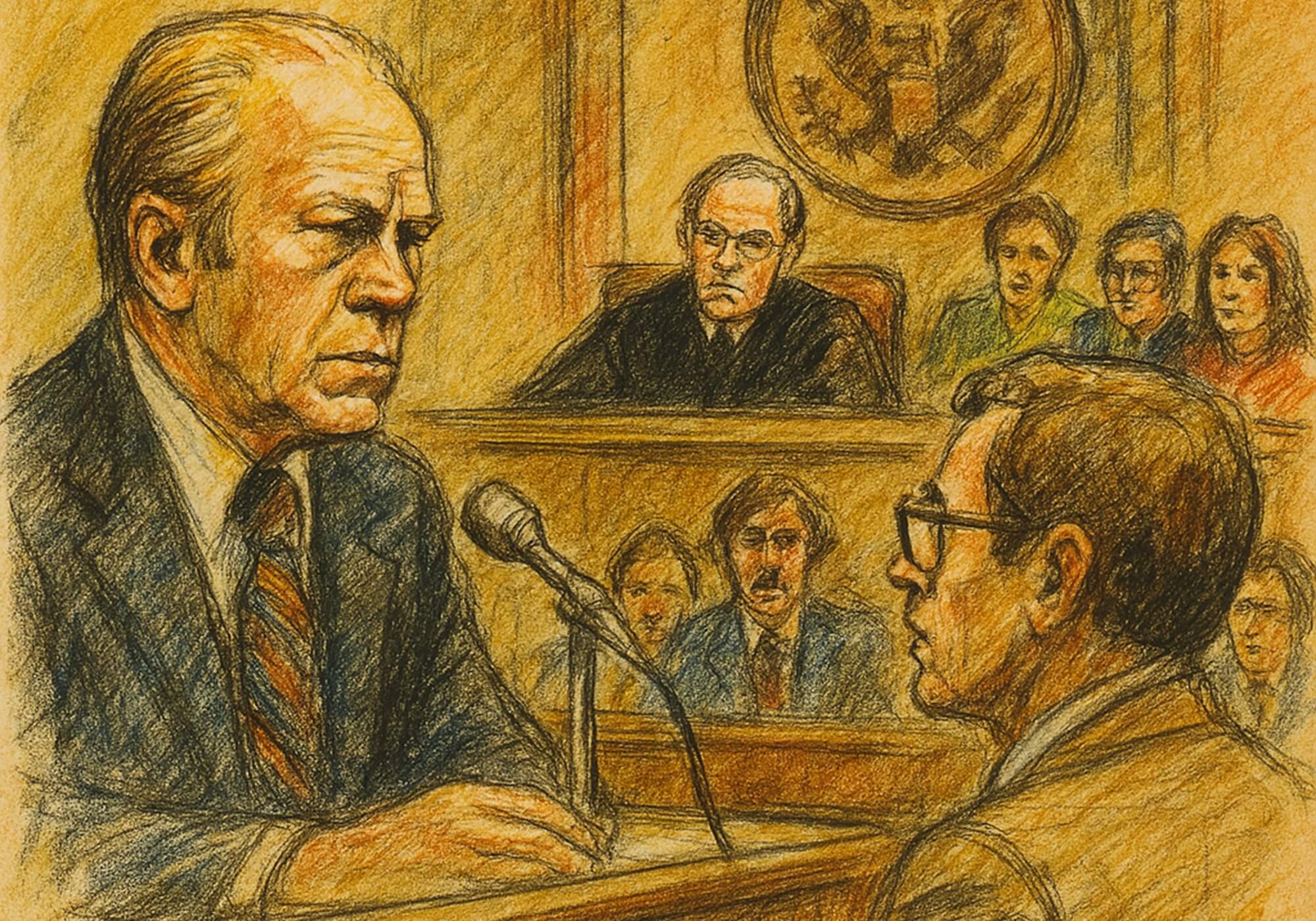
Strap yourselves in, kiddies. This edition of History’s Mysteries makes Perry Mason, L.A. Law and Boston Legal look like a Charlie Brown special.
History’s Mysteries: What is Golf City, Inc. v. Wilson, et al all about?
Today’s golf retail landscape is pretty straightforward. Golf Galaxy or PGA TOUR Superstore can sell you anything OEMs make. As the song says, if you got the money, honey, they got the time.
You youngsters out there need to know: It wasn’t always this way.
In the early 1900s, golf equipment was hand-made by club professionals. It was slow, tedious work. By the 1920s, companies such as Spalding, MacGregor and Wilson changed everything by mass-producing top-quality clubs.

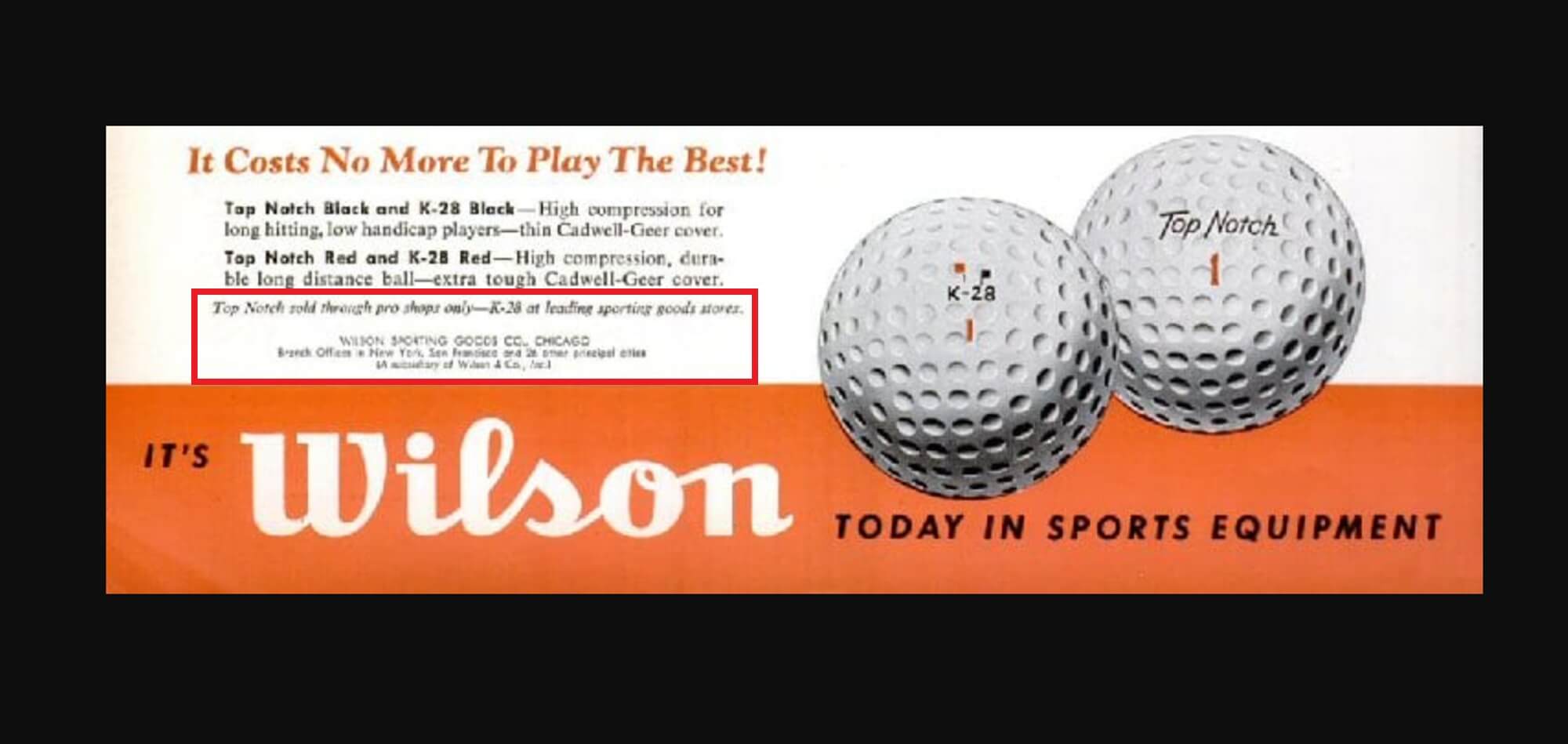
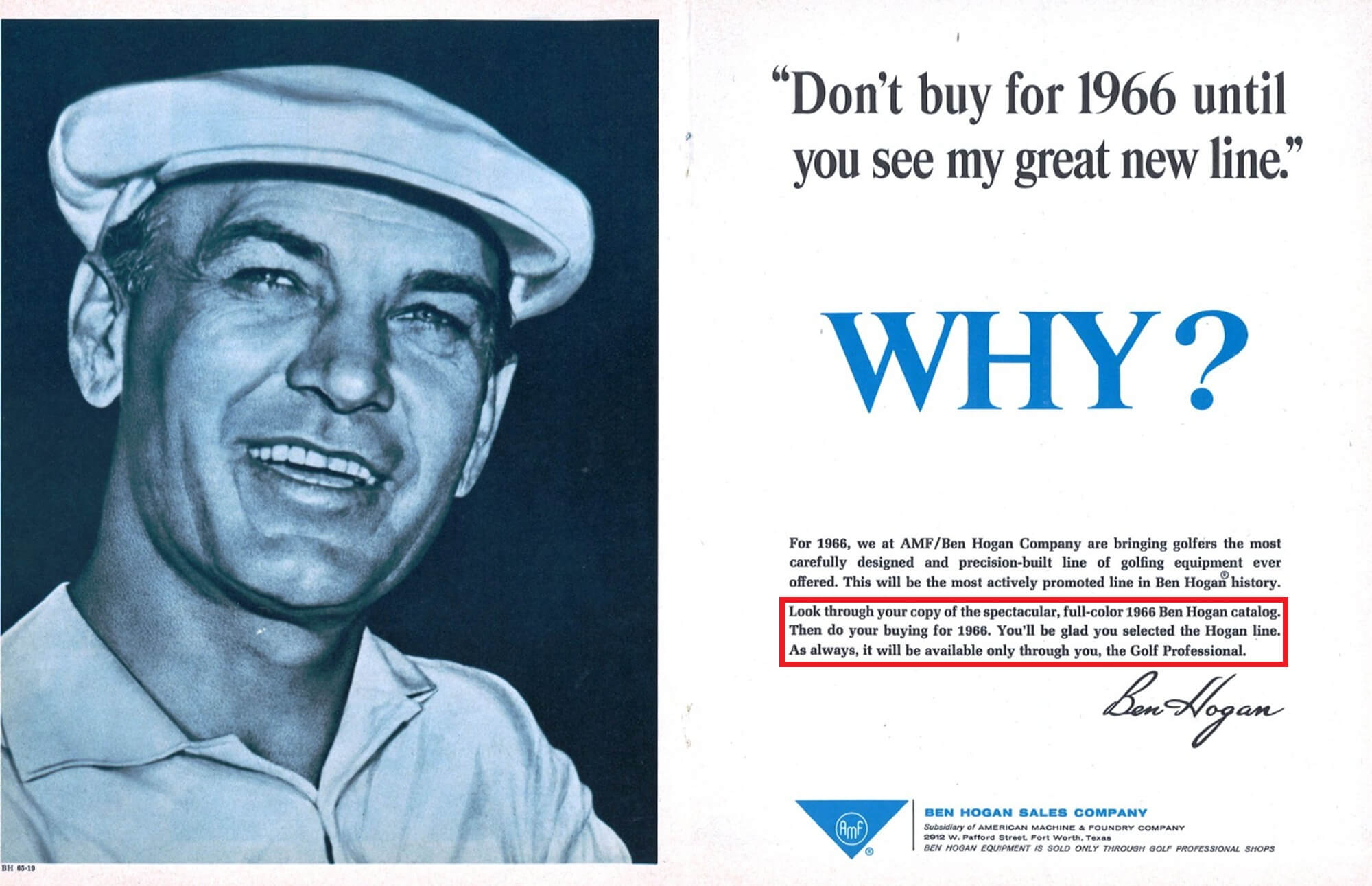
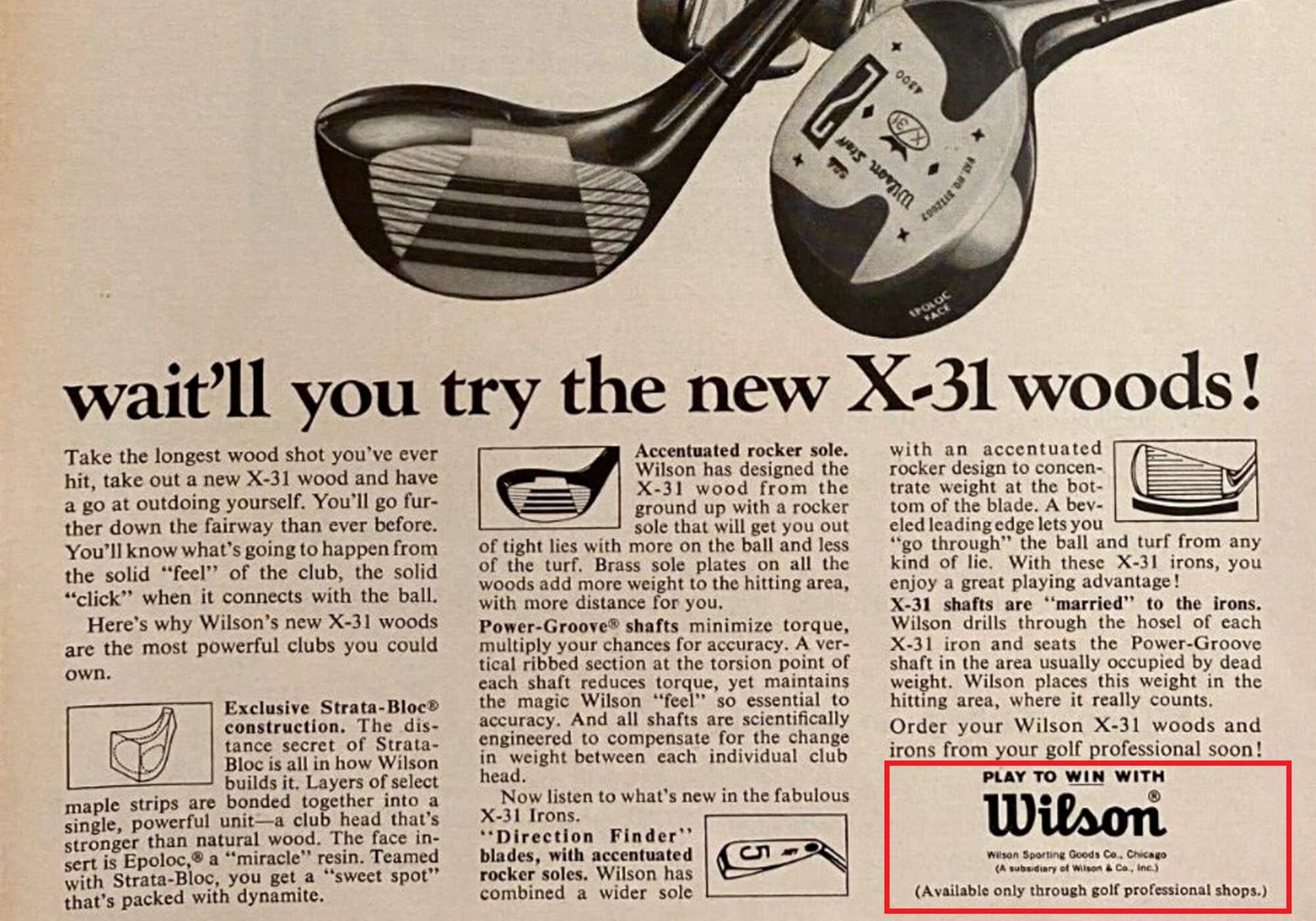
That, however, was an existential threat to club pros and their livelihood. Knowing they needed club pros on their side, manufacturers started making “pro-line” equipment specifically for club pros to sell. They would formalize the arrangement with a “pro-only” policy. Top-quality pro-line equipment would only be sold through golf professionals at their pro shops, while “store-line” equipment would be sold through sporting goods outlets and department stores.
This model stayed in place into the 1960s because it worked well for everyone. Until it didn’t. That’s when a market downturn, “bootlegging,” and an aggressive retailer who wouldn’t take no for an answer brought the system down for good.
That retailer was James “Buddy” Orange, a former Volkswagen executive turned golf entrepreneur. His store, the New Orleans-based Golf City, wanted to sell pro-line equipment. When the OEMs told him no, Buddy lawyered up.
The swingin’ ‘60s weren’t so swingin’ for golf
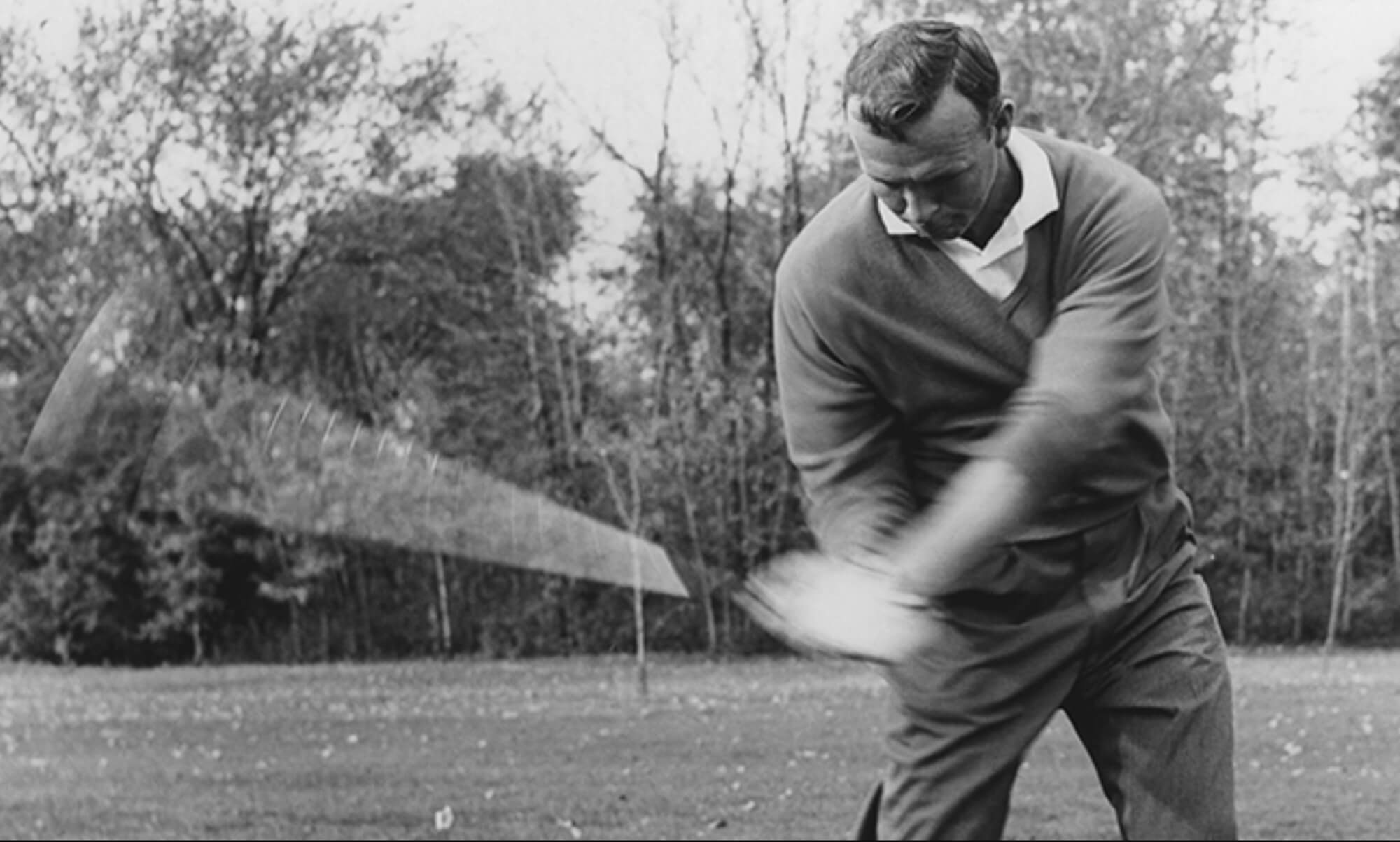
Golf was hot as the 1960s began. Arnie was the King, Jack was trying to take his crown and Gary Player was there to keep them both honest. Golf course construction was peaking. Nearly 300 courses opened in the U.S. in 1964, another 346 a year later. Golf equipment sales in 1965 topped $140 million ($1.4 billion today), a 9.3-percent increase over the previous year.
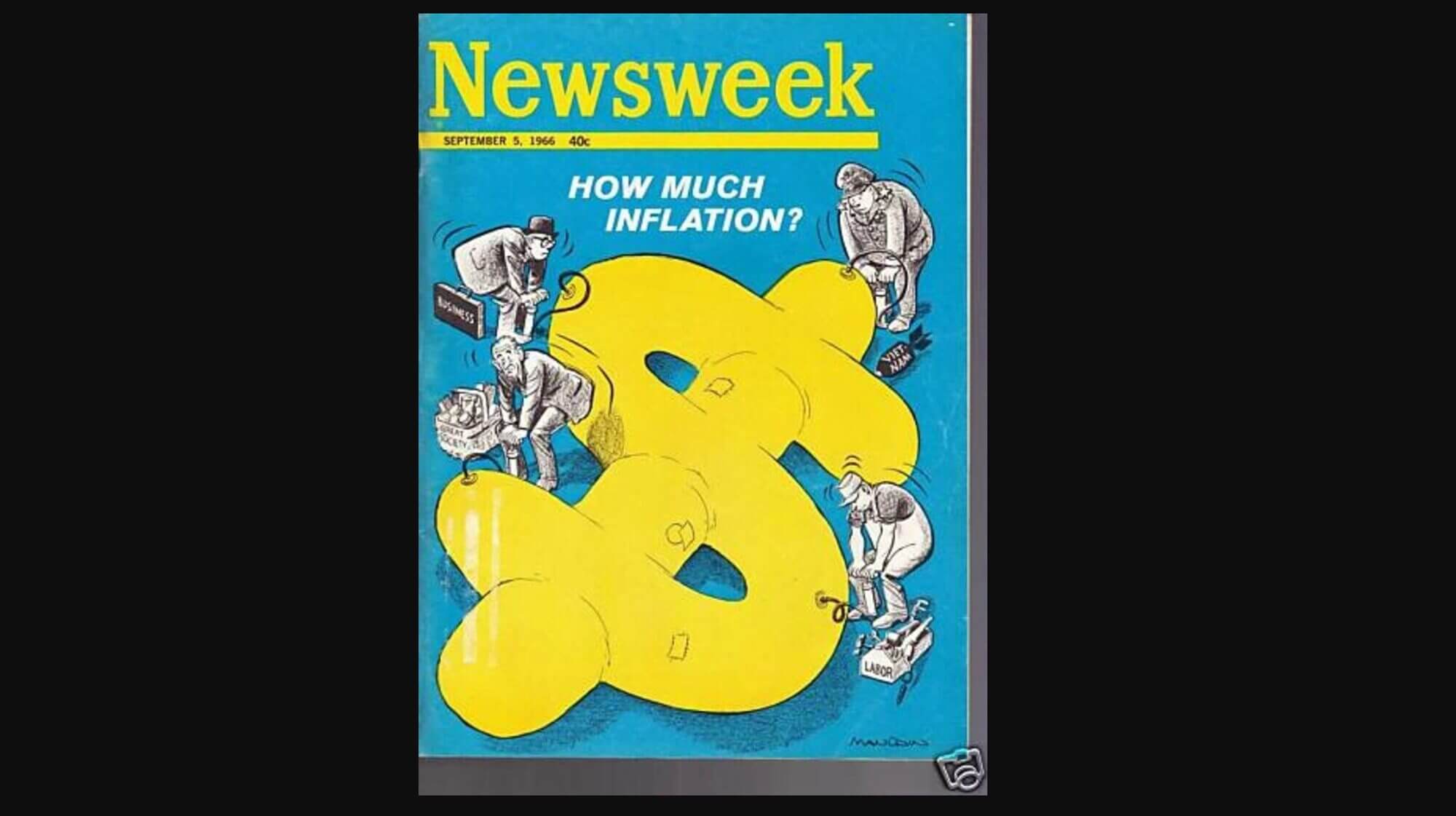
You could excuse golf manufacturers for getting a bit giddy. Everything said the gravy train they’d been riding would keep rolling, so they ramped up production. The times, however, were a-changin. In 1966, the S&P 500 dropped 22 percent, which led to a credit crunch. Inflation followed, with the Consumer Price Index rising by over 23 percent by 1969 alone.
To make matters worse, the influx of new, young golfers slowed considerably. Hippies, it seemed, would rather make love, not birdies.
This glut of equipment, combined with tightening credit, rising prices and fewer new customers soon put PGA professionals in a bind. Their pro shops were filled with pro-line equipment but no one was buying it.
To get themselves out of their financial jam, many pros turned to “bootlegging.” They would quietly sell leftover inventory under the table to golf specialty retailers who’d been lusting after pro-line equipment for years. One of those retailers was a guy named Burt Dargie. By working with “bootleggers,” Dargie filled his store in Memphis with pro-only gear, which he sold at bargain prices.
That caught the attention of Burt’s good friend, Buddy Orange.
Buddy Orange, Golf City and the Sherman Antitrust Act
In early 1969, Buddy turned his enthusiasm for golf into a business, as he opened Golf City in New Orleans. Buddy bought his initial inventory from his pal Burt. In court, Buddy testified that he modeled Golf City after Burt’s store in Memphis, including large display areas, club fitting services and a full repair facility.
Buddy wanted to include pro-line inventory from all the major OEMs, but was politely told no. He could have the store-line equipment, but pro-line was strictly pro-only. After being stonewalled at every turn, Buddy filed an antitrust lawsuit that December against a who’s who of golf manufacturers.
Defendants included Wilson, Spalding, Acushnet, Dunlop, MacGregor, Ram, PowerBilt, Ben Hogan, Northwestern, Royal Golf and others. For good measure, the suit also named the PGA of America as a co-conspirator.
According to Buddy, it was a conspiracy. Golf City’s legal team claimed the defendants conspired to prevent legitimate golf retailers from accessing pro-line gear. The suit alleged the conspiracy was “designed to exclude from the market direct competitors of some members of the conspiracy.” That, they claimed, was a restraint of trade and in direct violation of Section One of the Sherman Antitrust Act.
The key to Golf City’s complaint was the golf industry’s reaction to the bootlegging problem. During the discovery process, Golf City obtained documents from the PGA outlining its efforts to stop its members from bootlegging pro-line equipment. Those documents showed the PGA worked in cooperation with manufacturers to end the practice.
A “win” for Golf City
The court case went on for a full five years. During the proceedings, Wilson testified its pro-only policy had been in place since 1930, and that pro-only gear was sold “only to pro shops at outdoor golf courses or driving ranges.” Additionally, the court learned that OEMs would advertise pro-line gear heavily in golf magazines and that those ads clearly stated the gear was available only through golf professionals.
Store-line gear received comparatively little direct advertising from the manufacturers.
Also during the trial, the plaintiffs said manufacturers were initially enthusiastic when Orange first contacted them about his plans for Golf City. Until, of course, they weren’t. Wilson, being the lead defendant in the case, said pro-only policies were adopted by each manufacturer unilaterally. They also claimed pro-only was an effective form of non-price competition, as golfers liked to purchase prestigious golf equipment that was available only through pro shops.
As the trial wore on, something unusual happened. Every manufacturer except for Wilson eventually settled with Golf City and was released from the lawsuit. To get out, those companies paid Golf City cash totaling $127,000 (nearly $1 million today) and agreed to sell Golf City their pro-line equipment.
By the time February 1975 rolled around, only Wilson and the PGA of America were left in the lawsuit. That’s when District Judge James Comiskey issued his ruling in favor of Golf City, saying there was, in fact, a conspiracy.
In May, Comiskey awarded Golf City treble damages, interest and attorney’s fees.
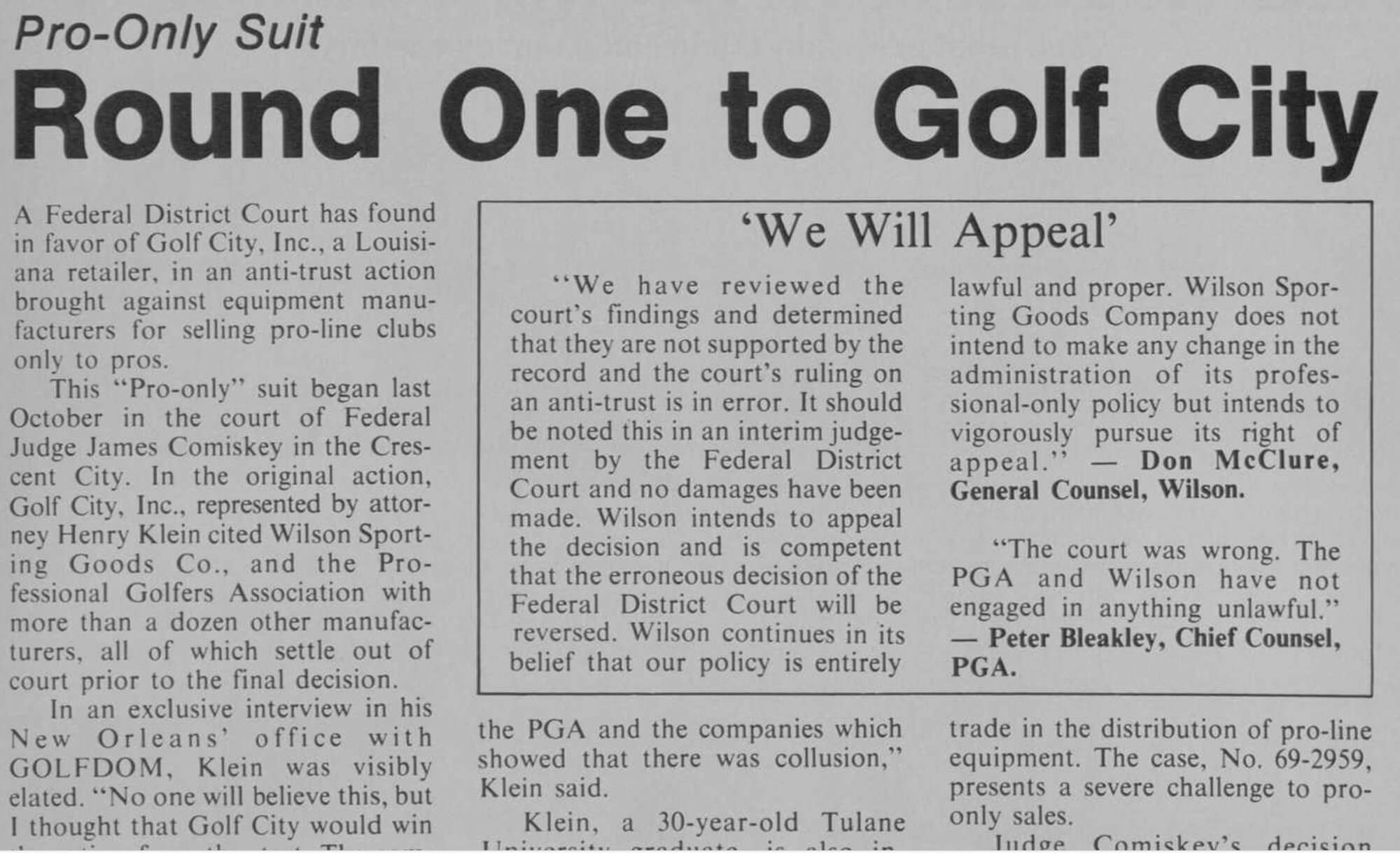
“Upon further review …”
As you’d expect, Buddy was thrilled with Judge Comisky’s decision.
“After five years with this thing, I’m obviously very happy,” he told Golfdom Magazine. “We feel we are in a fair and competitive market now and we never meant to shoot at the pros in the action. We feel we’re just as qualified as the pros to fit clubs.”
“The companies based their defense on the fact that they arrived at their marketing philosophies separately and there was no hint of communication or consultation between them,” said Golf City attorney Henry Klein. “We disproved that theory by producing correspondence between the PGA and the companies, which showed there was collusion.”
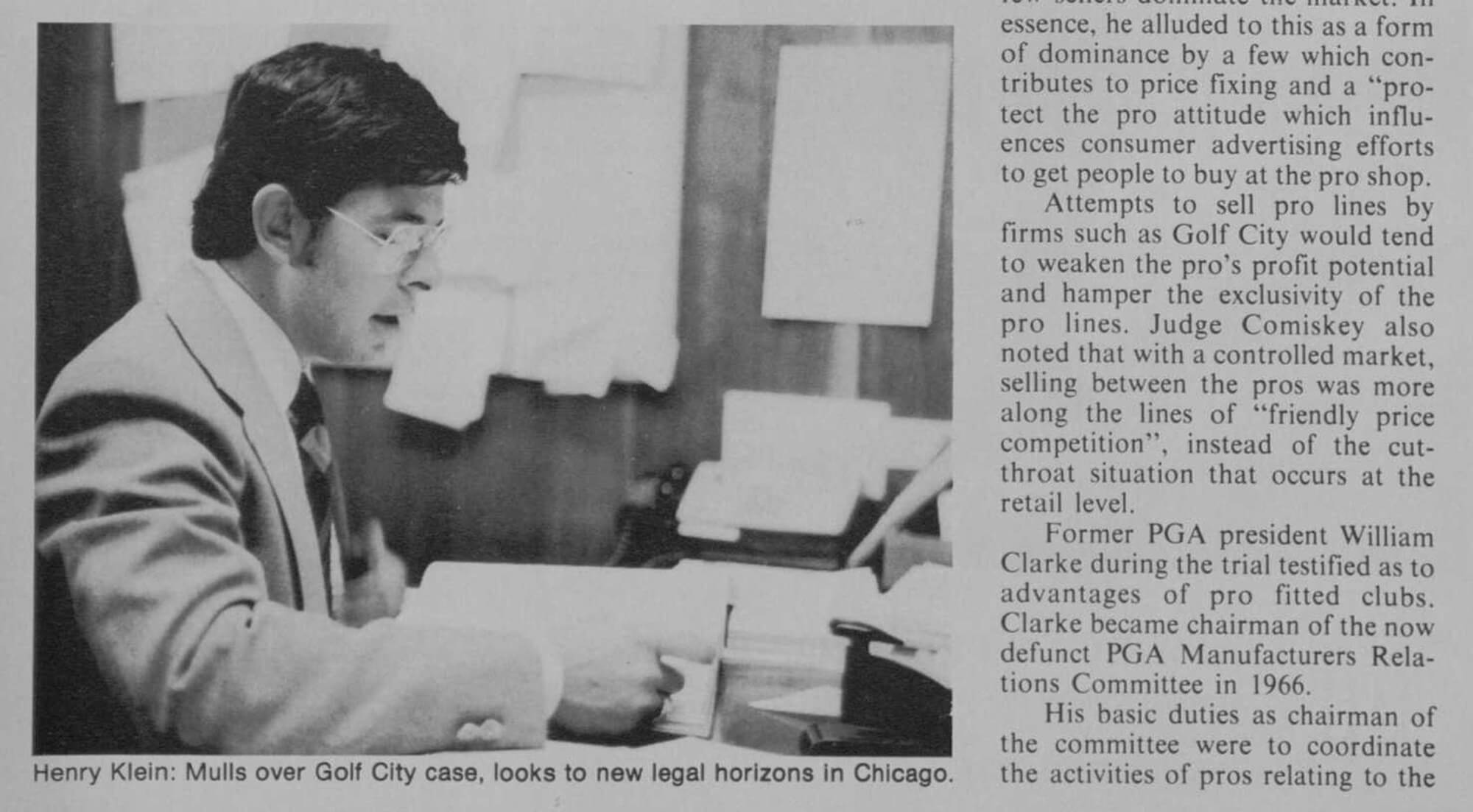
That proof, however, would not hold up.
Wilson and the PGA of America appealed. Two years later, in July of 1977, the Fifth Circuit Court of Appeals found the lower court failed to address key defense evidence and was “unclear” in how it concluded the PGA and Wilson were liable for restraint of trade.
In remanding the case back to the district court, the appeals court dismissed the PGA of America from the suit, saying it didn’t do enough business in Louisiana to be held liable. It also ruled that documents showing the PGA and manufacturers had worked together to stop bootlegging did not prove they had also conspired to prevent Golf City from selling pro-line equipment.
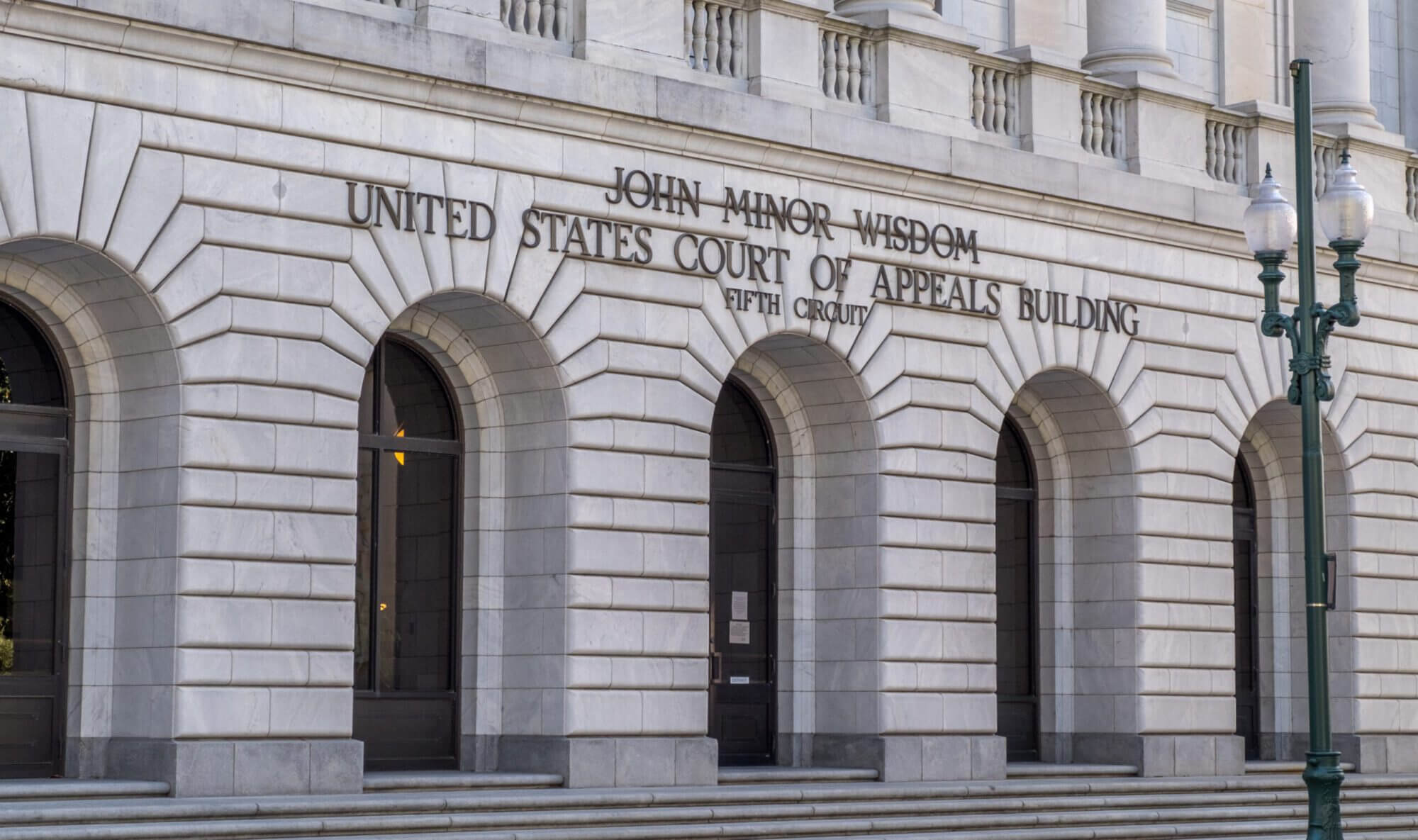
Additionally, it also ruled that pro-only policies did not constitute restraint of trade, provided that each company arrived at those policies independently. “The law does not prohibit independent business actions and decisions,” the court wrote. “A person still has the right not to do business with another, provided he acts independently and not unlawfully.”
The “Litigation Tango” and its fallout
It’s widely considered that Golf City “won” its case against the golf industry, opening the floodgates for retailers to start selling pro-line equipment. In fact, in the wake of Golf City’s initial win, several similar lawsuits were filed in Buffalo, Kansas City and, most notably, Wilson’s hometown of Chicago. Klein joined the legal team for each case.
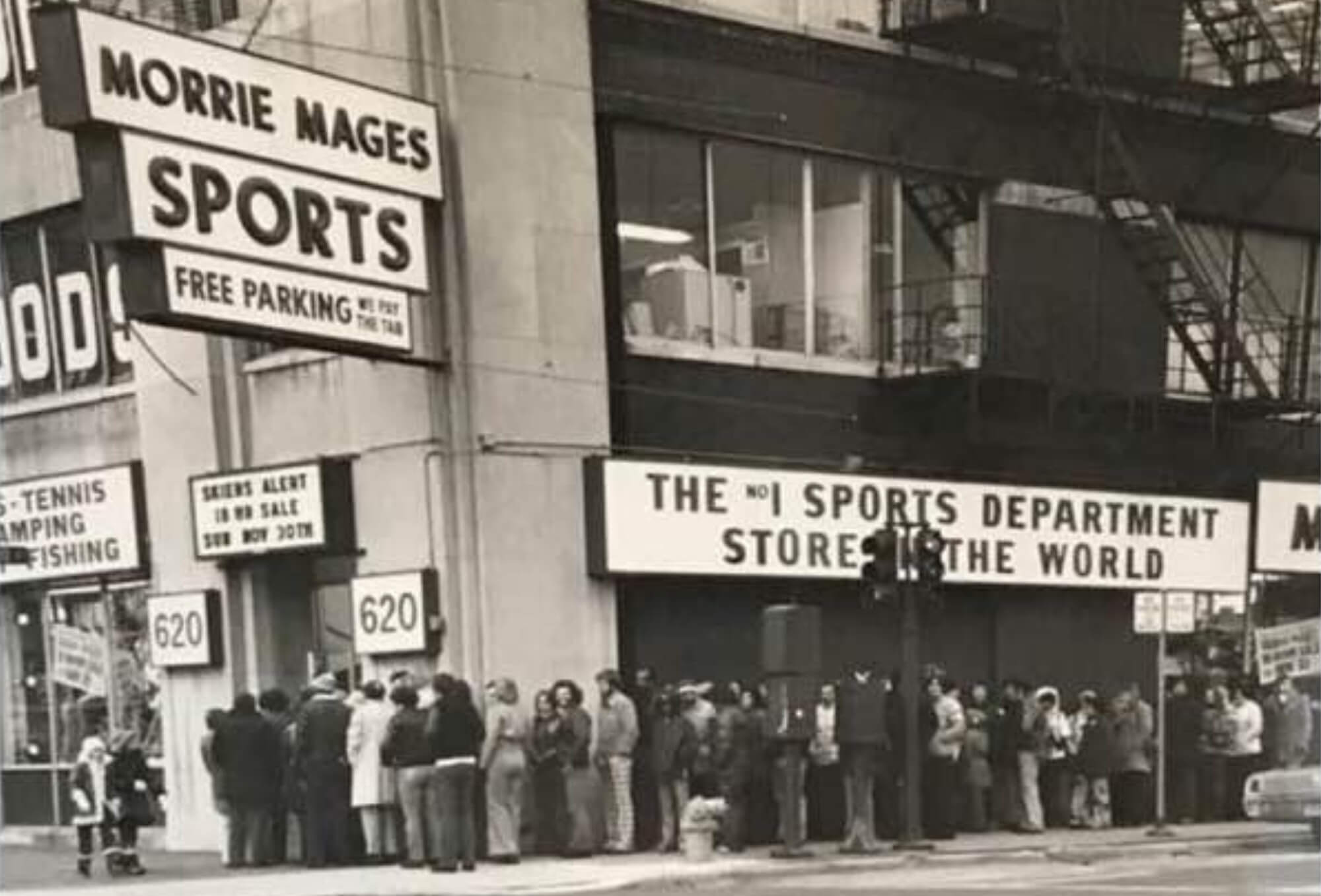
The Buffalo and Kansas City lawsuits were thrown out of court due to a lack of evidence. The Chicago case did go to trial, but a six-person jury ruled in favor of the manufacturers, concluding that their pro-only policies were not in violation of antitrust laws. However, as with the Golf City case, several of the manufacturers exited the suit before the trial, agreeing to sell pro-line merchandise to the plaintiff, Morrie Mages Sports.
The Golf City case was returned to the district court in New Orleans, but there’s no public record of what happened. In all likelihood, either Wilson and Golf City settled or Golf City, figuring it had already gotten most of what it wanted, simply withdrew the case.
So why, in the wake of all these court decisions supporting pro-only policies, is the Golf City case so important? Golf companies are in the business of making golf clubs, not fighting legal battles in court. Time, energy, effort and money spent in court is time, energy, effort and money not spent on business.
Additionally, all of those OEMs that settled early with Golf City and Morrie Mages agreed to sell both retailers their pro-line equipment. When the district court finally did rule in Golf City’s favor, the pro-line spigot was officially open. Even the appeals court ruling two years later couldn’t put the genie back in the bottle.
History’s Mysteries postscript: The evolution of retail
Wilson felt vindicated by the court of appeals ruling and by the Chicago victory. Still, the handwriting was on the wall. With most of its competitors already selling pro-line equipment to golf specialty retailers, Wilson had no choice but to give up the fight and adapt.
By the mid-1980s, pro-only policies had largely disappeared. In turn, retailers did what they do best and seized the opportunity. Golf Headquarters was founded when 10 independent golf retailers joined forces to form the National Golf Buyers Association. Nevada Bob’s may have started in the ‘70s, but it began franchising in the mid-‘80s. In its heyday, Nevada Bob’s would reach 77 stores across the U.S. and Canada before going under in 2022. Pro Golf Discount expanded significantly in the ‘80s, particularly in the Pacific Northwest. Its model, which would be copied, was high-volume sales at discount pricing that undercut pro shops.

In the mid-’90s, Golfsmith evolved from a catalog business into a retail monster. It would ultimately have over 100 stores in 20 states. Golf Galaxy opened for business in 1997. In 2004, Martin’s Golf and Tennis Superstore of Myrtle Beach was rebranded as PGA TOUR Superstore. Six years later, Home Depot co-founder Arthur Blank bought it and has since expanded to 77 stores in 28 states, with plans to exceed 100 locations by 2027.
All of it, however, was started by one guy, Buddy Orange, who didn’t like being told no.
Buddy’s original Golf City closed for good over a decade ago, ironically due to increased competition from big-box golf retailers and online equipment sellers.
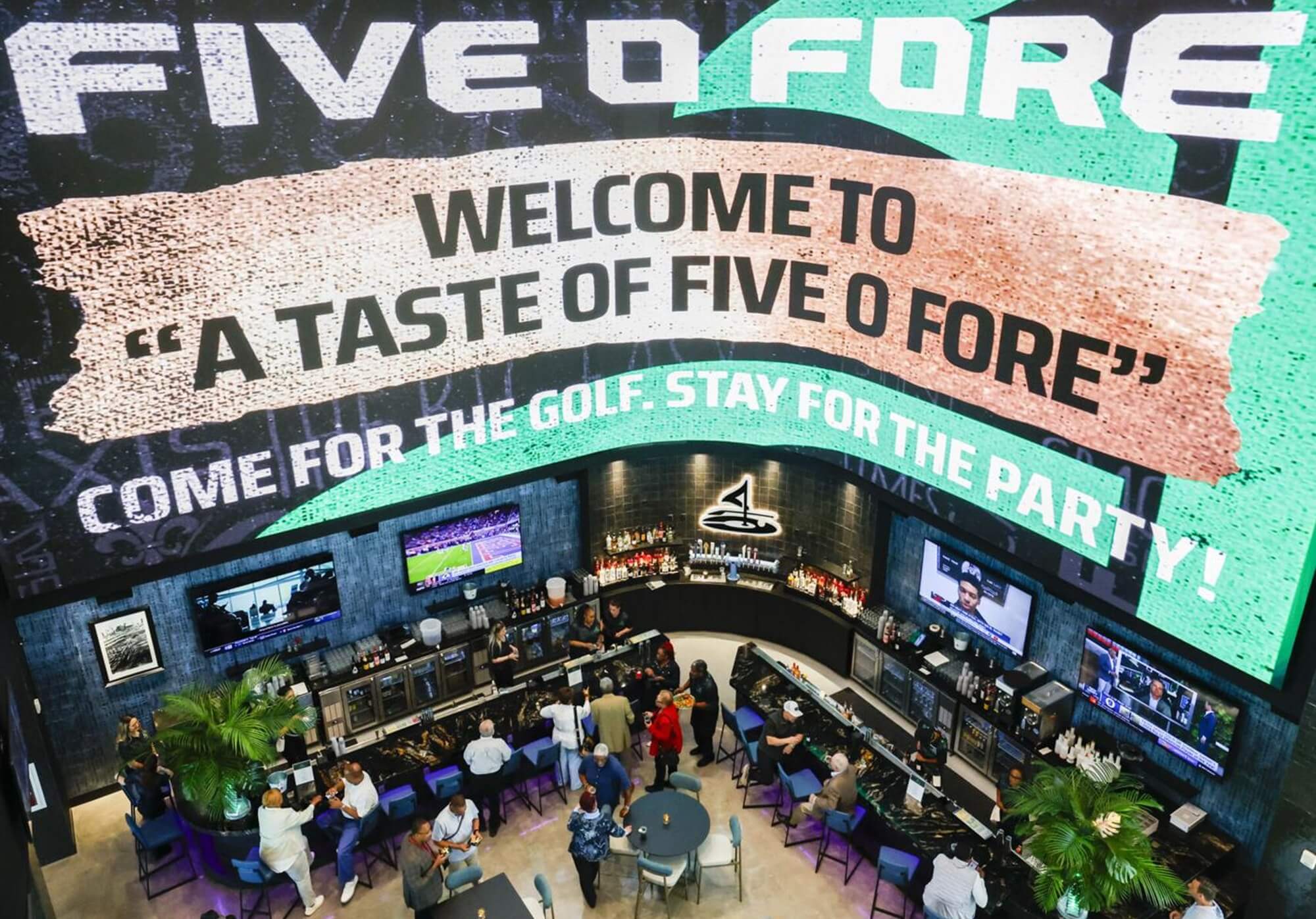
A Topgolf copycat, the Cajun-infused Five O Fore Golf + Entertainment, now resides where Golf City once stood.
Thanks for reading History’s Mysteries
We hope you enjoyed this little piece of time travel. Connecting dots and providing perspective is what we do here at History’s Mysteries, so the next time you visit your favorite golf store, do us a favor: wear something Orange and give a nod to Buddy.








Joseph Parent
1 year ago
Really enjoyed this article. Love the history and it brings back tons of memories. My first round of golf was in 1969 and I’ve been playing steadily since then. It also made me think about how many different sets of clubs I’ve owned over the years.