



Welcome back, MyGolfSpy compatriots, to another edition of History’s Mysteries. Submitted for your approval is a Twilight Zone-worthy tale of an underfunded golf brand with a unique, patented technology. It was rescued by an entrepreneur with deep pockets, big dreams and high hopes, only to crash and burn three years later.
That brand is back with putters that surprised us all in this year’s MyGolfSpy testing.
This, friends, is the story of TearDrop Putters.

History’s Mysteries: TearDrop Putters
The science of putting hasn’t changed much over the generations. You roll a round ball into a round hole on flat ground with a flat stick. It’s a simple task but, every year, someone tries to invent a better tool for the job.
There have been putters that look like birdhouses, hammers, xylophones and even the Starship Enterprise. For every PING Anser, Odyssey 2-Ball or TaylorMade Spider, there are thousands more that make you wonder if the designer could pass a drug test.

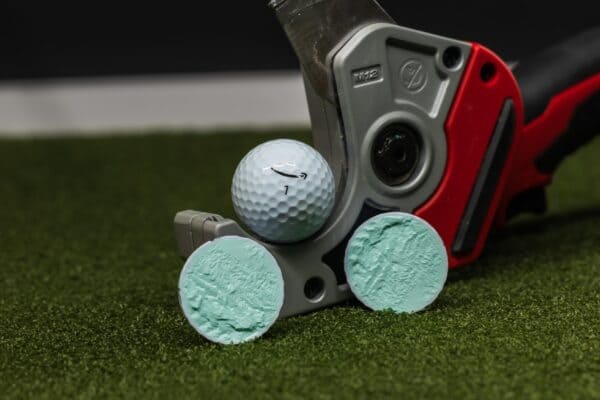
Fred Hochman’s TearDrop putter with its patented rolled face was somewhere in the middle. It may have been a one-hit wonder but that face smacked the putter establishment right in the kisser.
Hochman founded TearDrop in 1992 in Hilton Head, S.C. He believed a rounded face would reduce, if not prevent, bouncing and skidding just after impact. The result would be a smoother, more accurate roll.
A year later, Hochman had seven different rolled-face models in his stable and was gaining traction at the pro level. A growing legion of players on the PGA, Senior and NIKE tours were gaming TearDrops, even though Hochman couldn’t pay them. By 1995, just three years after the company’s founding, TearDrop ranked in the top 10 in victories across all tours.

TearDrop was also establishing a beachhead with consumers. Sales for the fledgling company reached $780,000 in ’94 and topped $1 million in ’95. The bottom-line ink, however, was a deep, dark red.
Hochman was running out of money and needed a white knight.
Boy, did he get one.
Meet Rudy Slucker, Entrepreneur
Rudy Slucker was, in 1995, a very rich man.
He was also a very bored man. As fate would have it, he was also Hochman’s neighbor.
Slucker’s story began in 1974 at the age of 24. Fresh out of college, Slucker went to work for the Atlas Group, a New Jersey-based importer/distributor of hardware and hand tools. Hardware suited Slucker and he rose to the point where he’d buy the company outright. Under his guidance, sales grew from $1.2 million in ’74 to over $50 million by 1987.

Slucker was the quintessential wheeler-dealer. He would buy and sell businesses seemingly at whim. Over the years, he owned New York’s Beach Theatre, various food chains and fitness clubs and even a few minor-league baseball and hockey teams.
Slucker made so much money that in 1990, at age 40, he sold his interests in Atlas and retired to Hilton Head. It was there he took up golf and became fast friends with Hochman.
By 1996, however, Hochman was in trouble. TearDrop was suffering from the fast-growth blues. Even though sales topped $1 million, the company found itself $1.5 million in debt trying to finance that growth. Hochman needed cash or he’d have to shut down.
Fortunately, he knew a guy.

Slucker had already invested in TearDrop. When Hochman told him what he was up against, the Jersey wheeler-dealer didn’t hesitate.
“It didn’t take me long to tell Fred I would buy,” Slucker told Interview magazine. “I thought I could make something out of it. And, besides, I needed something to do.”
TearDrop takes off
Slucker didn’t waste time. He pumped $1 million into TearDrop in September 1996. That December, he launched an IPO that raised another $5.5 million. Slucker used that money to pay off TearDrop’s debt and to fund an ambitious turnaround strategy.
The mid-1990s were a tumultuous era in golf equipment. By 1996, Callaway, TaylorMade, COBRA and PING controlled 75 percent of the market. Callaway was a $600-million monster while Acushnet bought COBRA for an astounding $700 million. Weeks later, investment giant KKR bought Spalding for an even more astounding $1 billion.

The overall market, however, was relatively flat. While the Big Four grew, industry stalwarts Wilson, MacGregor, Ram and Hogan went backward. Lynx was teetering and even an all-star ownership group featuring Fred Couples, Jim Nantz, Jack Nicholson, Clint Eastwood and Sean Connery couldn’t save it from bankruptcy.
Against that backdrop, Slucker set about building a brand.
He started with TearDrop infomercials featuring PGA Tour pro Bret Ogle and baseball Hall of Famer Jim Palmer. Next was TearDrop Putt of the Week on Golf Channel, a showcase of the best putts across all golf tours. The brand building was working, as Q1 1997 sales more than doubled. Brand building, however, isn’t cheap. Despite the huge jump in sales, Q1 losses approached $700,000, nearly triple that of the year before.

Undeterred, Slucker kept pushing. TearDrop sponsored several regional and developmental golf tours. In September, he bought Golf Promotions, LLC, which owned and promoted tours across North America.
That, however, was child’s play compared with what was coming.
The spending spree continues
By 1997, Tommy Armour was reeling. Its iconic 845s irons were a tremendous success but the company never did come up with a worthy successor. Additionally, Tommy Armour had been bought and sold three times since the 845s release and was coming off a monumental flop, the Ti-100 irons.

Owner U.S. Industries was two years into its stewardship and was already looking to get out. It first sold off Odyssey putters to Callaway for $130 million, hoping Callaway would take Tommy Armour as part of the deal. Callaway politely declined. By early November, ownership let it be known Tommy Armour could be had for the best reasonable offer.
Two weeks later, Slucker pounced, buying the brand for $25 million.
He wasn’t finished.
Two weeks after buying Tommy Armour, Slucker bought another Chicago-based icon, Ram Golf, from the Hansberger brothers for $10 million in cash and stock.

Slucker’s new companies were certainly prestigious. They were also on shaky ground, losing $40 million combined in 1996. Slucker’s confidence, however, never wavered.
“I bought two companies with great names but that have been hammered to death,” Slucker told the Chicago Tribune. “They don’t think I can get it done. Well, those people don’t know me. I wouldn’t be in it if I didn’t think I could get it done.”
In its analysis, the Tribune put it bluntly. “Either Slucker will splash down faster than a skulled 7-iron into a pond, or he’ll change the face of the golf industry. He doesn’t want any in-between.”

Ely Callaway was even more blunt.
“If he can do something with those companies, more power to him. But neither of them has done it up to now.”
“Movin’ on up ….”
Slucker kept the pace up in 1998. He first consolidated his new TearDrop empire at the Tommy Armour headquarters in Morton Grove, Ill., and then signed major winners Steve Jones and Fred Couples to endorsement deals. He tried to buy Lynx out of bankruptcy that year but his cash and stock offer was bested by Golfsmith’s $11-million cash bid.

The Slucker magic appeared to be working. TearDrop posted its first-ever profitable quarter in Q1, with sales of $25 million. Wall Street was impressed, too. TearDrop stock soared by 500 percent as Slucker kept wheeling and dealing. He bought more mini-tours and became the exclusive North American distributor for Genuin Golf, a high-end European shoe and apparel brand.
Late in ’98, he would sign a landmark deal with Value America to become the first major brand to sell its clubs on this new global phenomenon called “the internet.”
By the fiscal year-end, TearDrop topped $60 million in sales, fueled by the Ram and Tommy Armour acquisitions. Overall, however, the golf industry was sluggish in 1998 and nearly 25 percent of TearDrop’s growth came at discounted prices through Sam’s Club stores. Despite top-line growth, the bottom line was still red, with losses reported at $43 million.

Despite that, Slucker was predicting growth and profitability for 1999. That year, the annual Robb Report “Best Of” issue named TearDrop the best putter and Genuin the best golf footwear. On the surface, all the right ingredients were in place. However, despite market share success (fourth in putters, fifth in irons), TearDrop remained highly leveraged.
In short, TearDrop was a house of cards.
Lonely teardrops …
Slucker predicted $90 million in sales for 1999. By mid-year, however, he was forced to revise that projection to $65 million to $70 million. Wall Street hates downward projections and the market reacted predictably, with stock prices taking a tumble. TearDrop needed cash and that fall secured $30 million worth of credit from Textron, the owner of E-Z-GO golf carts.
“The year 2000 has the potential to be our breakout year,” the ever-optimistic Slucker proclaimed at the time. In reality, TearDrop was rearranging the proverbial deck chairs on the Titanic.

Sluggish sales prompted management to make a series of bad decisions, which only pushed TearDrop further into a death spiral. The company slashed R&D and marketing costs while cutting selling prices to make top-line sales look better. In any business, that’s a bad combination.
By the fall of 2000, Crain’s Chicago Business Review issued a dire warning. “The company is highly leveraged now in an extremely competitive industry. It can’t afford to have too many things to go wrong … they’re walking a tightrope.”
Slucker may have been a business daredevil but he was no Flying Wallenda. TearDrop stock, which once peaked at over $14, was now worth nine cents per share. The tightrope was getting slipperier.

Companies can survive slumps but when falling gross margins combine with increasing sales volumes, it’s time to circle the wagons. Losing money on each product you sell is bad. Cutting the price to sell more only makes things worse. Losses go into overdrive and you simply run out of cash.
Slucker fell off the tightrope and his house of cards finally collapsed in December 2000 when TearDrop filed for bankruptcy.
Gen-X and the ownership follies
Earlier that fall, Slucker had a white knight of his own on the line. Gen-X, a Canadian scooter and snowboard company, signed a letter of intent to buy Teardrop in October. However, it withdrew the offer after TearDrop reported horrendous Q3 financials. Gen-X saw the Chapter 11 handwriting on the wall and figured it could scoop up TearDrop for pennies on the dollar soon enough.
Which is exactly what happened.

While other suitors (Golfsmith, Adams) wanted parts of the now-bankrupt TearDrop carcass, Gen-X was willing to buy the whole thing. For $18 million, it picked up all $ 31 million worth of TearDrop’s assets while staying clear of its debts and liens.
For his part, Slucker netted enough cash to pay off his personal loan guarantees. Other creditors, however, were left high and dry. Among those hardest hit were Fred Couples (for product endorsements), Pebble Beach, True Temper, Forbes magazine and The New York Times.
TearDrop employees were the biggest losers. Most were laid off and their retirement plans were filled with now worthless TearDrop stock.

Gen-X had no background in golf but it made a really smart first move. It teamed with Ralph Maltby and Golfworks to design and build new clubs, specifically a new line of Tommy Armour 845s irons.
It worked. 2002 was another flat year for golf but the Gen-X golf division posted a remarkable 40-percent increase in sales, following a year in which the entire company posted a $5.5 million profit. Therefore it was a bit of a surprise when Gen-X sold out that summer to Huffy, the Ohio-based bicycle and sporting goods company, for $19 million in cash and five million shares of stock. This was only 18 months after buying TearDrop out of bankruptcy for $18 million.
What on earth was Huffy thinking?
Unfortunately for TearDrop, Huffy was a financial disaster area in 2002. Leadership clearly thought buying Gen-X was a good idea, but in retrospect, it’s hard to fathom. Huffy posted a $1.4 million loss in 2002, followed by a $7.3 loss a year later. The ship was sinking in 2004. That March Huffy sold its Gen-X acquisition, except for the golf division, back to the original Gen-X ownership. Layoffs soon followed, and that summer Huffy stock prices bottomed out at 59 cents per share. By the fall, Huffy filed for Chapter 11.

A new, leaner Huffy emerged from bankruptcy a year later with a court-ordered reorganization plan. That plan included selling off the golf division by 2007. That January, Hilco Consumer Capital Group, which already owned lost brands such as Halston, Linens ‘n Things and Polaroid, took over the TearDrop stable. It immediately entered into an exclusive retail deal with sporting goods giant Sports Authority.
In 2010, Sports Authority bought the brands outright. They remained low-quality store brands until March 2016 when Sports Authority filed for bankruptcy.
Three months later, DICK’S bought all of Sports Authority’s brands and intellectual property, including TearDrop, Ram, Zebra and Tommy Armour, for $15 million.

DICK’S turned Tommy Armour into its store brand soon after. By 2020, DICK’S sold the TearDrop, Ram, Zebra and the newly acquired MacGregor brands to Nevada golf entrepreneur Simon Millington.
Millington immediately put plans in motion to bring each brand back. Those plans were completed this spring, with TearDrop’s return to the putter market.
History’s Mysteries: A postscript
Millington tells MyGolfSpy that, before relaunching TearDrop, he wanted to make sure his team understood what that patented Roll-Face Technology could do.
“We started by buying as many of the original models as we could. We tested them to see if the rolled face genuinely did skid less and if top spin did get on the ball quicker. Our tests showed it absolutely did.”

Millington collaborated with renowned putter designer Austie Rollinson on the new TearDrops. Rollinson had spent the previous two decades with Odyssey and worked with Millington on several products before taking his current position as Senior Director of Putter R&D at Acushnet.
The new TearDrop lineup features an Anser-style blade, a small rounded mallet and a larger, Spider-ish mallet. They’re multi-material (CNC-milled carbon steel and aluminum), with TearDrop’s classic rolled face. The TearDrop TD-1 blade finished tied for third in performance from five feet and seventh overall in this year’s MyGolfSpy testing. It beat out entries from TaylorMade, Mizuno, Scotty Cameron and PING.

TearDrop’s Roll-Face technology is still based on Hochman’s patent. It’s designed to create ideal launch and spin conditions and get the ball rolling forward quickly with as little skidding as possible. The result is a consistent roll regardless of where on the face you strike the ball.
Thirty years later, our testing shows Hochman’s one-hit wonder still rolls true.

We hope you enjoyed this edition of History’s Mysteries and we’d love to know: Did you ever game a TearDrop? Please share your memories below.



Rob
1 year ago
I just put an old (circa 2005) Tear Drop TD31 putter back in the bag and had 2 of my best putting rounds ever back to back. Made me wonder why I ever gave it up in the first place.