


I’m going to do this a few times at different price points so bear with me. I’m starting at $100 because, to me, it’s the most basic level and that feels like the right place to begin.
Do I think $100 is going to completely change your game? Probably not. But there are some smart ways to spend it that can make a real difference. Small steps, but they add up.
Here are seven options for how I would spend the money.
1. Take a lesson
If you can find the right teacher and show up ready to get something out of it, a $100 lesson is well worth your time. Ask around and go in with one or two specific things you want to work on instead of “fix everything.”
Prices vary depending on where you live. If the only place around you charges that much for a half-hour, that’s fine. A focused 30 minutes with a good instructor beats a month of guessing on the range.
2. The basics refresh
Find a dozen golf balls designed for your game. The right ball for your swing speed and short game can help more than you’d expect. Add some practice time at the range and a new glove and you’ve got a simple package that makes every round feel a little better.
Use the MyGolfSpy Golf Ball Selector to compare 48 golf balls using data from our 2026 robot test. Filter by swing speed and see how each ball performs from driver to wedge to find the best fit for your game.

3. The home training setup
I like the Divot Board Mini as a training aid because it keeps you swinging at home and lets you check your low point control, one of the most important things in ball striking.
I’d pair it with Ben Hogan’s book, “Five Lessons: The Modern Fundamentals of Golf.” Taking the time to read and understand the game, combined with the ability to check your low point (and keep you swinging) at home, is a great combination.
4. Get in better golf shape
Spend $100 on a few free weights or a medicine ball and a stretch band and then go find a workout online. There are plenty of free ones on YouTube so you don’t need to pay for a program.
I recently started a program that isn’t golf-specific and I’ve gained distance and consistency just from getting into better shape. There’s a correlation between being in good physical shape and playing better golf, especially as you come down the stretch.
5. Build a short-game setup at home
I hate cheap putting mats so I wouldn’t go that route. The roll is never true and I don’t feel like they help enough to justify the price. Instead, I’d get a putting stroke trainer like the Putt Mirror to check your alignment and path and then add a net you can chip into to work on distance control. You can use both indoors or in the backyard and get some extra practice in when you can’t be at the course.
6. Start tracking your game
Download a shot-tracking app, free if you can, as long as it has Strokes Gained. Use it for a few rounds and learn from it. It will show you where you’re losing shots so when you have your next $100 to spend on getting better, you’ll know exactly where it should go. This is the best way to get some direction into what causes you to shoot the scores you shoot. Most amateurs think they need practice on the short game or putting and find out it’s a 140-yard shot or an approach on a par-5 that is putting them in a bad position.
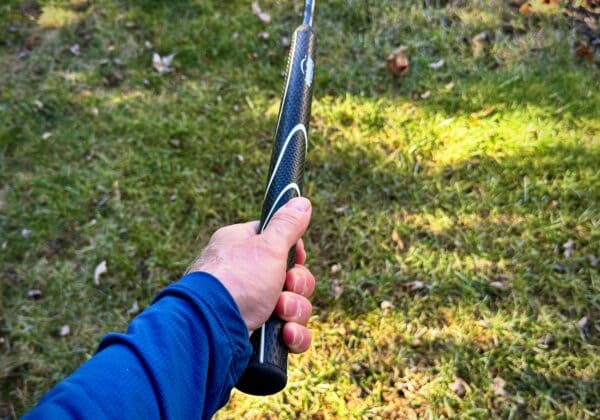
7. Regrip your clubs
If you do it yourself, you can regrip a set for close to $100, sometimes considerably less. New grips give you more confidence in your swing and a little more traction in your hands. It doesn’t sound like much but it matters. When you let your grips get slippery, it can cause you to grip the club tighter than necessary and create problems when you practice.
Where I’d start
If you’re not sure where your game needs work, take the lesson. If you play a lot and already know what you need, put in some time on the range and regrip your clubs.
Next up, I’ll look at what to do with a bigger budget. Stay tuned.





mg
58 seconds ago
Regrouping makes clubs feel like new.
mg
4 seconds ago
Gripping.