



A lot of golfers know their swing speed. Far fewer know their ball speed, the number that gives you a better indication of how far a shot can go.
The examples below are modeled scenarios provided by GOLFJOY to show how ball speed works. They aren’t measured averages for all golfers.
Ball speed versus swing speed
Swing speed (or club speed) is how fast the clubhead is moving at impact. Ball speed is how fast the ball is moving right after it leaves the face. The link between them is smash factor which is how much ball speed you get for every mph of club speed.
Ball speed = club speed × smash factor
Take two golfers with the same 100-mph driver swing. Golfer A has a 1.40 smash factor and a 140-mph ball speed. Golfer B has a 1.48 smash factor and a 148-mph ball speed. Golfer B gets eight mph more without swinging any faster because more of the swing’s energy is transferred to the ball.
A few things decide how much.
- The club itself. Face design and construction differ from club to club which can move smash factor even when the swing is the same.
- Where the ball hits the face. Strikes near the center are the most efficient. Hits toward the heel, toe, top or bottom of the face lose ball speed.
- The loft at impact. The loft the club has when it meets the ball, which can differ from the loft printed on the club, changes how much energy goes into the ball.
- The golf ball. Firmer, higher-compression balls generally produce more driver ball speed than softer ones. In MyGolfSpy’s 2025 Golf Ball Test, the gap between the fastest and slowest ball was about six mph for faster swingers, four mph for mid-speed golfers and two mph for slower swingers.
How much ball speed should you have by club?
Ball speed drops as you move down the bag. Clubs get shorter so you swing them slower and they get more lofted which lowers smash factor. Ball speed also depends on how fast you swing so the chart groups golfers by driver swing speed.
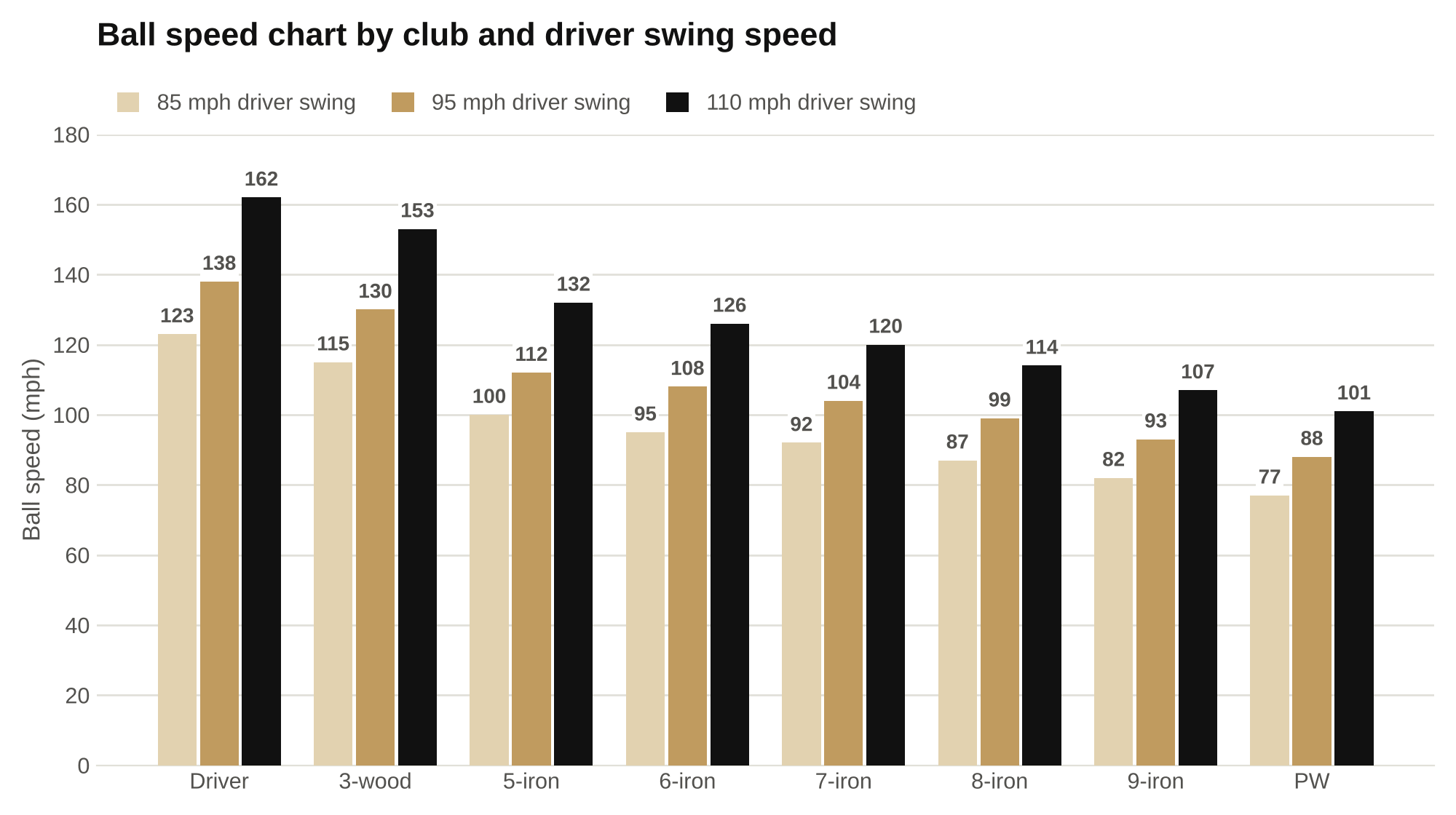
Find your driver swing speed and read across. At a 95-mph driver swing, for example, you’d see about 138 mph of ball speed with the driver, 104 mph with a 7-iron and 88 mph with a pitching wedge. A faster swinger will produce more ball speed but that doesn’t always make them the better ball striker. They simply swing faster.
How much does smash factor impact ball speed?
The fairest way to judge your ball speed is against your own swing speed. Divide ball speed by club speed and you have your smash factor. With a driver, close to 1.50 is about as efficient as it gets.
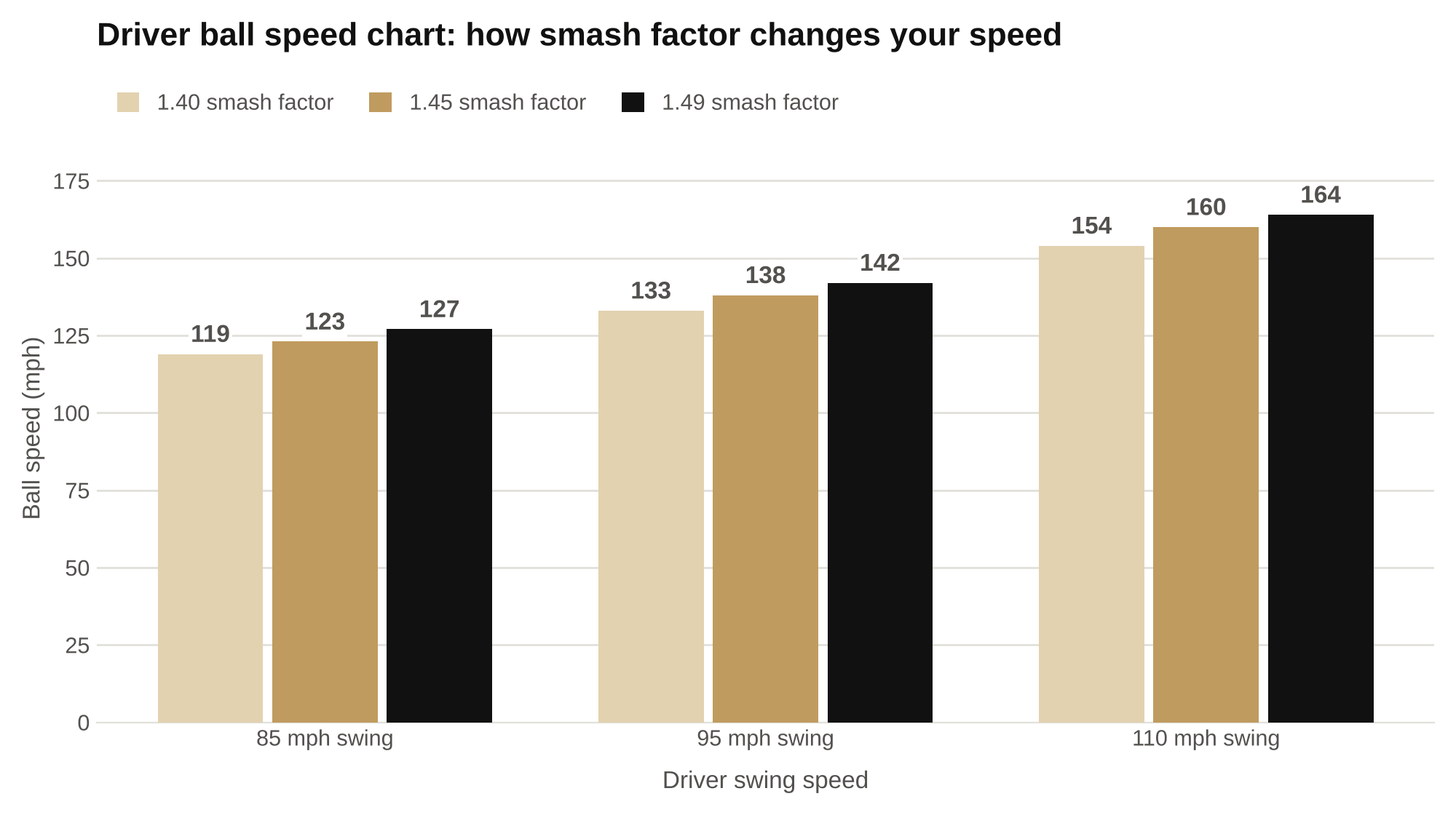
At a 95-mph swing, going from a 1.40 to a 1.49 smash factor raises ball speed from about 133 to 142 mph, nearly nine mph more without swinging any faster.
How to measure your ball speed
You can’t feel ball speed so the only reliable way to know your number is a launch monitor. Accuracy matters because smash factor depends on two measurements: club speed and ball speed. If either one is off, your smash factor is off, too. The gap between a 1.40 and a 1.49 is only about nine mph so a few mph of error can hide it.
Hit a full session and look at your average, not your best, shot.
GOLFJOY’s Spica 3 measures 27 data points on every shot including club speed and ball speed. Their overhead monitors go further with up to 42 on the Rigel 3 Pro, adding details like face angle, face-to-path and dynamic loft.
The benefit of knowing your ball speed and smash factor is understanding how much more efficient your golf swing could be. If your driver smash factor is already close to 1.50, there isn’t much more to gain from better contact so extra ball speed has to come from swing speed.







Leave A Reply