


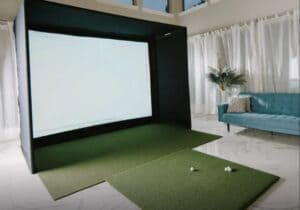
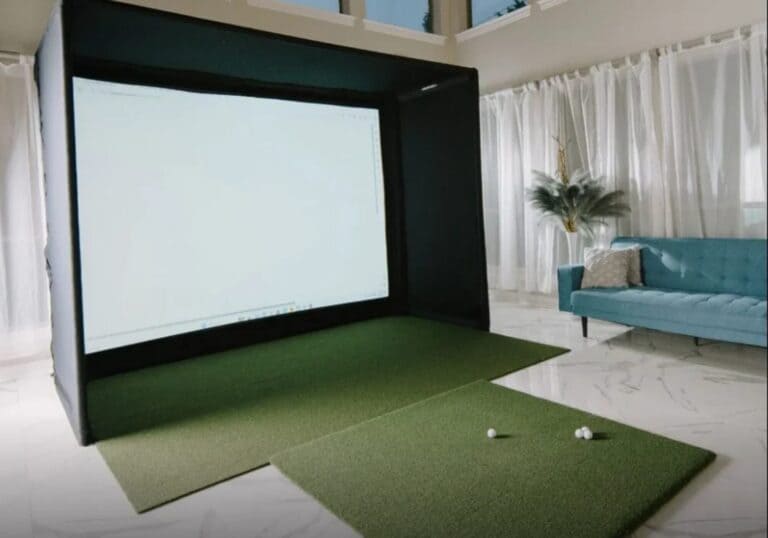
I’d love to put a golf simulator in my garage but with two kids and a husband, the lawnmower, tools, fishing poles, golf clubs, bicycles and the car take up most of the space. There might be more to it than that, though. I’ve always wondered if I could somehow make it work based on the actual dimensions of the garage.
If you’re in the same mental space and thinking this might be what your home needs, I put this guide together with the help of Indoor Golf Shop. It should give you all the details you need to figure out whether you have enough space to build a golf simulator.
The first thing to understand right off the bat is that this isn’t just about how high the room is. There’s more to it than that.
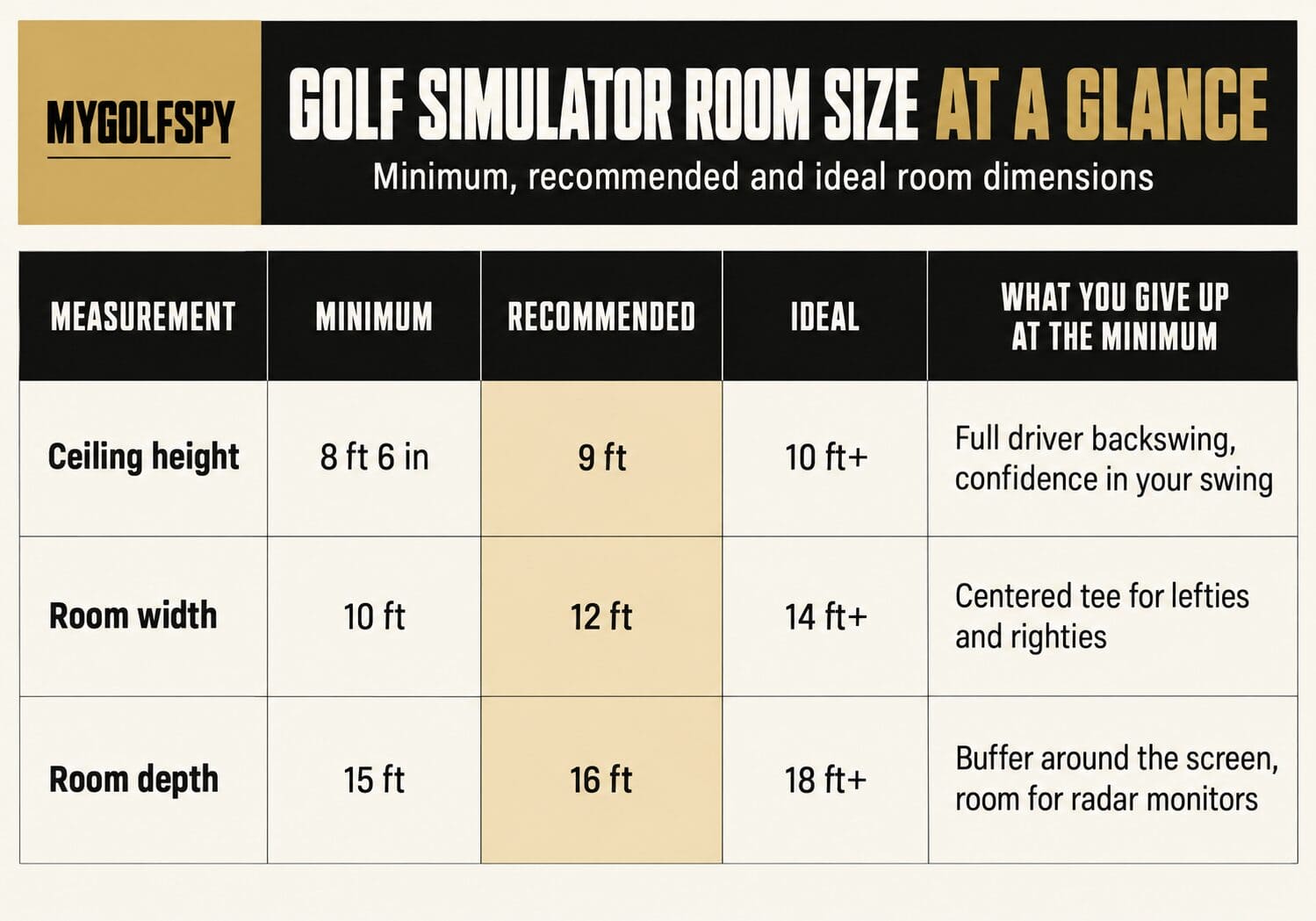
These numbers are your starting point but there is more to it. Here are the other questions you’ll have to work through.
- Where will the simulator go?
- How high is your ceiling, and how high does your swing need it to be?
- Which launch monitor will you use?
- How deep is your room?
- How wide is your room, and who will be swinging?
- Will you use a projector and screen, or just a net?
Where will the simulator go?
Most golfers build in a garage, a basement or a spare bedroom. Garages usually offer plenty of depth and height but door tracks, door openers and a parked car can get in the way. Basements are private and easy to light but low ceilings, ductwork and support columns are common. Spare bedrooms are easy to climate control yet they’re often too short front to back for a radar launch monitor.
| Space | Where it tends to work | Where it tends to fail |
|---|---|---|
| Garage | Plenty of depth and height, easy to leave set up | Door tracks and openers in the swing zone, temperature swings, parking |
| Basement | Dedicated and out of sight, easy to control lighting | Low ceilings, ductwork, beams and columns |
| Spare bedroom | Easy to climate control | Often too shallow for radar and ceilings can be tight |
How high is your ceiling and how high does your swing need it to be?
I’m short and that helped me as a kid when I set up a hitting station in my parents’ garage for the winter. It was freezing but there was no snow and I had a net, a mat and Ben Hogan’s Five Lessons: The Modern Fundamentals of Golf with me plus about two inches of clearance. I’d like a little more if I ever did that setup again.
It took me a little while to fully trust swinging back because of the ceiling height. Unless you have ample room, don’t even try it because you will restrict your swing.
The easiest way to find out is the driver test. Stand on a hitting mat, which lifts you an inch or two, and make your fullest backswing with your longest club. Have someone mark the highest point the clubhead reaches, then add six inches. That’s the ceiling height you need.
| Ceiling height | What to expect |
|---|---|
| Under 8 ft | Irons and wedges only for most golfers. Not recommended |
| 8 ft to 8 ft 6 in | Workable but many golfers hold back their driver swing without realizing it |
| 9 ft | The sweet spot with full swings for most heights |
| 10 ft+ | Best for tall golfers, big backswings and ceiling-mounted monitors |
If you plan to use a ceiling-mounted launch monitor, check its mounting height, too. Uneekor, for example, recommends mounting its QED sensor nine to 10.5 feet off the floor.
If the height you need is more than the height you measured, stop here and look at another room. No launch monitor or enclosure will fix a ceiling that’s too low.
Which launch monitor will you use?
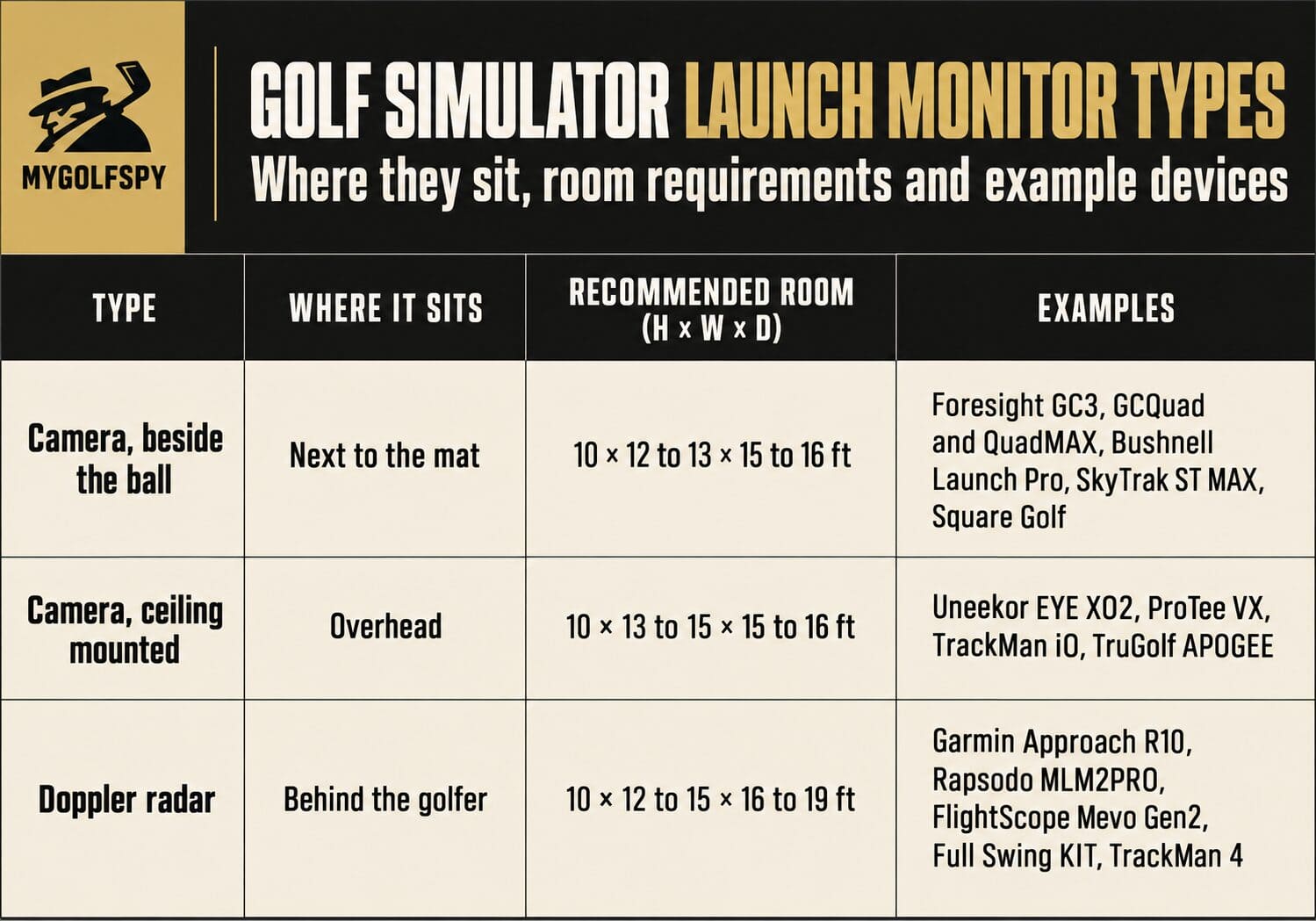
You have options now when it comes to launch monitor types and mounting and that can make it easier to fit a simulator into your space. Camera units that sit beside the ball need very little depth, ceiling-mounted systems free up floor space but want a wider room and radar units sit behind you and need the most room of the three.
Radar units need about eight feet of ball flight and sit seven to nine feet behind you which makes them the hardest to fit in a short room. Camera-based units are the easy answer for tight garages and spare bedrooms. Always check the spec sheet for the exact model you plan to buy because positioning rules vary by manufacturer.
How deep is your room?
Depth is one that I think most people don’t consider enough and it plays a big part in the accuracy you’ll get from your launch monitor, especially with radar. Eighteen feet is ideal and 15 feet is the realistic floor.
| Zone | Typical distance |
|---|---|
| Impact screen to back wall | 12 to 16 in |
| Screen to ball (ball flight) | 10 to 12 ft |
| Swing space behind the ball | About 7 ft |
| Total room depth | About 18 to 20 ft for a fully comfortable setup |
Your launch monitor then sets the minimum you can get away with. Take the depth you measured and compare it with your answer to the previous question.
| Monitor type | Minimum depth | Comfortable depth |
|---|---|---|
| Camera, beside the ball | 15 ft | 16 ft |
| Camera, ceiling mounted | 15 ft | 16 ft |
| Radar | 16 ft | 18 ft or more |
Many golfers make 15 feet work, although some manage with less, but squeezing below these numbers always costs you something. It might be the buffer behind the screen, your swing space or the gap between you and the screen. That last one is a safety issue because a fast shot that lands too close to the screen can bounce back at you.
Remember that depth also has to cover anything else you want in the room. A couch, a bar stool or a bench placed behind the hitting area adds to the total so decide on your seating before you settle on a plan.
How wide is your room and who will be swinging?
You need at least 10 feet of width and about 14 feet if you want one setup that works for both right- and left-handed golfers. In a narrow room, you can shift the hitting position toward one side so the open side has room to swing but that only works for one-handedness. In a wide room, the tee can sit in the center.
| Room width | Tee placement | Works for |
|---|---|---|
| 9 to 10 ft | Offset to one side | One-handedness, tight swing arc |
| 12 ft | Slightly off-center | One-handedness comfortably |
| 14 ft+ | Centered | Right- and left-handed golfers |
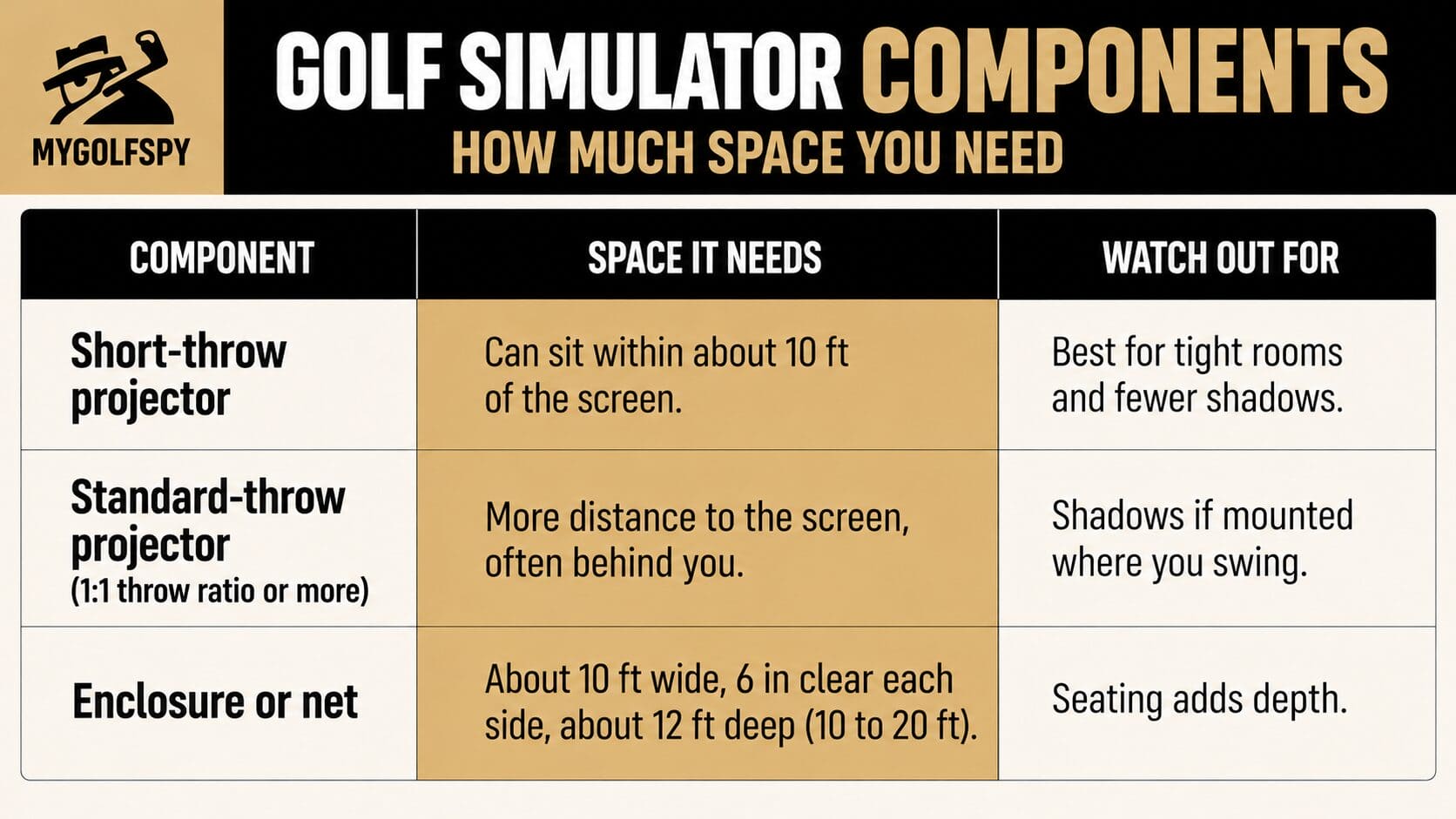
Your enclosure matters here, too. Most enclosures and nets are about 10 feet wide and need at least six inches of clearance on each side. If width is your main problem, compact options like the SIG8 are built for exactly this situation.
Will you use a projector and screen or just a net?
If you’re only hitting into a net, you can skip most of this section. A projector and impact screen add visuals but they also add a piece of equipment that needs its own space.
The key spec is the projector’s throw ratio. A short-throw projector can sit within about 10 feet of the screen and still fill it whether it’s mounted on the floor or the ceiling. A standard-throw projector (a throw ratio of 1:1 or more) needs to be farther back which often puts it behind you. That can cause shadows and eat into your depth which is why short-throw models are the popular choice for golf simulators.
Golf simulator space FAQ
What is the minimum room size for a golf simulator? Plan on at least 10 feet wide, 15 feet deep and 8.5 feet tall. Smaller rooms can work with camera-based launch monitors and shorter clubs but you’ll be compromising.
Can I build a golf simulator with an eight-foot ceiling? Yes, but expect to shorten your driver swing or leave the driver out. An eight-foot ceiling is the absolute minimum and nine feet is a far more comfortable target.
How deep does a golf simulator room need to be? Eighteen feet is ideal: about a foot behind the screen, 10 to 12 feet from the ball to the screen and seven feet behind you. Many golfers get by with 15 feet.
Do I need a wider room if I’m left-handed? Only if the tee needs to serve both hands. A single-handed setup can use an offset tee in a 10- to 12-foot room while a centered tee for everyone needs about 14 feet.
Do radar launch monitors need more space than camera-based ones? Yes. Radar units need about eight feet of ball flight and should sit seven to nine feet behind the golfer so plan on a room at least 16 feet deep and 18 feet or more for comfort. Camera-based units work with much less.
Can I put a golf simulator in a 10’×10′ room? The width works but 10 feet of depth is too short for a full-swing setup with a screen and a proper tee-to-screen distance. Look for another room or a rearranged space.
Where to shop and current offers
Once you know your room size, shopping gets a lot simpler. Indoor Golf Shop carries enclosures, hitting mats, nets, impact screens, projectors, launch monitors and full packages, and it offers custom design for rooms that don’t fit the standard. We have an exclusive discount code where you can use MGS5OFF for an extra five percent off SIGPRO products. In addition, Indoor Golf Shop is running a sale with up to 25 percent off select hitting strips, screens, nets and accessories through Dec. 14.








Leave A Reply