


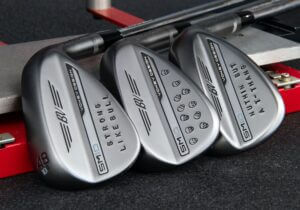

If you’re in the market for new wedges, here’s the good news. You’ve got a lot of options for wedge setups and we are here to help show you how to choose the right wedge lofts for your game!
Here’s the bad news. You’ve got a lot of options for wedge setup. You’ve got so many that it can be a little daunting and, in an era of loft-jacked irons, you can’t really grab the same old lofts off the rack you’ve always used and head for the course.
For instance, the new Vokey SM10 wedges will hit retail with 25 different loft, bounce and grind combinations. So, if you want to round out your bag with the best wedges for your game, whether full shots or chip shots, it’s time to bone up on how to pick the right ones.

Wedge Basics
Let’s start with the basics.
Wedges fall into one of four main categories: pitching wedge, gap wedge, sand wedge, lob wedge.
Pitching Wedge
A pitching wedge will normally range from 44 to 46 degrees and, as the name implies, it’s used primarily for shots requiring more distance than your other wedges.
And, I guess we might as well deal with this now: lofts on pitching wedges have been trending downward. In most cases, your pitching wedge comes as part of your iron set and the golfer who should ditch that set pitching wedge for a specialty one is a rarity. More on that later. (A specialty wedge refers to a wedge from a lineup of exclusively wedges. Think Titleist Vokey, PING Glide, Callaway JAWS, etc.)

Gap Wedge
Next up, the gap wedge: ranging from 48 to 52 degrees designed to bridge the gap (see what I did there?) between pitching wedge and sand wedge. In many cases, the gap wedge can also come as part of your iron set but this, for some, becomes the point where the set wedge takes a seat in favor of a specialty wedge. Making that determination usually boils down to a simple question: How will you use it? If you’re almost always hitting full-swing or three-quarter approach shots with your gap wedge, stick with the set wedge version. If you start getting cute with your greenside self with the gap wedge and need a more versatile club, perhaps it’s time to bag a specialty gap wedge.

Sand Wedge
Which brings us to the sand wedge. You guessed it. It’s primarily for use out of the sand. Sand-wedge loft will typically range between 52 and 56 degrees. There’s a lot more to picking out a sand wedge than loft, though, and don’t think they’re to be used exclusively for bunker shots.
Lob Wedge
Finally, the lob wedge, a 56- to 60-degree wedge designed to hit a ball very high and land soft. The lob wedge is often the go-to wedge around the green for chipping as well.
Maybe even too much of a go-to for some as reaching for a 60-degree wedge isn’t always a good thing. Especially for beginners. I digress.
Simple enough, right? Easy, golfer. You’re not quite ready to buy yet.
The Trouble With Lofts
Let’s go back to your pitching wedge. Whether a beginner or seasoned vet, you need to know the loft of that pitching wedge and how far you hit it. As a very general rule, you want four- to six-degree gaps between your wedges. More than that and you’ll have lots of difficult in-between club yardages on the course.
Suppose you’re a creature of habit who always goes for a 52-, 56- or 60-degree setup. When you upgrade your irons, there’s a good chance your pitching wedge loft increases from two to four degrees, depending on how old your old gamer is. Bagging that 52-degree wedge could put an eight-degree gap between your gap wedge and your set pitching wedge. See the problem?

Put away the pitchforks. You can rage on about the evils of loft-jacking somewhere else. It’s happened. Move on.
Where was I? Oh, yes, wedge gaps. Let me complicate it for you a little further.
Listed Loft Vs Actual Loft
All stamped wedge lofts, just like all wedges, are not the same and will not perform the same. Wedge companies use different materials. Some are forged, some are cast. Some use different groove patterns that spin the ball appreciably differently. Others locate the center of gravity differently. Most will likely use a different shaft with different swing weights that result in different swing speeds and different grinds that interact with the turf differently.
In fact, you’ll even find that if you measure matching lofts between competing wedge companies, you’ll find different lofts within a quarter of a degree or two of the stamped lofts.The point is, pick up a couple wedges with the same stamped lofts and you will hit them different distances, to different heights and with different spin.
This is especially true if you’ve opted to forgo a set gap wedge in favor of a specialty wedge. For example, a set gap wedge in the Titleist T150, T200 and T350 rings in at 48 degrees of loft. If you’re going to pass on that set wedge and instead drop in a 48-degree Vokey, you’re very likely to find the Vokey will spin more, probably fly higher, and travel shorter than the gap wedge you kicked to the curb.
That means that the very general rule I mentioned about four- to six-degree gaps is just that, very general. What you’re really after is appropriately gapped wedges based on real performance. Oh, and if you upgraded to any of those Titleist irons I mentioned from say, T400, your pitching wedge loft will be five degrees weaker than what you’re used to!
Know thy wedge loft and performance.

Get a Wedge Fitting
So how do you get those appropriately gapped wedges based on real performance?
If you’re going to dial in your golf wedges, get a wedge fitting. It’s the only way you are going to ensure you set composition is based on the distances you actually hit these all important golf clubs.
Let’s not forget there is a heck of a lot more that goes into your choices of wedges than loft. Bounce angle and sole grind are hugely important in determining the right wedges for your game. “Bounce” refers to the angle between the leading edge of the wedge and the lowest point of the sole. “Grind” describes how material is removed from the wedge at the toe or heel to shape the sole and manage turf interaction.
Wedge grinds arguably are more important in determining the launch window and distance you’ll hit a wedge on approach shots from fairways off tight lies and they’re equally impactful on your green-side chipping. In the bunker, whatever your sand wedge loft choice, you need the right bounce for the type of sand you’re playing in.
Come back as we review and test all the new wedge releases in 2024. With a little research and diligent testing, you’ll bag the right sticks that will have you attacking pins this year!
PS: Need some help determining which wedge is right for you? Check out our comprehensive Wedge buyer’s guide.








WiTerp
3 years ago
Wedges – and putters – are the most likely clubs that can impact one’s handicap. Many casual players only have one shot. Meanwhile, short/long rough, high lip bunkers, short side/long side, and various sand (…mud) conditions require specific shots using multiple clubs. Way too many variables to process outside of a fitting. One can even make an argument that 6 wedges need to be available to have the right wedges for different playing conditions. I swap 58 wedges (Vokey K & M grinds) based on dry fluffy sand or the almost mud of poor sand and damp conditions. Similarly, a 48 set W and a 50 degree wedge., I can mix and match these as well.