


Compact Versus Long Backswing: Which Suits Your Game?
Instruction

Compact Versus Long Backswing: Which Suits Your Game?

Support our Mission. We independently test each product we recommend. When you buy through our links, we may earn a commission.

Compact Versus Long Backswing: Which Suits Your Game?

I recently watched two students hit balls side by side on the range. One student, about an 8-handicap, made these beautiful, flowing swings that looked like they belonged on Golf Channel. Her backswing was long, graceful, and technically impressive. The other student, a 16-handicap, had this short, compact motion that barely got the club to parallel. Yet he was striping it down the middle while she sprayed balls all over the range.

“Why can’t I hit it like him?” she asked, frustrated after another slice sailed out of the range onto the adjacent ninth fairway.

This question represents everything wrong about how many recreational golfers think about swing mechanics. After 20-plus years of teaching, I’ve learned the “perfect” backswing doesn’t exist. What matters is finding the backswing length that matches your body, your timing and your natural tendencies.

Social media has made this obsession worse. Dramatic full swings get more views than efficient, compact motions. But here’s what I know: Some golfers will always play better with shorter swings while others need that full extension to generate power and maintain rhythm.

Why compact swings work

A shorter backswing offers immediate benefits most golfers ignore. Control becomes easier when you’re not trying to manage a club that travels past parallel. Your timing windows expand. You eliminate the positions where things typically go wrong.

I’ve watched countless students transform their games by shortening their backswings. My favorite example: a 68-year-old retiree who couldn’t break 90 despite decent fundamentals. His long, loose backswing created timing chaos—fat shots, thin shots, everything in between. We shortened his swing to three-quarters. His contact improved immediately. He lost maybe 10 yards of distance but gained 30 yards of accuracy.

“Compact” doesn’t mean restricted or tense. Look at Tony Finau and Jon Rahm. They generate tremendous power from relatively short positions. Their swings are compact but athletic, controlled but aggressive through impact.
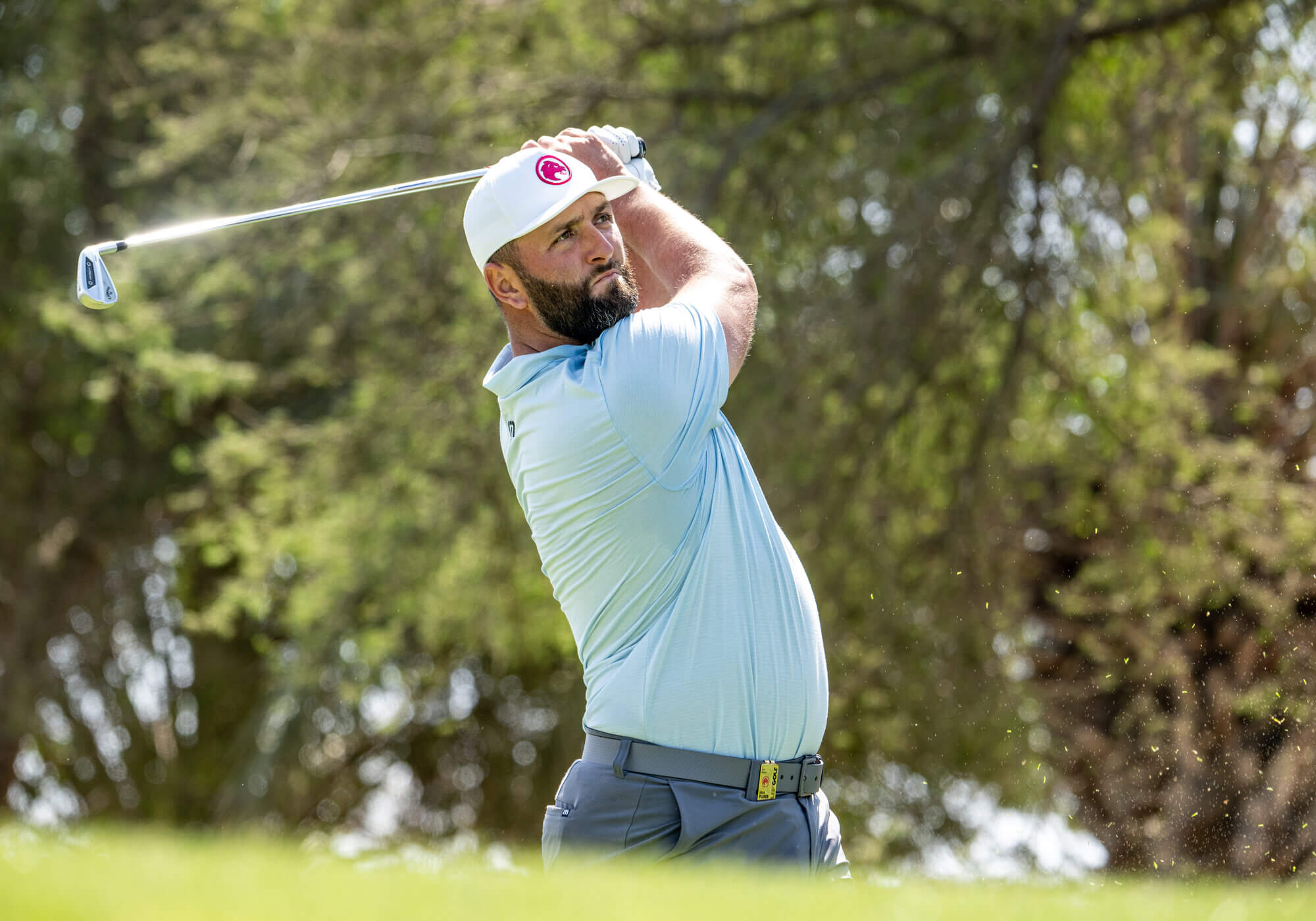
LIV Golf Jon Rahm

When you need the full swing

Some golfers absolutely need that full backswing to play their best golf. These are players with smooth tempos, good flexibility and natural timing. For them, a shorter swing feels rushed and uncomfortable—like trying to sprint in slow motion.

I worked with a college player who’d been told by multiple instructors to shorten his swing. His natural motion was long and flowing but coaches kept trying to make him more compact for “control.” The result? Mechanical, lifeless golf that destroyed his natural rhythm. When we restored his full backswing and worked on other areas, his ball-striking returned immediately.

The longer backswing helps golfers who struggle to generate clubhead speed. If you’re not particularly strong or flexible, that extra length provides the time and space needed to build momentum through the hitting zone.

Find your natural length

The biggest mistake golfers make? Copying what they see on television or social media. Tour players spent decades developing swings that match their specific physical capabilities and competitive demands. Your swing should match your body and your goals.

But here’s what matters more than how far back the club goes: The relationship between your upper body turn and your hip rotation. I’ve seen golfers obsess over getting the club to parallel or past parallel when they should focus on making a full shoulder turn against a more restricted hip turn. This coil creates the power and consistency they’re actually seeking.

Think of it this way: Whether your club reaches parallel, goes past it or stops short doesn’t matter if your upper body isn’t turning properly in relation to your hips. A golfer with a “short” backswing who creates good separation between shoulder and hip rotation will hit it better than someone with a “long” backswing who turns everything together like a spinning top.

Here’s what I tell students: Start with your natural motion and make small adjustments from there. If you naturally make a long backswing, don’t fight it unless it’s causing specific problems. If you’re naturally compact, embrace that efficiency instead of trying to create length you don’t need.

The key is ensuring that, regardless of your backswing length, you’re creating that proper turn relationship. Your shoulders should rotate more than your hips on the way back. That’s where your power comes from—not from how far the club travels.

Pay attention to your best shots. When you stripe one down the middle, what did that backswing feel like? Most golfers already know their optimal length. They just need permission to trust it.

Stop chasing perfection

Your backswing length should serve your game, not some idealized version of what a golf swing should look like. Compact swings aren’t automatically better. Long swings aren’t inherently flawed. What matters is finding the length that allows you to make solid contact consistently while generating adequate power for your game.

Stop chasing the so-called “perfect” backswing. Start perfecting your natural one. Your scorecard will improve when you work with your tendencies instead of against them.


For You

For You

Best Active Players Without A Major Best Active Players Without A Major
News
Jun 24, 2026
The 10 Best Active Players Without A Major
Instruction
Jun 24, 2026
5 Golf Habits That Feel Productive But Don’t Lower Scores
Instruction
Jun 24, 2026
3 Drills To Help You Control The Clubface Through Impact
Brendon Elliott

Brendon Elliott

Brendon Elliott

PGA of America Golf Professional Brendon Elliott is an award-winning coach and golf writer. Check out his weekly Monday column on RG.org, and to learn more about Brendon, visit OneMoreRollGolf.com.

Brendon Elliott

Brendon Elliott

Brendon Elliott

Driver Srixon ZXi Max Fairway Woods Srixon ZXi
Hybrids Srixon ZXi Irons Srixon ZXi4
Wedges Cleveland RTZ Putter Heavy Putter
Ball Z-Star XV  
Brendon Elliott

Brendon Elliott

Brendon Elliott


    This site is protected by reCAPTCHA and the Google Privacy Policy and Terms of Service apply.

      Gilligan

      10 months ago

      So the 8 handicap with the perfect swing was spraying the ball while the 16 was striping it. Got it 🙄

      Reply

      Joejoe

      10 months ago

      Golf swings are over rated.
      I hack it all around the course but I have an excellent short game and maintain a 5 handicap with zero practice.
      Most golfers would score better by just working on putting and chipping.

      Reply

      Jay

      10 months ago

      Swing YOUR swing!

      Reply

      Nobull prize

      10 months ago

      So the 8 handicap had worse swing outcomes than the 16 with the short swing. Does not compute.

      Reply

      OpMan

      10 months ago

      I like to John Daly it

      Reply

      Tom Blue Raven

      10 months ago

      Ive simplified my long swing. Trail elbow connected throughout backswing and downswing until naturally goes thru. Many more pars and occasional birdie. Distance about the same.
      ButI did a swing speed test without a ball on my lawn. My swing speed was 5-10mph faster with the barely above parallel swing. Much more whip. Havent hit any balls yet.

      Reply

      John K.

      10 months ago

      When you say restricted hips you don’t mean the once X factor instruction do you?
      Please elaborate.

      Thanks!!

      Reply

      AC

      10 months ago

      Great piece and I can totally relate. I was trying to be so precise and it just felt mechanical, trying so hard to put the club in certain positions. My swing was two parts, up and back, instead of 3 (a transition in the middle). Instead of trying to be so precise, I focused on my shoulders and hips, using my legs and torso to swing the club instead of my arms. Everything feels so much more sequenced properly and without tension. I have found that the longer the backswing, the better. And that’s just me. No sense in fighting it.

      Reply

      Roy Holsclaw

      10 months ago

      This article reminds me of Kenny Pary, from Kentucky. He at one time was considered a long hitter but had a compact swing.

      Reply

      Dave M

      10 months ago

      “What matters is finding the backswing length that matches your body, your timing and your natural tendencies.”

      Thank you Brendon, So true!

      Reply

      David K. Johnson

      10 months ago

      I’m retired, now; however, I taught for about 20 years, in the DFW area. I got “good enough” to try Monday qualifiers for the Champion’s Tour, in the ’90’s. (Missed the first one by 2!) Those who can’t play, teach.
      Anyway, I’ve worked on my swing, and re-worked my swing, over the decades, to the point of – it is now more “Hoganesque” – short, three quarter, and on (his flat) plane. One “secret”, that I think is rarely taught, or even used, by the vast majority of players is the way the wrists cock. Faldo’s book, in 1989, covers it. As soon as I started to use the wrists correctly with the back, or underneath wrist getting into a more “waiter” position, with a large “cup” in it, I must have gained 15 yards, and VERY accurate. The wrists do NOT cock straight up, and down. So, if you can comfortably use a 3/4 backswing, and you can accomplish this “magic wrist set”, you’ll be far more accurate, and plenty long!! I used to have a long backswing, when I was young, but it isn’t necessary. I believe, Crenshaw, J.T., Rory, Spieth, etc. could all benefit from a 3/4, on plane backswing!

      Reply

      Hopp Man

      10 months ago

      I would like a short compact back swing, but when I do that, my tempo gets screwed up as I try to swing at it too hard to make up for the short back swing and who knows where the ball is going. If I use good tempo on say a short back swing wedge, then I am ok with it, I just can’t do it consistently.

      Reply

      Lucas

      10 months ago

      Great article and advice, always enjoy your instructional insights. Thank you 🙏🏼

      Reply

      Whitney Hewatt

      10 months ago

      Great topic for sure, helpful

      Reply

      Steve

      10 months ago

      A compact swing is great for seniors who are not flexible enough.

      Reply

      Pat

      10 months ago

      I have definitely found that shortening my backswing a little bit creates urgency in shifting my weight forward in the downswing before I complete the backswing. This helps me create a natural lag that, at first, felt wrong — till I saw this beautiful straight ball flight.

      Reply

      RC

      10 months ago

      So true! I struggled with a flowing backswing, when it worked, it was money, but it only worked around 60% of the time. I actually saw what Finau and Rahm were doing, and started trying to take what in my mind was a shorter backswing. It totally changed my game. It seems like I have total control of my timing, and I get through the ball much better. It actually made driving the ball easier. But here’s something your article doesn’t really cover – I’m getting MORE distance because I’m coming through so much better (and probably hitting closer to the sweet spot). Another thing is, you may “think” in your head that your backswing is “short”, but my friends say that my club is “finishing” the backswing, but it looks a little flatter to them. It feels like I’m not taking it all the way back, but in actuality I’m just transitioning at the best time for my swing. All of that being said, I’m only talking about Driver. With Irons, I do lose some distance, but the ball comes out straighter with lower trajectory. I’m not sure why that is, but I’ve only been doing this for a few months, so maybe that will change.

      Reply

      CB

      10 months ago

      Nice write up and some good advice. I enjoy your instructional bits way more than the large volume of newsletter linked articles that simply reframe/recycle little bits from previously equipment tests that aren’t good for much more than click counts.

      Reply

    Leave A Reply

    required
    required
    required (your email address will not be published)

    This site uses Akismet to reduce spam. Learn how your comment data is processed.

    Best Active Players Without A Major Best Active Players Without A Major
    News
    Jun 24, 2026
    The 10 Best Active Players Without A Major
    Instruction
    Jun 24, 2026
    5 Golf Habits That Feel Productive But Don’t Lower Scores
    Instruction
    Jun 24, 2026
    3 Drills To Help You Control The Clubface Through Impact