


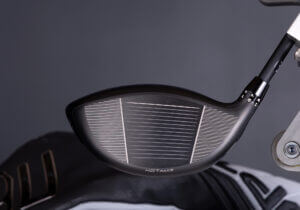
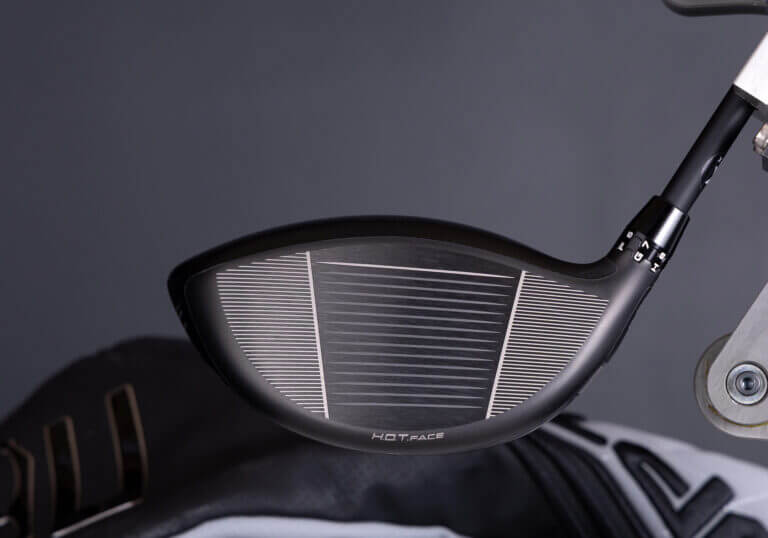
You hit a drive and it starts right. It curves more right. It ends up in the trees. Your playing partner says you came over the top. Your other playing partner says you left the face open. Someone else mentions your grip. Everyone has a theory but nobody actually knows what happened. Here’s the truth: your start line tells you almost everything you need to know about your miss. Learn to read it and you’ll stop guessing about your swing.
The start line matters most
Where your ball starts relative to your target line is the most important piece of information about your swing. It tells you about your clubface angle at impact. Trackman data shows that with iron shots, face angle accounts for approximately 75 percent of the initial launch direction while club path accounts for the remaining 25. With a driver, the face angle’s influence increases to around 85 percent, leaving just 15 percent to the swing path.
This matters even more with the driver because of its sensitivity to face angle changes. Due to lower loft and higher ball speed, just a one-degree change in face angle causes approximately seven to 12 yards of deviation at typical driving distances. Miss by two degrees and you’re looking at 14 to 24 yards offline. Small errors create significant misses.
The curve tells you about the relationship between your club path and that face angle. The curve is not created by the path alone but by the difference between where your face is pointing and where your path is traveling. If your face points two degrees right and your path is five degrees right, that three-degree difference creates the curve. The simple rule: face angle starts it, the face-to-path relationship curves it.
Most golfers ignore the start line and only pay attention to where the ball ends up. That’s a mistake. The finish is the result. The start line is the cause. If you want to fix your driver, understand what’s happening at impact. The start line is your best clue.
The push that stays pushed
If your ball starts right and stays right with minimal curve, your face is open to the target and your path is roughly matched to that face angle. This is actually a pretty good miss if you can control it because there’s no curve.
The fix isn’t to manipulate your path; it’s to get your face more square at impact. Work on your grip first. A weak grip makes it hard to square the face. Check your setup. If you’re aligned right, your face will naturally be open to the target. Strengthen your grip slightly or work on rotating the face closed through impact.
The slice that starts right
If your ball starts right and curves more right, your clubface is open to the target and your path is even more to the right than your face. This is the classic slice, the most common miss in golf. The ball starts right because your face is pointing that direction. It curves more right because your path is traveling even further right than where your face is aimed, creating left-to-right spin.
The mistake most slicers make is only trying to fix the path. They try to swing more from the inside but if the face is still open, they just hit push-slices. Fix the face first. Get it more square to your target. Then, if you’re still slicing, work on getting your path less to the right. Face angle is the priority because it controls where the ball starts.
The pull that stays pulled
If your ball starts left and stays left, your face is closed to the target and your path is roughly matched to that face angle. There’s minimal curve because your path matches where the face is aimed. This is common with better players who’ve learned to control the face but haven’t fixed their alignment or setup.
The fix is getting your face more square at impact. Check your grip: a strong grip can close the face too much. Check your alignment. You might be aimed left without realizing it. Work on feeling like you’re holding the face slightly more open through impact or weaken your grip a touch.
The hook that starts left
If your ball starts left and curves more left, your face is closed to the target and your path is even more to the left than your face. This is a pull-hook and it’s one of the scariest shots in golf. The ball starts left because your face is pointing that direction. It curves more left because your path is traveling even further left than where your face is aimed, creating right-to-left spin.
This miss usually comes from a closed face combined with an over-the-top path. Fix the face first. Weaken your grip or feel like you’re holding the face more open. Then work on your path. Get it more neutral or even slightly right. A square face with a slightly right path produces a draw. A closed face with a left path produces a snap hook.
The straight pull or push
If your ball flies dead straight but misses the target, your face and path are perfectly matched to each other, just not aimed at the target. These are actually good misses because there’s no curve. You just need to fix where your face is aimed.
Check your grip and alignment first. Your grip controls your face angle and your alignment might have you aimed where you’re hitting it. If those are good, you might have a face angle issue in your swing. Video yourself or get on a launch monitor to see what you’re actually presenting at impact.
The simple truth
Your start line tells you about your clubface angle. The curve tells you about your path relative to that face. Stop guessing about what’s wrong with your swing and start reading your ball flight. If it starts right, your face is open. If it starts left, your face is closed. If it curves, your path doesn’t match your face angle. Once you understand what’s actually happening, you can fix it. The ball doesn’t lie. It’s showing you exactly what your club is doing at impact. Pay attention to where it starts, not just where it ends up, and you’ll finally understand your miss patterns.








Troy
7 months ago
This is exactly backwards:
“It curves more right because your path is traveling even further right than where your face is aimed, creating left-to-right spin.”
If your path is traveling to the right, inside to outside, you create right-to-left spin and draw the ball to the left… right-to-left spin is created by an outside to inside(left) swing path. A perfect draw is a face that’s neutral or slightly open combined with a path that works to the outside (right) starting the ball straight or very slightly right and drawing it back onto target. The key is face-to-path… a +4 degree inside out path, with a +2 degree open face is a -2 degree (closed) face that will be a slight draw, a -4 degree outside in path, with a -2 degree closed face is a +2 degree open face that will fade.
Joey5Picks
7 months ago
100%. Did no one proof read this?