

How Hitting Greens In Regulation Affects Putts Per Round
Instruction

How Hitting Greens In Regulation Affects Putts Per Round

Support our Mission. We independently test each product we recommend. When you buy through our links, we may earn a commission.

How Hitting Greens In Regulation Affects Putts Per Round

If you’ve ever looked at your stats after a good ball-striking round and wondered why you had so many putts, you’re not alone.

A lot of golfers expect their putting numbers to drop as their greens in regulation go up. On the surface, that makes sense. More greens hit should mean easier scoring and fewer putts. But when you look at real performance data, that assumption doesn’t hold up the way most players think it does.

Using a large data set from Shot Scope, we can see exactly how greens in regulation affects total putts per round and why some of your better ball-striking rounds include more putts, not fewer.

What Shot Scope looked at

The goal of this analysis is simple: When golfers hit more greens in regulation than they normally do, what impact does that have on putting?

To answer that, Shot Scope looked at round data from two handicap groups: 15 handicaps and scratch golfers.

For each group, they compared:

  • Rounds where the golfer hit fewer greens than their personal average
  • Rounds where they hit about their normal number of greens
  • Rounds where they hit more greens than their personal average

These tables show how total putts per round changed as greens in regulation increased.

15 handicap golfers

Greens HitTotal Putts
228.1
432.3
735.4

When 15 handicaps hit significantly more greens than normal, their total putts increase by more than three per round.

Scratch golfers

Greens HitTotal Putts
727.4
1031.1
1332.6

The same trend appears at the scratch level. More greens hit leads to more putts, even for elite players.

Why this happens

The key factor here is proximity to the hole.

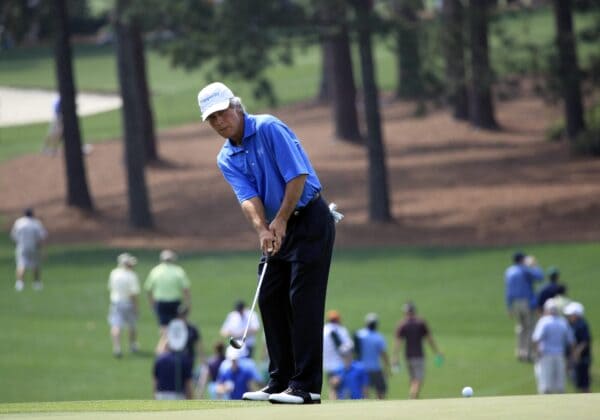
When a golfer hits a green in regulation, their first putt often comes from 20, 30 or even 40 feet. When they miss the green, they’re usually chipping or pitching from much closer range. That creates shorter first putts and more tap-ins.

So as greens in regulation increase:

  • First-putt distance increases
  • Three-putt risk increases

In other words, the golfer reaches the green sooner in the hole, which is a good thing, but it naturally leads to more putts being taken from longer range.

Why total putts per round can be misleading

Total putts per round doesn’t tell you how well you putted. It only tells you how many times you putted.

Better ball-striking rounds often come with:

  • More long first putts
  • More birdie chances
  • Fewer chips and pitches

That combination frequently results in higher putt totals but lower scores. Because of that, total putts alone is a poor way to evaluate putting performance. It doesn’t account for how far your first putts are or how often you’re reaching the green without needing a short-game shot.

Smarter ways to evaluate putting

Instead of focusing only on total putts per round, pay attention to:

  • Three-putts per round
  • Lag putting performance from 20-plus feet
  • Putts per green in regulation rather than per round
  • Average first-putt distance

These metrics do a much better job of showing whether your putting is improving or if you’re simply reaching the green earlier in the hole.

The bottom line

Hitting more greens doesn’t guarantee fewer putts but it does create better scoring chances. Two-putting on the green is still a better outcome than relying on repeated up-and-downs. Be mindful of three-putts, not total putts.

For You

For You

Instruction
Jun 9, 2026
If You Still Play Long Irons, Copy This Thought From Ludvig Åberg
PLM 2025_Most Wanted_Foresight GC3 PLM 2025_Most Wanted_Foresight GC3
News
Jun 9, 2026
College Golf Tournament Prep Looks Nothing Like It Did When I Played
News
Jun 9, 2026
The Best Father’s Day Golf Gifts That Won’t Break the Bank
Brittany Olizarowicz

Brittany Olizarowicz

Brittany Olizarowicz

Britt Olizarowicz is a scratch golfer, former teaching professional and one of MyGolfSpy’s leading voices on equipment testing and golf performance. She has spent more than 15 years working at private clubs in New York and Florida and now specializes in translating test data and swing mechanics into practical advice for everyday golfers. Britt began playing at age 7 and has never left the game. When she’s not writing, you’ll find her on the course, playing pickleball, cooking, running or out on the boat with her family.

Brittany Olizarowicz

Brittany Olizarowicz

Brittany Olizarowicz


    This site is protected by reCAPTCHA and the Google Privacy Policy and Terms of Service apply.

      Andrew

      4 months ago

      Strokes gained is the only one that’s consistent. Putts per GIR can change because your approach shot proximity improves, either through better ball striking or because you stop going for par 5s in two and instead lay up to 40-100 yards out.

      Reply

      Matt C.

      4 months ago

      Felt like a putter to the ankle realizing haven’t had <28 putts in my last 110 rounds as a 0.8 – 2.2 Handicap. Gonna blame the 73.4/144 course

      Reply

      Skip

      4 months ago

      Common sense logic. It shouldn’t take Shot Scope to know this

      Reply

      Sean

      4 months ago

      This is state the obvious stuff.

      Reply

      League Golfer

      4 months ago

      This was “I have to put out another piece of work today. What can I write?” kind of stuff. I can’t believe I bothered reading it and now commenting on it.

      Reply

      Jimjam

      4 months ago

      It’s always Brittany. She loves her Shot Scope data no matter how bad the comparisons are.

      Reply

      Chris

      4 months ago

      Strokes gained putting? Its pretty logical and intuitive if you take a few minutes to learn about it or listen to a podcast or two.

      Reply

      Dr Tee

      4 months ago

      This is a topic (running area of discussion) I have had with my coach who specializes in short game.
      For sure I shoot lower scores when hitting more GIR BECAUSE I emphasize lag putting distance drills to reduce or eliminate 3 putts. Lets face it–you can 2 putt even at fairly long distance more frequently then you can get up and down from off the green.
      So as you have alluded to in your article-my coach’s recommendation for reducing 3 putts and scoring better on GIR is all about proximity: “HIT IT CLOSER” !

      Reply

      Greg

      4 months ago

      Excellent advice: “Be mindful of three-putts, not total putts.”

      Reply

      Jim R.

      4 months ago

      Way to go @Golf2Much ! You really know your game!

      I’ve moved to a course with big greens, so more greens hit and more three putts. Very typical. My three putts are a combination of poor first putt speed on putts over 40′ and missing putts under 7′. So now I make sure to hit a few warm up putts over 40′ and make sure I two putt. For first putt distance, I’m normally short so now I make sure to exaggerate a long backstroke and sweet spot contact.

      Reply

      SJW

      4 months ago

      This article makes no sense. Obviously, if you hit the green from 150 you will have a longer putt on average than if you chip just off or around the green. Who would think you would get up and down from 100-200 yards more often than around the green.

      Reply

      ColossalPP

      4 months ago

      I was thinking the same thing. Like did anyone think hitting more greens meant fewer putts? Lol. I thought it was fairly obviously that they were inversely related

      Reply

      Golf2Much

      4 months ago

      Welcome to my world! As a senior golfer with more replaced body parts than should be legal, I’ve lost a good deal of distance. With a course handicap of 12, I’m typically short on most par 4’s and rely on pitching, chipping and putting to score.
      Looking at my Shot Scope data for 2026 so far this year I definitely fit into discussion.
      Greens in regulation: 18%
      Up and downs: 51% within 50 yards of the green
      Total putts per round: 26.9
      Average first putt distance: 11 ft.
      Average distance of putts made: 44 ft.
      Average putts per hole: 1.8
      Probably the most amazing statistic is that I’ve gone 300 holes without a three putt. I guess it pays to play on a classic Rees Jones designed course with small greens!
      One thing that helps keep my scores from blowing up and I view just as valuable as up and downs for par are the up and downs for bogey. Nothing kills a round and momentum than a double!
      My playing buddies have gotten so used to me getting up and down from all sorts of situations that they have turned my name into a verb. When any of them get up and down for par, they say they “Norm’d it!”

      Reply

      Clark

      4 months ago

      1.8 putts/hole x 18 holes/round = 32.4 putts/round, not 26.9 putts/round
      ????????

      Reply

      John J.

      4 months ago

      Your reply really hit home. At 78 years old and playing from the men’s tee with my younger playing partners, I have to rely on up-and-downs for par on any par 4’s over 350 yards. Very often, my rounds will consist of 5 or 6 up-and-downs for par and the other are generally bogey’s. I seldom have a 3-putt. Normally average around the 1.8 putts per hole per round. At my age, the most important thing I can do is continue to spend most of my practice time on chips and putts.

      Reply

      Dr Tee

      4 months ago

      300 Holes without a 3 putt–I’m calling BS
      agree that Golf2Much needs a math lesson calculating putts per round

      Reply

    Leave A Reply

    required
    required
    required (your email address will not be published)

    This site uses Akismet to reduce spam. Learn how your comment data is processed.

    Instruction
    Jun 9, 2026
    If You Still Play Long Irons, Copy This Thought From Ludvig Åberg
    PLM 2025_Most Wanted_Foresight GC3 PLM 2025_Most Wanted_Foresight GC3
    News
    Jun 9, 2026
    College Golf Tournament Prep Looks Nothing Like It Did When I Played
    News
    Jun 9, 2026
    The Best Father’s Day Golf Gifts That Won’t Break the Bank