


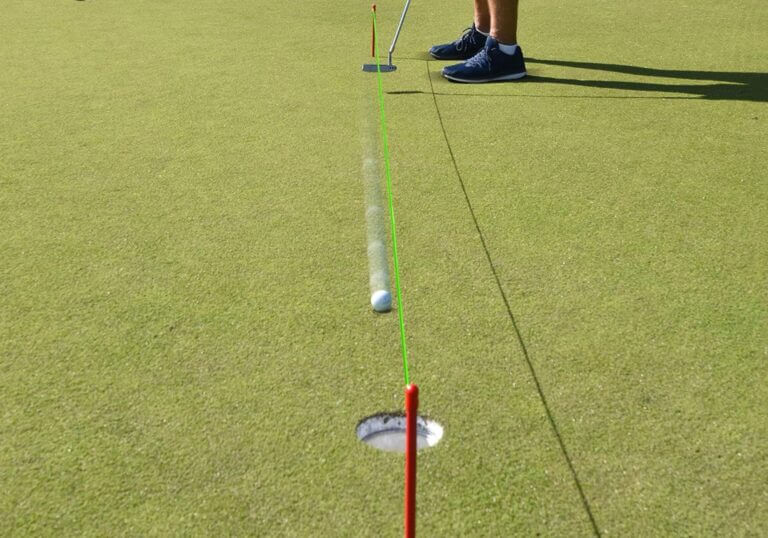
There are few things in golf more frustrating than watching putt after putt die just short of the hole. You read the line perfectly, your stroke feels smooth, but somehow the ball just doesn’t have enough juice to reach the cup. If this sounds familiar, you’re not alone—and the good news is this problem is entirely fixable once you understand what’s causing it.
The two main culprits
Most golfers who consistently leave putts short are making two fundamental errors that rob distance: deceleration through impact and looking up too soon. These seemingly minor flaws have a massive impact on your ability to control distance and hole putts.
Deceleration is putting death. When you slow down through impact, you’re not transferring energy efficiently to the ball. This happens when golfers make a backswing that’s too long for the distance they want the ball to travel. As a result, they instinctively slow down through impact to avoid hitting it too far. The stroke should accelerate slightly through impact or at minimum maintain the same speed from backswing to follow-through.
Looking up too soon is equally damaging. When you lift your head before the ball leaves the putter face, your body naturally follows, causing you to decelerate and pull up on the stroke. This breaks down your posture and reduces the solid contact needed for proper distance control. Keep your head down and eyes on the ball until well after impact.
Mental barriers that create short putts
Fear plays a huge role in short putting. Many golfers subconsciously leave putts short because they’re afraid of rolling the ball well past the hole. This psychological barrier creates a self-fulfilling prophecy: when you’re worried about hitting the ball too hard, you naturally decelerate through impact.
Remember: A putt that doesn’t reach the hole has zero chance of going in. It’s better to occasionally roll a putt three feet past the hole than to consistently leave putts six inches short. Embrace being slightly aggressive with your putting.
Distance control fundamentals
Distance control comes down to one primary factor: the length of your stroke, not how hard you hit it. Think of your putting stroke like a pendulum—it should have the same tempo regardless of distance. For longer putts, make a longer backswing. For shorter putts, make a shorter backswing. The acceleration through the ball should remain constant.
Your follow-through should be roughly the same length as your backswing, maybe slightly longer. If you’re making a long backswing and then stopping abruptly after impact, you’re likely decelerating through the ball, causing putts to come up short.

Setup keys for better distance control
Ball position should be slightly forward of center in your stance, roughly under your left eye (for right-handed golfers). If the ball is too far back, you’ll hit down on it, causing it to skid and lose distance.
Eye position should be directly over the ball or slightly inside the target line. Poor eye position leads to compensation in your stroke, often resulting in deceleration.
Posture should be balanced and comfortable. Your arms should hang naturally from your shoulders. Poor posture creates tension which leads to deceleration and short putts.
Green reading for distance
Misreading the green can make your putts come up short even when your stroke is perfect. Pay special attention to:
Uphill slopes: For every foot of elevation change over the length of your putt, add about 10 percent more distance.
Grain: When putting into the grain (against grass growth), the ball slows down more quickly.
Subtle slopes: Even slopes that look flat might be slightly uphill, causing putts to come up short.
Equipment factors
Sometimes the problem is your equipment. A putter that’s too light promotes a “handsy” stroke and inconsistent distance control. A heavier putter promotes a smoother, more pendulum-like stroke that’s easier to control.
Make sure your putter face is clean—dirt buildup reduces energy transfer efficiency. Consider the loft of your putter as well. Most putters have two to four degrees of loft to help the ball roll smoothly rather than skid.
Practice drills for better distance control
The Ladder Drill: Set up balls at 10, 15, 20, 25 and 30 feet from a hole. Practice hitting each ball so it finishes within three feet of the hole, with each successive putt traveling farther than the previous one.
The Follow-Through Drill: Practice making putting strokes where your follow-through is noticeably longer than your backswing. This helps develop the feeling of accelerating through the ball rather than decelerating.
The Head-Down Drill: Practice keeping your head down and eyes on the ball until well after impact. Count “one-thousand-one” after you hear the ball leave the putter face before looking up.

Putting it all together
Start by focusing on the two main distance killers: deceleration and looking up too soon. Work on developing a smooth, consistent stroke with proper tempo and acceleration through the ball. Practice keeping your head down through impact.
Most importantly, commit to being more aggressive with your putting. The fear of three-putting causes many golfers to be overly cautious but you’ll make more putts by being slightly aggressive than by being consistently short.
Remember: Those short putts aren’t a mystery—they’re a fixable problem. With the right fundamentals and practice, you can develop the distance control needed to start rolling putts with confidence and watching them drop into the hole instead of dying just short.








Tom
1 year ago
This was instantly helpful. I am a great putter, 7 cap but I would be a 12 without my ability to get up and down. I get a ton of putts to the pin but not past and it costs me putts. Both your reasons were real. I will try these both but thank you for a thoughtful article.