




You have 145 yards to the flag. It’s a comfortable 7-iron. Are you aiming right at it? The yardage and the club are only part of the decision.
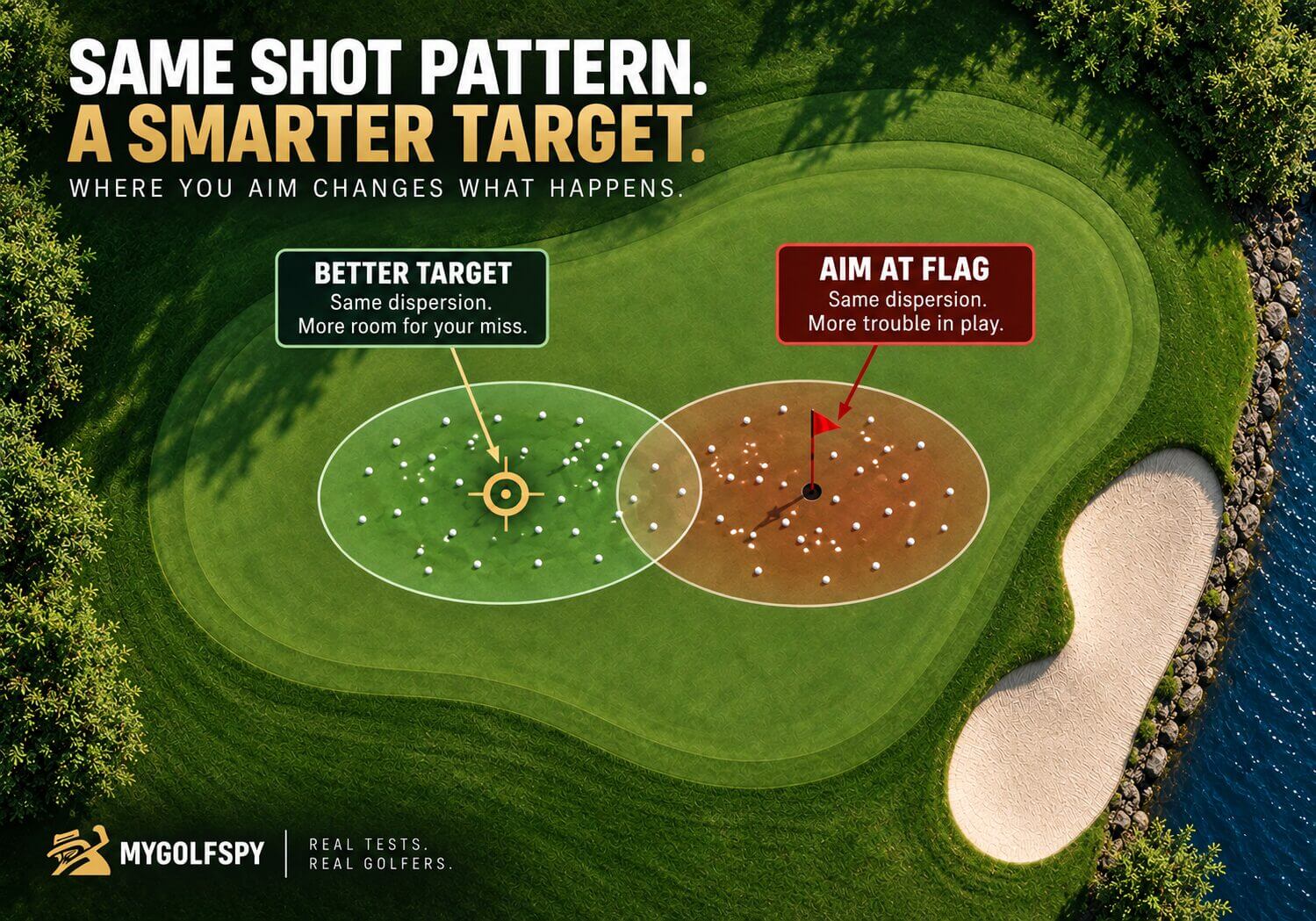
Where the flag sits, where the trouble is and how large your normal shot pattern is should all influence where you aim.
We went back through our 2026 game-improvement iron testing to see how dispersion changes from a pitching wedge to a 7-iron and 5-iron and how you can use this to determine if you should be aiming for the flag.
First, understand your dispersion
Before deciding whether the flag is the right target, you need some idea of how much room your typical iron shot needs.
Our 2026 game-improvement iron test gives us a useful example. Testers hit pitching wedges, 7-irons and 5-irons, producing 12,480 shots of data across the entire test.
This is still just one test with one group of testers. It isn’t meant to tell you exactly how wide your own dispersion will be. But it does show how much the expected result can change as the club gets longer.
| Club | Average Carry | Average Proximity | Average Spray |
|---|---|---|---|
| Pitching wedge | 106 yards | 15.7 | 15.4 yards |
| 7-iron | 142 yards | 23.8 | 30.8 yards |
| 5-iron | 155 yards | 30.5 | 39.1 yards |
The average spray with the pitching wedge was about 15 yards. With the 7-iron, it was roughly twice that. With the 5-iron, it increased to more than 39 yards.
Again, that does not mean pitching wedge equals “go at the flag” and 5-iron equals “play safe.”
It means the amount of room you need has to be part of the decision. If your expected dispersion gets larger, a flag tucked near the edge of the green becomes a very different target than one sitting near the middle with plenty of room around it.
Don’t look at the flag first
This is probably the hardest habit to break. Most golfers get a yardage, find the flag and start deciding what club to hit.
Instead, look at the green first. Where can you miss?
If there is water short and the flag is five yards onto the green, the flag may not be a very good target. If the pin is back-center with 20 yards of green short of it, the exact same club and dispersion pattern may give you much more room to be aggressive.
The consequences of your miss must be considered.
Where is the trouble?
Once you have an idea of how large your shot window might be, look at what falls inside it.
Water is obvious but it’s not the only thing that matters. A deep bunker, severe short side, penalty area or even a section of green that leaves an extremely difficult putt can all change the target.
This is where I think golfers get into trouble when they hear blanket advice like “aim for the middle of the green.”
Sometimes, the middle is the right target. Sometimes, you only need to move your target five or 10 yards away from the flag.
If shifting your aim slightly puts more of your normal dispersion on the green and takes the worst miss out of play, that’s probably the smarter target.
Know which direction you tend to miss
Your shot pattern isn’t perfectly circular. We’ve seen in previous on-course data that amateur golfers miss short far more often than they miss long. You should also know your own tendencies.
Do you tend to pull your short irons? Does your 5-iron leak right? Are you almost always short when you miss the green?
Those tendencies should matter.
If the flag is front-right over a bunker and your most common miss is short-right, aiming directly at it brings your most likely miss and the biggest trouble together. This is a situation where you move the target.
On the other hand, if the flag is back-left with plenty of green short and right, you may have considerably more room to take a shot at it.
So when should you aim at the flag?
I think you can simplify the decision to three questions.
1. How big is my likely shot window?
You don’t need to know that your 7-iron dispersion is exactly 28.4 yards. It can help if you do. But you do need to understand that your 7-iron covers a larger area than your pitching wedge and your 5-iron probably covers an even larger one.
2. What happens if I miss?
Look short, long, left and right of the flag. If a normal miss brings a penalty area, deep bunker or almost impossible recovery into play, move the target away from it.
3. Does my shot pattern fit around this flag?
If your normal dispersion brings too much trouble into play, move your target away from the flag. This is not always going to be the center of the green.
Generic advice is too simple. Your target has to match your shot pattern
The usual advice is easy enough: aim for the middle of the green and if you have a short iron in your hand, be aggressive.
But golf is not that simple. A 5-iron does not automatically mean you should play safe. A pitching wedge does not automatically mean you should fire at every flag. The better question is whether the target fits the shot you are likely to hit.
That starts with being honest about your game. How far from the pin could this shot finish? Do you tend to miss short, leak it right or pull it left? Is the trouble sitting exactly where your most common miss tends to go?
That is why the same club can lead to two very different decisions. A 5-iron into a large green with a center flag and no major trouble might still be a green light. A pitching wedge to a tucked pin over water might call for a much safer target.









sean
3 weeks ago
The vast majority of golfers should always aim for the fattest part of the green.