




The slice is the most common miss in golf and nobody needs another reminder of how it feels. Most of us have already read the fixes. The question I am asked most often? Is it the club or me?
The honest answer is that it’s usually some of each. Equipment can always be optimized and it’s worth doing. But for most golfers, the biggest chance to get better is the swing. This article will help you work out which one to look at first.
The one-minute version
The face starts the ball. The path curves it. A slice happens when the face is open to the path so the ball bends right for a right-hander. Every cause in this article works by changing that one relationship, either directly or by changing where the ball meets the face. Keep that in mind because it’s the reason the swing and the equipment get so tangled.
Three clues you can collect yourself
Before you start diving into the causes and which one is impacting your game, here are a few things to look at.
Your strike. Put impact tape on your driver and hit a few balls. Heel strikes add fade spin so a cluster near the heel can make a swing problem look worse than it is. Hit five or six balls and look for a pattern. A tight group means you have a repeatable strike and that’s when the club is worth looking at. Marks scattered all over the face point more toward the swing because your contact itself is the problem.
Your start line. Watch where the ball begins. That’s mostly the face. If a slice also starts right, the face is part of the problem.
The curve. How much does it bend? That tells you how far apart the face and path are. A divot pointing left of the target hints at an out-to-in swing and our divot guide could help you learn how to read it. Divots show swing direction rather than exact path so treat it as a clue.
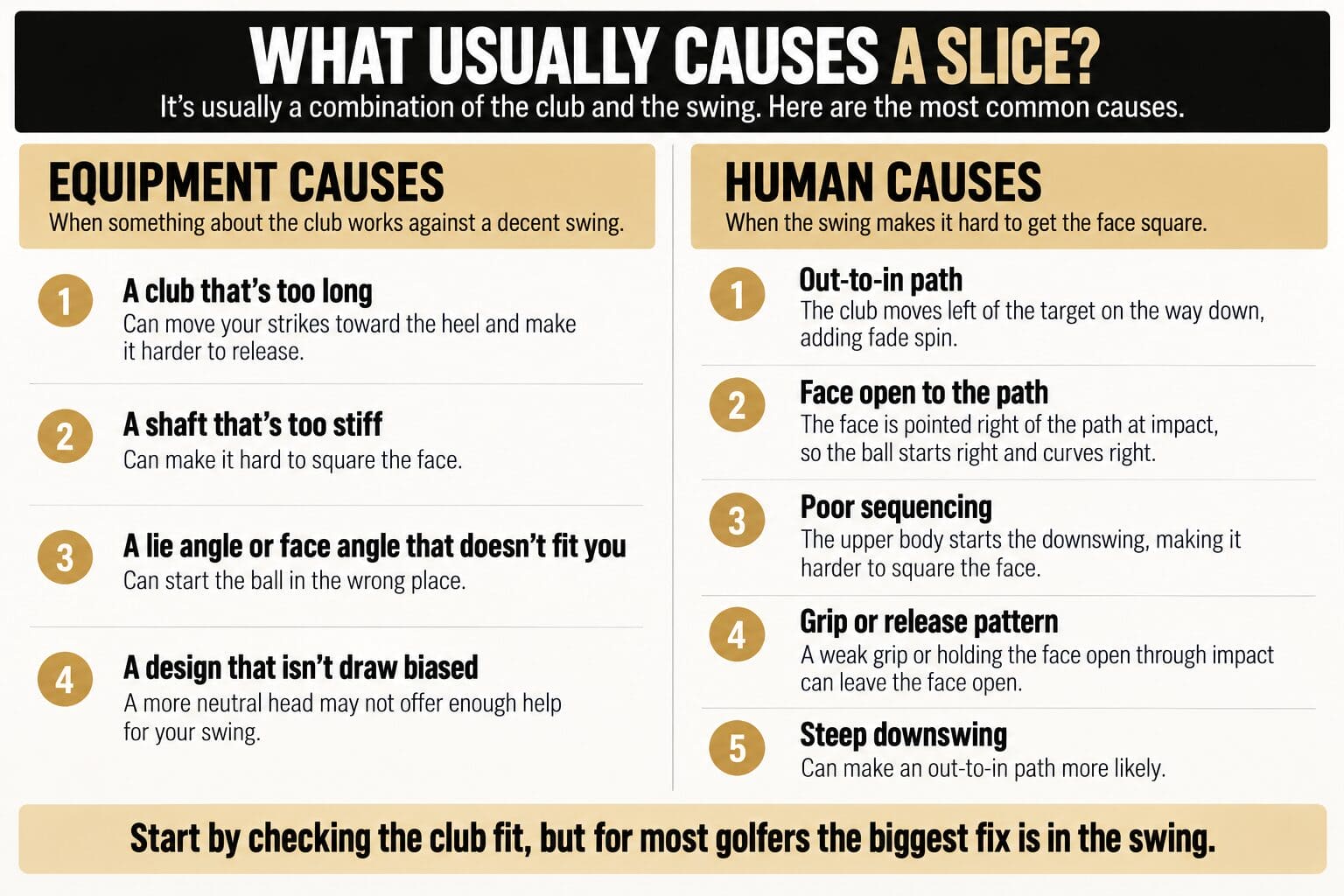
Bucket One: It’s the equipment
The club is the cause when something about it works against a decent swing. Look for these.
- A club that’s too long. It can pull your strikes toward the heel and make it harder to properly release.
- A shaft that’s too stiff. It can make it hard to square the face.
- A lie or face angle that doesn’t fit you. It can start the ball in the wrong place.
Equipment can also help on purpose. Draw-biased drivers use rear center of gravity, heel weighting, upright lies and closed faces to help the face get back to square.
We’ve also tested them. For our 2022 slice driver analysis, we looked at launch monitor data from 35 golfers who hit 38 drivers, more than 18,000 shots in all, and ranked the drivers on how much slice correction they offered. The takeaway is that no driver fully eliminates a slice but the best ones are built to keep it in play more often. The PING G425 SFT was the most left-biased head in the test, thanks to a fixed 23-gram tungsten weight that moves the CG toward the heel.
Keep your expectations honest, though. As our equipment guru Tony Covey once put it, “it’s a draw bias, not a draw promise.” For most golfers who need one, the club won’t turn a slice into a draw. It might turn it into a fade or a slice that stays in the fairway.
Bucket Two: It’s you
When the swing is the cause, the usual pattern is a pull-slice. Look for these signs.
- The ball starts left of the target and curves hard right.
- That points to an out-to-in path with the face open to it.
- The tape often looks fine, with contact near the center and the slice stays anyway.
When I taught, a golfer with a 30-yard slice rarely needed a new driver as the first step. The face and path needed work and equipment could only make it a little more playable. I get into this more in “It’s The Golfer, Not The Club.” Is That Even True?
Bucket Three: Where it gets muddled
While I wish the reason you slice could be a clear line between player or equipment, that’s not always the case. This is the space in which most amateur players who slice the ball live. It’s a combination of equipment and swing that causes the slice.
- Equipment changes the swing. A shaft that doesn’t suit you can make a good move harder to repeat so what looks like a swing flaw may be partly a fitting problem.
- Equipment hides the swing. A draw-biased club can cover up a path problem without touching it. That’s why golfers argue about whether these clubs are a fix or a bandage.
- Strike connects both. A heel strike can come from your swing or from a club whose length and lie don’t match your setup. The tape can’t tell you which.
Something to keep in mind
My miss is a hook, a mild one, because I tend to close the face a little more than I need to. If I suddenly started slicing my own driver, I’d know it was me since that isn’t my pattern. If I picked up a new driver and started slicing it, I wouldn’t blame my swing because the ball is doing something I don’t normally do.
That’s worth taking from all this. Know your own tendencies. When the miss changes, they help you tell whether it came from you or from the club.
What to do first
Start with the equipment. It’s likely one of the quickest ways to rule something out and if the impact tape shows consistent heel or toe contact or the specs don’t fit you, a fitting is the next step.
Then spend most of your time on the swing. A good fitting can take the edge off a slice but lessons and practice are what usually make it go away. Learning to square the clubface will help your game regardless of what club you have in your hand. Once your pattern is repeatable, equipment starts to matter a lot, and that’s the time to go back and fine-tune it.





Leave A Reply