
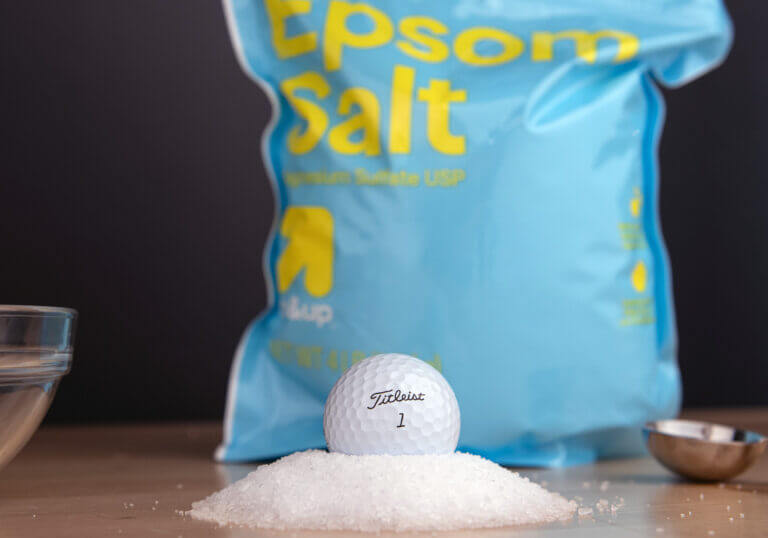
Should You Float Your Balls (in Epsom salt)?
Golf Balls

Should You Float Your Balls (in Epsom salt)?

Support our Mission. We independently test each product we recommend. When you buy through our links, we may earn a commission.

Should You Float Your Balls (in Epsom salt)?

The Epsom salt test for golf ball quality goes back a ways. There’s a 17-year-old video on YouTube where Ralph Maltby explains the process but that’s hardly its origin. The test itself likely dates back to balata.

It’s old-school, if not old-world, stuff.

But as is so often the case these days, Bryson DeChambeau recently reignited the Epsom salt conversation and, as a result, a string of posts has popped up. One I saw showed three TaylorMade balls floating in Epsom salt with the poster asking Bryson to weigh in on whether the balls were any good.

FFS, Bryson. See what you did?

golf ball epsom salt test

Bryson’s experience with Epsom salt isn’t new. When he signed with Bridgestone, he said it was because his Epsom salt testing showed the TOUR B to be the most consistent ball on the market.

It’s worth a passing mention that Bryson is now a Titleist Left Dash player.

Contracts were attached for both brands so I’m going to go ahead and float the idea that perhaps there’s a bit more than a salt test goes into what golf balls DeChambeau plays.

Anyway, given the renewed attention, we decided to dig in, kick some tires and see if maybe you should be floating your balls in Epsom salt.

How the Epsom salt test works (in theory)

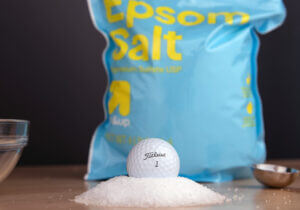
Without Epsom salt, golf balls sink in water.
Epsom salt allows balls to bob along the surface. Without it, they sink (but you knew that).

The test itself works like this: By mixing Epsom salt and water, you create a viscous solution. Instead of sinking like your last approach shot over water, the Epsom salt mixture allows the golf ball to bob along the surface.

From there, you place a Sharpie mark on the top of the ball to create a reference point. Once you’ve done that, give the ball a little flippy-tappy (this is highly technical stuff) to get the ball spinning in the solution.

If the previously identified and marked location on the ball returns to the original location quickly, then the ball is, in theory, imbalanced. This is bad because an imbalanced ball can fly offline when struck with a golf club (the more speed, the more offline it’s likely to fly) or roll offline on the putting green.

If the ball doesn’t return quickly to its original location or returns to a different spot entirely, it is balanced.

Does this actually work?

Kinda, not really, and it might depend on who you ask.

Bryson believes it works but we really should discuss the inarguable realities of why the Epsom salt test is problematic.

The result of the test is influenced, if not entirely dependent, on the ratio of Epsom salt to water. That is to say, if you expect a repeatable result from one day to the next, then your recipe needs to be precise every time you do the test. And, no, you can’t just mix once and leave it. Evaporation will get you.

There’s actual science at play here and the unintended consequence is that environmental conditions, temperature, humidity, altitude – your basic barometric pressure stuff – will also influence the result.

Even if your base mixture is consistent, if it’s not adjusted to compensate for changing conditions, your results will still be inconsistent.

I’m not going to sit here and tell you I put an exhaustive amount of research into this but, with a cursory check, I was unable to find any clear guidelines for adjusting the Epsom salt golf ball test to account for changes in environmental conditions.

In addition to the mixture itself, the speed at which a ball returns to its original point will be heavily influenced by (and try to stay with me because, again, this is highly technical) how hard you flick it.

It’s so obvious that I feel stupid saying it, but the repeatability and subsequent reliability of your Epsom salt test will be heavily influenced by the consistency with which you are able to flick or roll a floating golf ball.

Finally, since we’re basing the good/bad determination on the speed at which the dot returns to its original position, we need to define fast and slow. I haven’t seen anyone put a number on that and it’s by no small measure a subjective determination. And, to bring us back full circle, if your mix isn’t consistent, one day’s slow could be another’s fast.

Bryson’s fast might be your slow.

The point is that, under the best of conditions, the Epsom salt test, while loads of fun, is problematic.

With all of that said, I suppose you could do a year’s worth of balls at a time and make a reasonable evaluation as to which ones return to the original spot a bit too quickly. Even then, there are no assurances.

What do the experts think?

To get a handle on where the industry stands, I reached out to a few golf ball manufacturers to get their take.

One dismissed it out of hand.

A second told us the salt test is unreliable and isn’t needed with the quality control tools and procedures they have in place.

To my surprise, a third company had done some testing recently. I’ll spare you the suspense. Its take is that the test has little value.

To arrive at that conclusion, it started by asking Tour players to run the Epsom salt test. It took any balls those players identified as bad and retested them with more advanced methodologies before running them through performance testing.

They were unable to find any significant performance detriment and most of the balls passed all of their tests.

Most. Yes, we’ll come back to that.

In another test, weight was added to the outside of the golf ball to create an imbalance that was even more dramatic than you would expect from a ball with a layer concentricity issue or that is out of round.

Even in those extreme cases, the results of the Epsom salt test were inconsistent. Sometimes the expected result was returned; sometimes it wasn’t.

To summarize the findings, sometimes the Epsom salt test identified bad balls. Sometimes it failed to identify bad balls and sometimes it identified perfectly good balls as bad.

That last one isn’t problematic if you’re Bryson, but if you’re paying for golf balls, you can see where this might get expensive.

My two cents

Manufacturers will tell you that the QC checks they have in place are ultimately more reliable than a salt test. I’m going to tell you that’s almost certainly true. It’s also true that nobody is perfect and sometimes bad balls escape the factory.

What we’ve learned through our Ball Lab is that golf ball quality begins and ends at the factory level. Good factories make fewer bad balls so, ultimately, starting with a high-quality brand (and factory) is your best protection against bad golf balls.

But, sure, if you want to try the Epsom salt test, go for it.

I’m going to tell you it’s a waste of time and if the unreliability of the test causes you to start tossing perfectly good golf balls, it’ll be a waste of money as well.


For You

For You

News
Jul 23, 2026
The Best Blade vs. Mallet vs. Zero-Torque Putter of 2026: A Head to Head
Worst Golf Courses In America Worst Golf Courses In America
Golf Talk
Jul 23, 2026
The 10 Worst Golf Courses In America For 2026
News
Jul 23, 2026
A Putter Fitting From PING Changed My Game, Literally.
Tony Covey

Tony Covey

Tony Covey

Tony is the Editor of MyGolfSpy where his job is to bring fresh and innovative content to the site. In addition to his editorial responsibilities, he was instrumental in developing MyGolfSpy's data-driven testing methodologies and continues to sift through our data to find the insights that can help improve your game. Tony believes that golfers deserve to know what's real and what's not, and that means MyGolfSpy's equipment coverage must extend beyond the so-called facts as dictated by the same companies that created them. Most of all Tony believes in performance over hype and #PowerToThePlayer.

Tony Covey

Tony Covey

Tony Covey

Tony Covey

Tony Covey


    This site is protected by reCAPTCHA and the Google Privacy Policy and Terms of Service apply.

      rickyGgolf4152

      2 years ago

      A lot of people who are gullible enough to believe testing balls in this manner will actually help their game will lose them faster than they can test them. I know this for sure as I lose a lot of balls. The rate of loss factor would surely render this test useless for me and a lot of other people (average golfers). I am sure the test would only increase the rate and quicken the timing of ball loss.

      Reply

      SpanishHands

      2 years ago

      I am sorry, but being a fluid mechanics professor, I find several inaccuracies in your article and I think that the conclusions may also be wrong.

      What the salt changes is the water density. Golf ball density is slightly higher than water (1,12 relative density) and therefore balls sink in lakes. There is no minimum weight for a golf ball, so it is possible to manufacture legal balls that float (although performance-wise they would be bad).

      The idea of floating a ball is to find any imbalance in the mass distribution of the ball. A floating body experiments an upward force (Archimedes’ principle) that is applied in the center of the submerged volume (center of buoyancy). The weight of that body is applied in the center of gravity. When they are not aligned, an overturning moment (torque) appears and the body rotates until both centers are on the same vertical. 

      This is addressed as the stability of floating bodies:

      https://www.eng.uwo.ca/people/esavory/STABILITY OF FLOATING BODIES.pdf

      The idea behind floating the balls is based on:

      1) assuming that the ball is perfectly symmetrical (it should be)

      2) 

      a) if the mass is perfectly distributed in the ball (a great ball), there will be no rotation when we introduce it in water

      b) if the mass is imbalanced (bad ball, as one part is heavier than the other) then the lighter part will eventually end up floating up

      3) If we mark the top point, then the following will happen:

      a) if the ball is a great ball, when we rotate it, the ball will come to rest with a different point on top, since there is no lighter or heavier side

      b) if the ball is a bad ball, then the same point will end up again on top. 

      Since a ball is not a perfect sphere, this is not a exact science, but if we float a ball and the point we marked ends up on top after 2 or 3 trials, then, we definitely have a poorer ball than if it does not. 

      4) Finally, if we have a poor ball (it ends up floating in a similar way every time) then we should mark the line for the putter on top of that point, as that would mean that the equator passing through the heaviest-lightest point, will be in contact with the grass, and once we roll the putt, there will be no lateral forces adding to any existing breaks .

      I obviously have floated some premium balls that I play and I have found that most of them (Titleist) end up being good balls. None of them are extremely consisting in the top point floating up, but some do show a pattern. This would be consistent with the findings of the Lab at MyGolfSpy that finds some excentricities in balls layers, which obviously will have an impact on the homogeneity of the mass distribution. 

      Therefore, please do not discard the method. It is sound. A totally different matter is whether it is worth the effort given todays’ manufacturing standards. 

      Reply

      Dick Morris

      2 years ago

      Yeah, I got a 30 year old gyro that was supposed to show the balance of a golf ball and reduce strokes from my game, statistically, it did nothing other than give me something to do the night before a round.

      Reply

      Jeff Ward

      2 years ago

      I would like to see this done with a “Check n GO” ball spinner. I have used one forever and I can tell you it works. One brand was horrible over and over again for me. Some of the balls would not even stay in the device. I have never had one ball match up with the target line that the company puts on either. The current brand of ball I use, i average about 1 in 19 balls that are way off.

      Reply

      TonyG

      2 years ago

      It is interesting that you will read articles about how golf balls will absorb water and effect play (including this site). Then you see articles telling you to float your ball in water to check balance. Now before someone says “well you are only floating the ball for a minute or so”, those articles about golf balls absorbing water, never give you an acceptable amount of time. They just state that a golf ball will absorb water and cause issues.

      Reply

      Craig Brown

      2 years ago

      I tried the Epsom salt test with a dozen new balls. After.marking the top of the ball, I could not get any ball’s dot to return to the top or even above the water level.

      This tells me two things:
      1. Today’s balls are pretty well manufactured.
      2. The olden balls, especially wound balata, probably were not consistent ball to ball even from same days batch.

      If.my balls are performing inconsistently, it is more likely my skill, or lack thereof, than manufacturing “failure”.

      Reply

      Tim Radtke

      2 years ago

      You are a lucky man, Craig. I have not had the same success. I have had some pro v’s and tp5’s that were out of balance. Unless the ball indicates it has been checked for balance you are taking a chance.
      So, if you hit that putt and you’re sure it was a straight putt and you missed by an inch perhaps you should test that ball – just saying.

      Reply

      William Dickman

      2 years ago

      I went to playing Bridgestone balls after I ran a ” wobble” test. I roll 5 major brands of balls down a stimpmeter. Each ball was marked with a ” Sharpie” circle and I measured how far they rolled end over end before they started to ” wobble” …. They Bridgestone balls beat everybody by at least 4 feet. That was the last time I played a ProV ball.!

      George P. Burdell '75

      2 years ago

      Another Ga. Tech engineer here (not on the golf team – but I paid attention in fluid dynamics class.). You’re over-thinking the environmental conditions issue, as you’re only using the epson salts to make the ball float (by changing its buoyancy) when you do each test. The key is being certain that a good portion of the ball is above the water line, it’s completely at rest, and not influenced by the side of the bowl, etc. before marking. After “flicking” it you need to wait until it comes to rest again, and multiple trials are better to be sure your “flicks” are random. If the dot CONSISTENTLY returns to the top, that indicates the center of gravity of the ball is significantly off-center (and closer to the bottom of the ball when the mark is on top). This should only happen if the CG is grossly off-center, which I’d think would be infrequent with any quality ball made these days.

      Reply

      Russell Stevens

      2 years ago

      I learned this “trick” from Ben Hogan circa 1970’s. It was slow and laborious with wound balls, nowadays balls are more consistent, and I am not a good golfer since 2016, hence I do not look for every 0.5 stroke advantage. And I still have my ball spinner which was not as consistent, but did help with putting having the ball roll with the weighted line rolling with the least deviation.

      Reply

      Scott Denton

      2 years ago

      back in the 70’s. I played with cheap, low end golf balls. majority appeared out of balance. also seams affected flight of ball when struck directly on them. Dave Pelz ,golf coach,Nasa Physicist explored this concept of balance and explained it convincingly.

      Reply

      Hopp Man

      2 years ago

      If it is on the internet or youtube, must be legit, especialy if Decahambeau is doing it. /s

      Reply

      Mick

      2 years ago

      I use the check-go pro spinner to find the center of gravity to align for tee shots and putts. Doesn’t matter if the ball is balance or not balanced it will show the line for where the heavier aspect of the ball is so it can be aligned in the direction of travel and thus less likely to pull off to the side. Now I know you’re thinking a balanced ball doesn’t need it. But even if doing the salt water test, theoretically you would have to do it extensive enough to see if the ball had the opportunity to come to a different stopping point at every dimple in order to say it’s perfectly balanced. Even balls that show to be good in the salt water as balanced, you can’t say are perfectly balanced and that’s where I feel the check go helps. I personally don’t have time to do the salt test. But checking a dozen balls with the check go only takes a few minutes and I do think it makes a difference on putts especially longer ones.

      Reply

      Roger

      2 years ago

      I am 62 and possibly a solid 30 handicap – thus the occasional breaking 100. Engineering by training, I started using a different method years ago.

      I do not float my balls in a solution. BUT, I use a golf ball spinner like this one: https://a.co/d/7Wfr6bA

      Bought mine years ago and I spin every ball. The law of physics – gyroscope effect – forces the ball to spin along an axis where the axis will go through the true centre of gravity. Effectively, every ball would then be drawn with a line going along its equator with the heavier side at the bottom of the ball while the ball is in this “ball spinner”. As such, it is NOT to separate the good vs. bad balls but every ball has a “preferred axis of rotation by gyroscopic effect” – in other words, it may make a difference at the tee box as when you tee it up with a shorter iron, it tends to spin more closely to the speed the ball spinner is in.

      At my handicap level, I suppose it still don’t matter much at putting or on the tee box.

      Reply

      Richie Hunt

      2 years ago

      I tried the epsom salt test back when I read about it in Dave Pelz’s book ‘Putt Like The Pros.’ That was around 1992. When I tried it back then it had merit. I remember having one ball (a Rextar) that was severely off balance. We used to have this round metal device to make sure the golf balls were still round. The Rextar was straight ouf of the box and was still round, but it was so severely off balance one could easily see it affecting the putts. But when I tried it out in subsequent years I could never really find a really bad out-of-balance ball quite like the old ones were.

      Reply

      Kansas King

      2 years ago

      Why not test it?

      Get a dozen or more of balls that you have found have poor quality control and test them with the saltwater test. Then cut them all in half and see if the test is accurate. This doesn’t seem to be up to MGS standards of actually testing things. This is just opinion spewing because theoretically the saltwater test is valid. It’s just a matter of if the test is consistent enough using the human touch.

      Also, you mention that ball manufacturers have better ways of testing during their QC checks. If that were truly the case, then you wouldn’t need to do any of the ball testing you do then.

      Test the balls and get back to the readers with the results. We’re genuinely curious.

      Reply

      Cory.JustGolf

      2 years ago

      So do you want them to do the test and THEN tell you they think the results are completely meaningless and invalid or tell you they think the results are completely meaningless and invalid and then do the test?
      Tony obviously has a strong (and pretty well informed given everybody he reached out to) opinion on this, so asking to dedicate time and resources to extensively testing it is about as likely to happen as asking to test placing balls between chakra crystals to improve performance.

      Reply

      HikingMike

      2 years ago

      Cutting them in half does not show where the center of gravity is. It might hint it if you can see the layers are not aligned properly, and this does occur on some balls in Ball Lab I believe. Otherwise I agree with your sentiments. There is still a potential test here of some kind that can be done for MGS Ball Lab.

      This article doesn’t actually say it doesn’t work. It says the test is not repeatable and doesn’t have a good quantified result. Ok, so we need a better test. Use better environmental controls. Use some other method of “flicking” the golf ball. Or something else altogether that finds the center of gravity. Find some way to measure results. Tire shops do it when balancing tires, though that’s kind of 2D instead of 3D, and a bigger object that’s easier to manage.

      “During a tire balance service, a trained technician mounts your wheel and tire assembly onto a tire balancing machine. The machine spins the wheel and tire assembly to determine the amount of imbalance. Using that information, the technician can install the correct wheel weights to properly balance the wheel and tire.”

      Reply

      Jack Taylor

      2 years ago

      Feel free to send me all of your bad ProVs.

      Reply

      Brendan

      2 years ago

      The Epsom salt makes the water more dense than the golf ball and thus the golf ball floats. It is not viscosity. If it were viscosity then a ball would float in olive oil (more viscous than water but less dense).

      Reply

      Rich

      2 years ago

      Yeah I’m not sure why he’s talking about all of these variables when the salt is literally just there to keep the ball only partially submerged, with just enough sticking out to be able to mark it. Needing an exact recipe and accounting for evaporation is crazy. No idea if the salt test itself is worth it in the long run, but inconsistencies in the setup is not the issue with it.

      Reply

      Neal Watts

      2 years ago

      Absolutely correct. And if you saturate the water with salt, Eva ration doesn’t matter, because the excess salt will simply come out of solution and the buoyancy of the water will remain the same

      Paul

      2 years ago

      This is correct. Only the density of the fluid is important here. The introduction of irrelevant physic’s principles makes the argument much less convincing.

      The saltwater test is inconsistent because of procedural factors. I think it is very plausible that golf ball companies have more consistent tests at their disposal. That is not to say that the saltwater test is wrong or unreliable, just that it will result in inconsistent quantification of the relative positions of the centre of mass and centre of buoyancy of the ball being tested.

      Reply

      HikingMike

      2 years ago

      Kind of bugged me too. It’s all down to the density.

      Reply

      tlh67

      2 years ago

      I used to spin balls with epsom salt and a drop of dishwashing rinse aid (not soap but the stuff that get rid of spots on your dishes). The rinse aid is suppose to reduce the friction when you are spinning the ball. After spinning the ball I would mark it and then spin it several times. As you know the theory is if the ball comes up in a different spot each time then it is balanced. From my experience there would be only 2 or 3 balls in every dozen that were balanced, even with the ProV.

      Reply

      Kirk McCreadie

      2 years ago

      Excellent article. Thanks for the information, was seriously considering running this test but you’ve convinced me would likely just a be a waste of time. I have my preferences in golf balls now after doing some ball fitting online and research and happy with what I’ve learned and currently using. (Callaway Super Soft for the curious minded)

      Reply

      Leon

      2 years ago

      Wouldn’t the changing environmental conditions issue be mitigated by making a fresh solution each day and putting a ball in the water before adding the salt, then add only enough salt, in small increments of, say, 1/4 teaspoon, to get the ball to float?

      Reply

      Joe Lafives

      2 years ago

      If you can get the ball to flow and it moves freely, in effect you are doing a dynamic balance check just like tires. If the ball moves forward and then settles BACK, it’s out of balance.

      Reply

      Stoutz

      2 years ago

      I think it only works if you are on a boat in a salt water sea

      Reply

      Dok

      2 years ago

      But only after you cross the international date line.

      Reply

      Dan

      2 years ago

      I’ll admit to trying out this ball test and found it inconclusive on a dozen Maxfli balls. This may be because the balls were all “good” but I observed other problems with the test that made it unreliable at best. There are 2 major variables that are unrealistic to control. 1. any small bubbles of air trapped in the dimples underwater and 2. water remaining in the dimples above the waterline. I would not expect the type of salt or concentration to have much of an issue as long as there is enough for the ball to float and for there to be an exposed area above the water where you could make a mark.

      Reply

      John

      2 years ago

      I am a retired engineer who played golf for Georgia Tech a long time ago. I have been floating balls and spinning balls for quite a while. It started when I was testing some different line patterns on three balls when putting on a Birdie Ball mat in my basement. I had 3 “identical” ProV1 balls, each with a different style of lines. After a lot of putting, I noticed that one of the three balls tended to miss just left of the hole, one went in most of the time and one missed right by a small amount. I floated all the balls and found out that the on two that missed consistently to one side or the other, the mark was not in line with the lines on the ball, so the heavier side was pulling the ball to one side as it rolled. On the ball that rolled straight, it turned out that the dot was very close to the lines so the ball was rolling with the heavy side going end over end and didn’t pull the ball to one side.

      Prior to noticing this on that day putting, I had believed that the current manufacturing tolerances were good enough that floating or spinning wasn’t needed. That is no longer the case. I do not consider how fast the dot returns to the surface (although in theory that should indicate how out of balance a ball is), but I do make sure I mark my golf balls so the heavy side is rolling end over end and won’t cause a ball to pull to one side.

      Sometimes, but not very often, I find a ball where the ball won’t come to the same resting position after spinning and that indicates a ball that is perfectly balanced (or very close to it). To me, if I can eliminate one variable that could possibly cause a good putt to miss, I am increasing my chances to make the putt. I fully understand that there are many imperfections in putting surfaces that can also cause a well struck putt to miss, but to me, eliminating an unbalanced ball is sort of like fixing a ball mark in my line. If the rules allow me to do it, I will because it increases my odds of making a putt.

      Reply

      Pablo Sola

      2 years ago

      You don’t need to do it with Epsom salt. Table salt is exactly the same for this test

      Reply

      HackerBill

      2 years ago

      I’m going to try this method of testing golf balls as soon as I’m done with the need on thread over my wrist to determine if my daughter is having a boy or a girl baby

      Reply

      HackerBill

      2 years ago

      *needle

      Reply

      MarkM

      2 years ago

      I’m not sure asking ball manufacturers what they think of this test is the best option as they obviously have their own interests at heart. But I have to agree that these days, unless you really have nothing to do, it’s not worth the time because the quality and consistency of the top “tour” balls are so good.
      I used to do the epsom salt thing (and used a Check-Go too) back in the balata days up until about 10 years ago and it did weed out a lot of bad balls. It used to be a minimum of 3 per dozen and those would go in the shag bag. Once it became apparent it was a waste of time I stopped.

      Reply

      Brian

      2 years ago

      I did this about 6-7 years ago and did discover some bad/unbalanced balls, but really only with cheap/DTC balls. The Bridgestone and Pro-V1 balls were always good (as confirmed by MGS Ball lab). So, I just switched to Pro-V1 and don’t have to think about it anymore.

      Reply

      Vito

      2 years ago

      First, you don’t need to use Epson salt. Regular table salt will do the same thing, increase the density of the water. Second, I use it only to identify really bad balls. I usually do this in mid winter after buying a years supply at Christmas sale prices. The key is to do each ball multiple times. If the results repeat, then you have a bad ball. If it’s inconsistent probably not. I usually do this while watching a football bowl game or NHL hockey so I’m not bored to tears. Oh yeah, I never throw the bad balls out. I give them to my playing partners.

      Reply

      Goran Barnes

      2 years ago

      Another great article!

      To “keep the party going” you’ve tested used or second chance golf balls extensively, and your conclusion is they grossly underperform compared to brand new golf balls.

      So, for poop and giggles, put these used or second chance golf balls to the salt test and in theory majority of these should fail?

      Reply

      Mark

      2 years ago

      I can’t remember the year, I think in early 2000’s but when Wilson brought out their true golf ball they had a robot putting other companies golf balls and their true ball and the results were actually scary. The Strata tour ultimate was the worst. It was basically a 5 or 10 foot putt and the unbalanced balls when the heavy side was put to the right or left, that ball missed the cup. When the ball had the heavy point straight up it went in. Then They sent out these displays that had multiple golf balls in them and a salt water mix you could shake it and every other golf ball came up with the same marked spot pointing up. The true ball had multiple dots on it and it never was in the same position. To bad that ball was super short.

      Reply

    Leave A Reply

    required
    required
    required (your email address will not be published)

    This site uses Akismet to reduce spam. Learn how your comment data is processed.

    News
    Jul 23, 2026
    The Best Blade vs. Mallet vs. Zero-Torque Putter of 2026: A Head to Head
    Worst Golf Courses In America Worst Golf Courses In America
    Golf Talk
    Jul 23, 2026
    The 10 Worst Golf Courses In America For 2026
    News
    Jul 23, 2026
    A Putter Fitting From PING Changed My Game, Literally.