

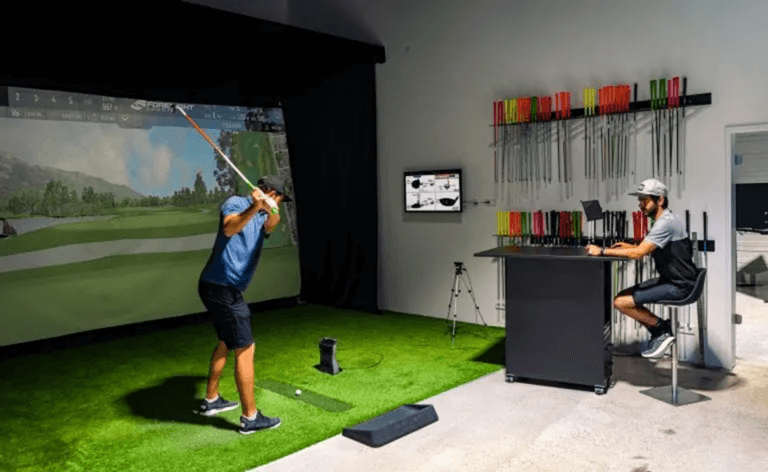
Should You Get Fitted Or Just Buy New Irons? What I’d Tell Any Golfer After Going Through It
News

Should You Get Fitted Or Just Buy New Irons? What I’d Tell Any Golfer After Going Through It

Support our Mission. We independently test each product we recommend. When you buy through our links, we may earn a commission.

Should You Get Fitted Or Just Buy New Irons? What I’d Tell Any Golfer After Going Through It

Last year, I went through three different fittings: driver, irons and wedges.

They were all worthwhile. I learned something from each one and I’m happy with the equipment I ended up with.

But if you asked me which one I’d recommend first, it’s irons.

I’ve been playing golf for more than 30 years and every time I’ve gone through an iron fitting, it’s made a noticeable difference in my game. Here’s why.

You hit more iron shots than you think

Yes, the putter gets used the most. But if we’re talking about full swings, irons are where most of your round happens.

Approach shots, layups, recovery shots, par-3s—you’re constantly relying on them. And they have to do a lot.

I need to be able to flight them down or hit them high depending on the situation. I need to trust where the ball is starting and how it’s going to land. I want distance but I also need control.

That’s a tough combination to get right if the clubs don’t match your swing.

Iron shafts are a different animal

For me, one of the biggest reasons iron fitting is worth it is the number of shaft options.

With a driver, there are a lot of options but I know it will be graphite and it’s pretty quick to figure out the proper flex and then we dial in the rest.

Irons are different.

Now you’re deciding between steel and graphite, then weight, flex, launch profile and feel. It adds up fast and it’s not easy to sort out on your own. It might not even stay consistent throughout the entire set.

Even if you understand the basics, it’s hard to know what really works without seeing the numbers and feeling the differences side by side.

It’s gapping, too

Gapping was part of the process for me when I had my iron fitting last year.

I play the Titleist T250 but I carry a T350 5-iron. That combination gives me better spacing at the top of the bag without sacrificing control in the scoring clubs. That’s not something I would have figured out on my own or if I had hit just a few 6-irons at a test facility and decided on what I thought was best.

Iron gapping is important and it’s more than loft. Speed, spin and launch all play into it.

Let’s talk about cost

I get it. Cost matters.

The last set of irons I had made it into the bag because I found a good deal. They weren’t a fit for my game and I felt it. I had to learn to adapt and make them work.

Here’s my advice.

At some point, pay for a proper iron fitting. Get the data. Ask questions. Take pictures. Get a printout.

Then use that information however you want. If that leads you to a brand-new set, great. If it leads you to a three-year-old model with the right shaft and specs at half the price, that works, too.

It’s not about spending more. It’s about finding something that fits so you’re not fighting your equipment every time you play.

Final thoughts

If you’re deciding whether to get fitted before buying irons, I’d do it.

You could probably convince me to put a driver, fairway wood or hybrid in the bag without a fitting. Irons are just different. They influence too many shots and require too much precision to guess your way through it. In an ideal world, get fitted for every club in your bag.

Next on my list? A putter fitting.

I’ve had the same putter in the bag for 20 years. Feels like it might be time.

For You

For You

Instruction
Jun 9, 2026
If You Still Play Long Irons, Copy This Thought From Ludvig Åberg
PLM 2025_Most Wanted_Foresight GC3 PLM 2025_Most Wanted_Foresight GC3
News
Jun 9, 2026
College Golf Tournament Prep Looks Nothing Like It Did When I Played
News
Jun 9, 2026
The Best Father’s Day Golf Gifts That Won’t Break the Bank
Brittany Olizarowicz

Brittany Olizarowicz

Brittany Olizarowicz

Britt Olizarowicz is a scratch golfer, former teaching professional and one of MyGolfSpy’s leading voices on equipment testing and golf performance. She has spent more than 15 years working at private clubs in New York and Florida and now specializes in translating test data and swing mechanics into practical advice for everyday golfers. Britt began playing at age 7 and has never left the game. When she’s not writing, you’ll find her on the course, playing pickleball, cooking, running or out on the boat with her family.

Brittany Olizarowicz

Brittany Olizarowicz

Brittany Olizarowicz


    This site is protected by reCAPTCHA and the Google Privacy Policy and Terms of Service apply.

      CK

      3 months ago

      I would say go through the fitting but always walk out of there with feels the best to you. When you get on the course that’s all that matters.

      Reply

      Andrew the Great!

      3 months ago

      Here’s my experience with getting fitted for irons (one of which was at a ballyhooed TaylorMade Kingdom site): you get fitted for ONE iron – likely the 7 – and the rest of the set is built from that. You do NOT get fit for each of your 4-9 irons. As a result, your 4, 5, 6, 8, and 9 are guesswork, not fitted.

      Reply

      Trevor Ferguson

      3 months ago

      This is a great call out. Places like Club Champion absolutely fall short in my opinion because of this exact aspect, especially at the prices they charge. Another consideration within the same vein of thinking, how about all of the shafts that have profile/weight changes based on which club they go into? Like the True Temper AMT line, how the heck are you supposed to know if it works for you if each one of them has a different weight that is specific to each club, but you only hit the seven iron!?

      Reply

      WiTerp50

      3 months ago

      Even the pros go through a fitting. That 80% of them have mixed sets says something. They don’t guess what they need. If a 4 or 3 iron from a set isn’t giving them the distance and window, they search out an alternative.
      I cringe when someone asks about what they should mix into their set. That there is an 80% chance that some mixed set will work is one thing. Even before they get to that point, they’ve already selected the base iron set and shaft. Then they want to adjust the lofts of the mixed components before even trying the primary clubs. That’s not how it works. Or least not optimal.
      Before paying $1500 (or more) for irons or $500 for the newest putter or whatever a pro won with last week, the only result not based on luck is finding a good fitter to all clubs other than putter on turf approaching your regular home area conditions. An indoor putting with all the electronics to analyze your stroke is better than on turf to rule out grain and slope to find your best fit.

      Reply

      Gary

      3 months ago

      I can’t imagine buying clubs without a fitting. Spend $1500 but save $100? I think the best fitters are brand agnostic. Only recommendation I would make is make sure they’re not there to upsell shafts. Some fitters don’t make money off OEM shafts. You want someone who will fit you into stock shafts if that’s the best. The other challenge is DTC clubs. It’s hard because you’re going off of paper information . I do believe they have some stock shafts that work with their irons, but getting upgraded shafts is tricky. Then the issue of used clubs. Sometimes the club works but not the shaft and you can really try different shafts in a used clubs. They will eventually sort out with AI or something a way to get fit with used clubs and potential shafts. I grew up playing before fittings. Played standard lie clubs where 2° upright was the necessary fit. Consequently I never knew how to hit a draw until I got fit years later in my first set of PING irons. Can’t imagine playing clubs not fit for me.

      Reply

      Jon

      3 months ago

      I went through a fitting with a well recognized brand, and learned a lot. I also spent a lot. In the end, I invested over $3,000 in new irons and a putter. After struggling for a month, numerous range sessions, and watching my handicap soar, I revisited the fitter. We made some tweaks and I went back to playing with the revised set of new irons. I gave them a real honest try, but the inconsistency was frustrating. In the end, after seven weeks of struggle, I went back to my old irons and immediately saw my score improve. I appreciated the exercise, learned some stuff about my “numbers” and also paid the stupid tax. I agree fitting is good, but I would encourage any one getting fitted to do it on a grass range. The fitting inside was not the same, and my results reflected that. I’ll never do a fitting like that again, and likely given my experience will never do a fitting again. I’m a 3 handicap, and sometimes searching for scratch is less in equipment than we may want to believe. Just my two-cents to the discussion.

      Reply

    Leave A Reply

    required
    required
    required (your email address will not be published)

    This site uses Akismet to reduce spam. Learn how your comment data is processed.

    Instruction
    Jun 9, 2026
    If You Still Play Long Irons, Copy This Thought From Ludvig Åberg
    PLM 2025_Most Wanted_Foresight GC3 PLM 2025_Most Wanted_Foresight GC3
    News
    Jun 9, 2026
    College Golf Tournament Prep Looks Nothing Like It Did When I Played
    News
    Jun 9, 2026
    The Best Father’s Day Golf Gifts That Won’t Break the Bank