




Playing “shots” on the golf course can be overdone.
If your natural ball flight is a fade, you probably do not need to spend the entire round trying to decide whether each pin calls for a draw. The same goes for a player who naturally turns the ball over. Even the best players in the world rely heavily on a stock shot because golf is hard enough without trying to manufacture a different ball flight every time.
However, there are situations where being able to move away from your normal shot pattern can help.
Maybe you need to keep the ball below the wind. Maybe you have to get it up quickly over a tree. Sometimes, your normal curve simply does not fit the shot in front of you.
That is where the nine-shot matrix comes in.
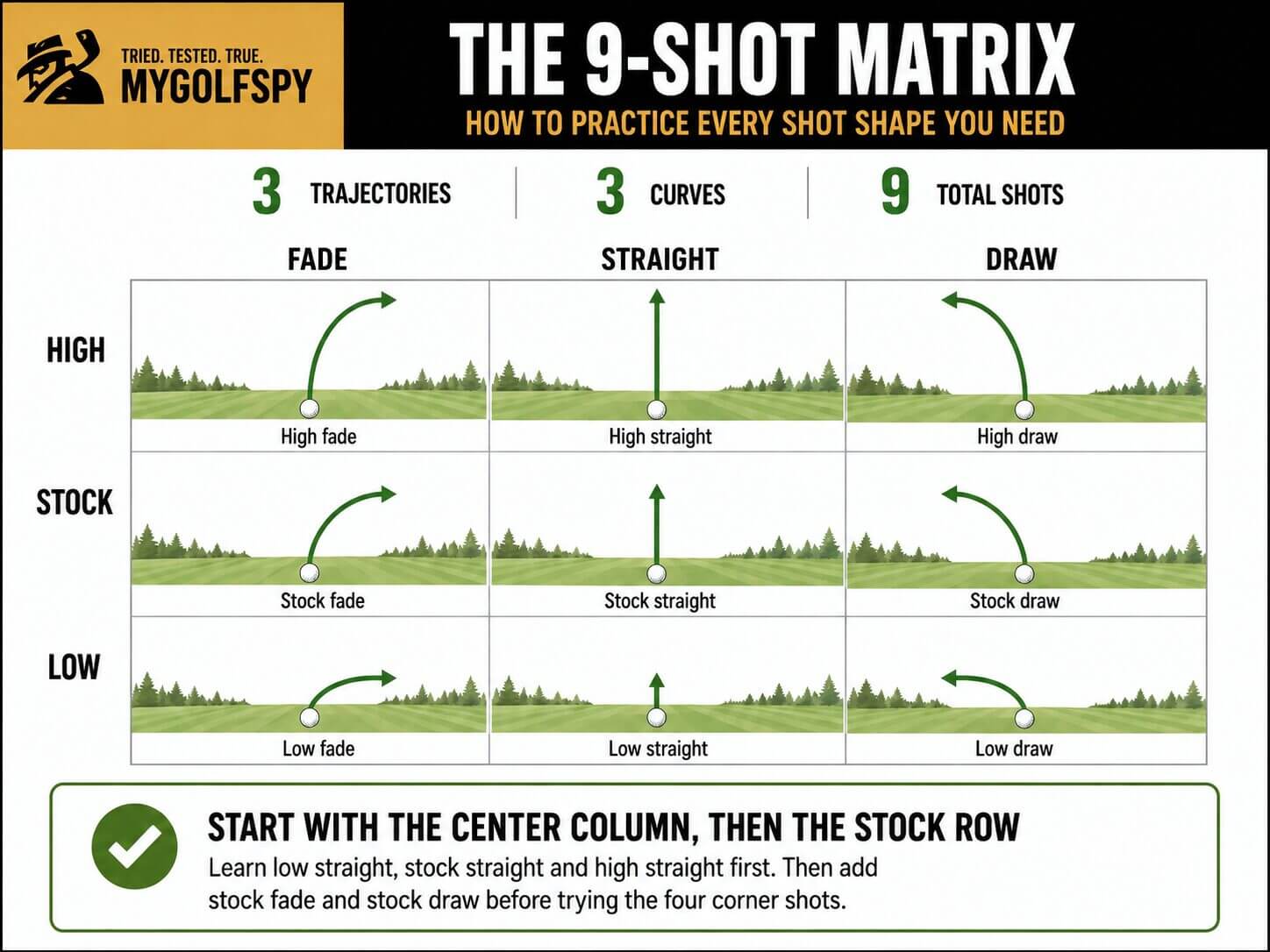
The idea is simple: combine three trajectories (low, stock, high) with three shot shapes (fade, straight, draw).
| Fade | Straight | Draw | |
|---|---|---|---|
| High | High fade | High straight | High draw |
| Stock | Stock fade | Stock straight | Stock draw |
| Low | Low fade | Low straight | Low draw |
You do not need all nine of these shots to play good golf. Think of the matrix more as a practice exercise that teaches you how to control ball flight. And while there are several ways to create these shots, I think the easiest place for most golfers to start is with setup.
Instead of trying to learn nine different swings, we are going to change the setup and keep the swing itself as normal as possible.
For the examples below, assume a right-handed golfer. Left-handed players can reverse the directional adjustments.
Start by controlling trajectory
Before worrying about curve, work down the center column of the matrix.
Hit a low straight shot, your normal straight shot and a high straight shot. The goal is simply to see how much you can change the window while keeping the ball moving in essentially the same direction.
For the low shot, move the ball slightly back from your normal position, grip down a little and favor the lead side slightly at setup. A little forward shaft lean can also help you deliver less loft.
The important part is what happens next. Make a normal, balanced swing. You do not need to chop down on the ball or force your hands dramatically ahead.
For the high shot, work in the opposite direction. Move the ball a little farther forward and let the handle sit more neutrally so you can preserve some loft.
What you do not want to do is hang back and try to scoop the ball up. You are creating conditions at setup that make a higher launch easier and then letting the club do the rest.
Your stock trajectory stays exactly that: your normal setup and normal swing.
Once you can see a clear difference between low, stock and high, move on.
Next, work on curve
Now go across the middle row of the matrix.
Start with a stock fade, stock straight shot and stock draw. Keep the trajectory relatively normal and focus on changing the direction the ball curves.
The setup does not guarantee the shot. The clubface and path still have to work together at impact. The goal is simply to make those conditions easier to create without feeling like you need a completely different swing.
For a fade:
- Move the ball slightly forward of your stock position.
- Aim your body a little left of the target.
- Keep the clubface aimed closer to the target than your body is aimed.
- Make your normal swing along your body line.
For a draw:
- Move the ball slightly back of your stock position.
- Aim your body a little right of the target.
- Keep the clubface aimed closer to the target than your body is aimed.
- Make your normal swing along your body line.
With the straight shot, go back to your normal ball position, alignment and clubface position.
I would leave grip changes out of this at first. You can certainly manipulate the grip or add different release feels to shape shots but that gives you several more variables to manage.
Put the pieces together
Once you can control trajectory and curve on their own, the four corner shots are really just combinations of the same setup changes.
- Low fade: Ball slightly back, body aimed left, clubface aimed closer to the target, grip down a little and favor the lead side.
- High fade: Ball slightly forward, body aimed left, clubface aimed closer to the target and keep the handle more neutral to preserve loft.
- Low draw: Ball slightly back, body aimed right, clubface aimed closer to the target, grip down a little and favor the lead side.
- High draw: Ball slightly forward, body aimed right, clubface aimed closer to the target and keep the handle more neutral to preserve loft.
From there, make your normal swing along the setup.
You are not trying to invent four more golf swings. You are just combining the trajectory and curve adjustments you have already practiced.
The easiest way to practice the nine-shot matrix
I would work through this process in a deliberate way. You’re going to notice that there are certain shots you like hitting and can repeat easily and those that are hard. For instance, I have a hard time hitting a low fade but the high fade isn’t an issue. It’s not that I wouldn’t use it in a round but I’m less likely to.
If you can go through this chart and add at least one more than one shot to your bag, you’re going to help your game. Having the ability to create shots (when needed) will get you out of trouble and help you be more aggressive.
I’d use a 7-iron or 8-iron. Start with your high and low stock shots and then move to the stock fade and draw. The others get difficult but are worth experimenting with. Give yourself a little room for success here. If you normally hit a fade and you manage to turn one three yards right to left, that counts. You are learning to influence ball flight.
You probably will not use all nine
If your stock shot works for the vast majority of the shots you face, keep hitting it. There is no reason to make golf more complicated just because you know how to hit a draw.
The value of the nine-shot matrix is knowing what to do when your stock shot does not fit the situation..
More importantly, practicing gives you a much better understanding of how ball position, alignment, clubface position and delivered loft influence the golf ball.








Joe
3 weeks ago
Do you follow Decade golf and the statistics of tour players relying on a stock shot vs 9 windows?