


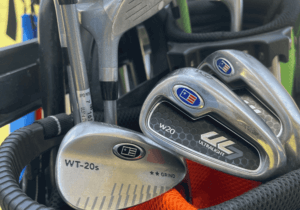

As a former junior golfer who turned pro, nothing has come close to the satisfaction and joy of teaching my own kids to play golf. It’s been one of those rare experiences that brings out the best parts of the game—patience, precision, passion—and shares them with my favorite people. My kids are 8 and 10 now, and we’re hitting that inevitable phase of outgrowing golf clubs almost every season. Along the way, I’ve learned what to look for when buying kids’ golf clubs and how to set them up with the tools they need to succeed.
Height range matters

When buying golf clubs for kids, most companies will give you a height range to help you with club fitting. These ranges are sometimes several inches and that can be a problem.
You’ll want to look for clubs where your child is at least a half inch taller than the minimum height range. I’ve always found that kids who have clubs that are slightly short have much more confidence than those with clubs that are too long.
The U.S. Kids golf clubs break down their sets into four-inch height ranges. Therefore, a child who is 40 inches tall can choose the set that is designed to work for children 39 to 42 inches tall.
With other manufacturers like the Wilson Kids Profile JGI Complete, the recommended height range is 40 to 50 inches for the small set.
If you invest in something like this, make sure your child is close to 45 inches tall. Otherwise, they will struggle with the length and weight of these clubs for a bit.
Golf club weight
Kids’ clubs may seem lightweight to you as an adult but it’s a big ask to have a young kid swing this club dozens of times with any consistency.
Club weight is another factor to consider. My daughter has very good swing mechanics but the weight of some junior golf clubs made it difficult for her to generate enough speed when she was younger. We found something lighter and it helped her gain more speed.
The bottom line is that not all kids’ clubs are created equal when it comes to weight. The U.S. Kids Golf U.L. series is great if you have a young golfer who may have a smoother swing but a little less speed.
Set makeup: Start with basics, add as needed

A good junior starting set includes:
- A fairway wood (this way, they can use it off the tee or from the fairway)
- An iron or two
- A wedge
- A putter
This is all your child needs initially. You will almost instantly know when they need additional clubs.
My kids were struggling to get out of the rough so we added hybrids. When they started hitting their 9-iron or 7-iron a consistent distance, I filled in the gaps with additional irons.
Get the sand wedge
Take away most of your swing speed, put a 9-iron in your hands and try to get out of a bunker with a wall in front of you that’s two to three feet over your head.
It doesn’t work. Kids need a sand wedge with lots of loft.
They’ll need it to get out of bunkers and to improve their short game. The confidence a kid gets from hitting a high shot is hard to match. A great wedge makes golf more fun.
Consider switching out the putter
Junior sets come with putters and they aren’t always great. At some point, both of my kids told me they thought they needed to try a different putter to play better.
I was doubtful at first but I cut down an old putter of mine for my son and found a second-hand putter for my daughter and let them give it a try. I saw an immediate improvement in their putting.
The point is that even young kids can sometimes sense that a club is or isn’t right for them. Find a few used kids’ putters and let them switch out. You may have a few putters in your garage, too. Sometimes a putter change can make all the difference.
Play the used clubs game

Kids grow fast. They will outgrow golf clubs almost as fast as they outgrow clothes and shoes. I’m constantly looking for used clubs to purchase, even if they are a little longer than we need right now.
Recently, I found someone selling a used U.S. Kids set that was a size too big for my daughter. I picked it up for a great price and she has already switched to the driver, which is a little big for her, but she wants the extra yards. (Can we blame her?)
Having extra clubs in slightly different sizes allows us some flexibility in ensuring everyone always has what they need. When we are done, we pass them on again.
Replacing junior grips is just as easy as it is for adults. All you need is a clubhead and shaft in decent shape, and you can easily put on a new grip.
Club fitting: When and why
If your child is just starting to pick up the game casually, a club fitting is likely not necessary. Junior golf club manufacturers make purchasing clubs based on your child’s height simple enough.
If your child becomes interested in playing tournaments and is really starting to develop clubhead speed, a club fitting makes sense.
Final thoughts
The goal when buying kids’ golf clubs is to put golf clubs in your kids’ hands to help them find success. All it takes is a few shots up in the air, an escape from a bunker and a long putt that drops to give a child the golf bug. Choosing the right equipment can help get you there.









FakeRichGuy
2 years ago
Great advice. When I was a kid in the early 90’s, I had clubs that I could barely swing because of the weight. I don’t know if they were cut downs, or just a bad set. That, combined with trying to play off the reds when I couldn’t hit the ball more than 100 yards, really ruined the game for me for a long time.