



Golf would be a lot simpler if we could set up and swing the same way regardless of the club we have in our hands. Sadly, that’s not golf. One of the most important adjustments is your ball position or placement. Mastering ball placement for irons involves understanding what are long irons, mid-irons and short irons and where they should be positioned relative to the center of your stance. If you want to hit more consistent iron shots, use this guide to better ball placement for irons.
Continue Your Instruction Journey
Our instruction content combines insights from equipment testing, data analysis, and golf experts to help golfers improve with evidence-based advice. You’ve fixed one part of your game. These guides help you take the next step.
🎯 What tees should I play? Use this chart!
🛑 How should the driver sit at address? Many golfers still get this wrong!
🏌️ If you miss the center of the face, try THESE irons.
The key to correct ball placement – stance width
The piece of this puzzle that many amateur golfers is missing is the adjustments to the stance width. You’ll move the ball around much less if you know how to adjust the width of your golf stance. In this video from Kerrod Gray, you’ll learn how to find a consistent placement for the golf ball with irons and then adjust your stance according to the loft of the golf club.
Ball placement chart for irons
The diagram below should help you determine the best ball placement for your irons. The biggest issue that golfers have is struggling to get the stance width correct. Give this a shot.
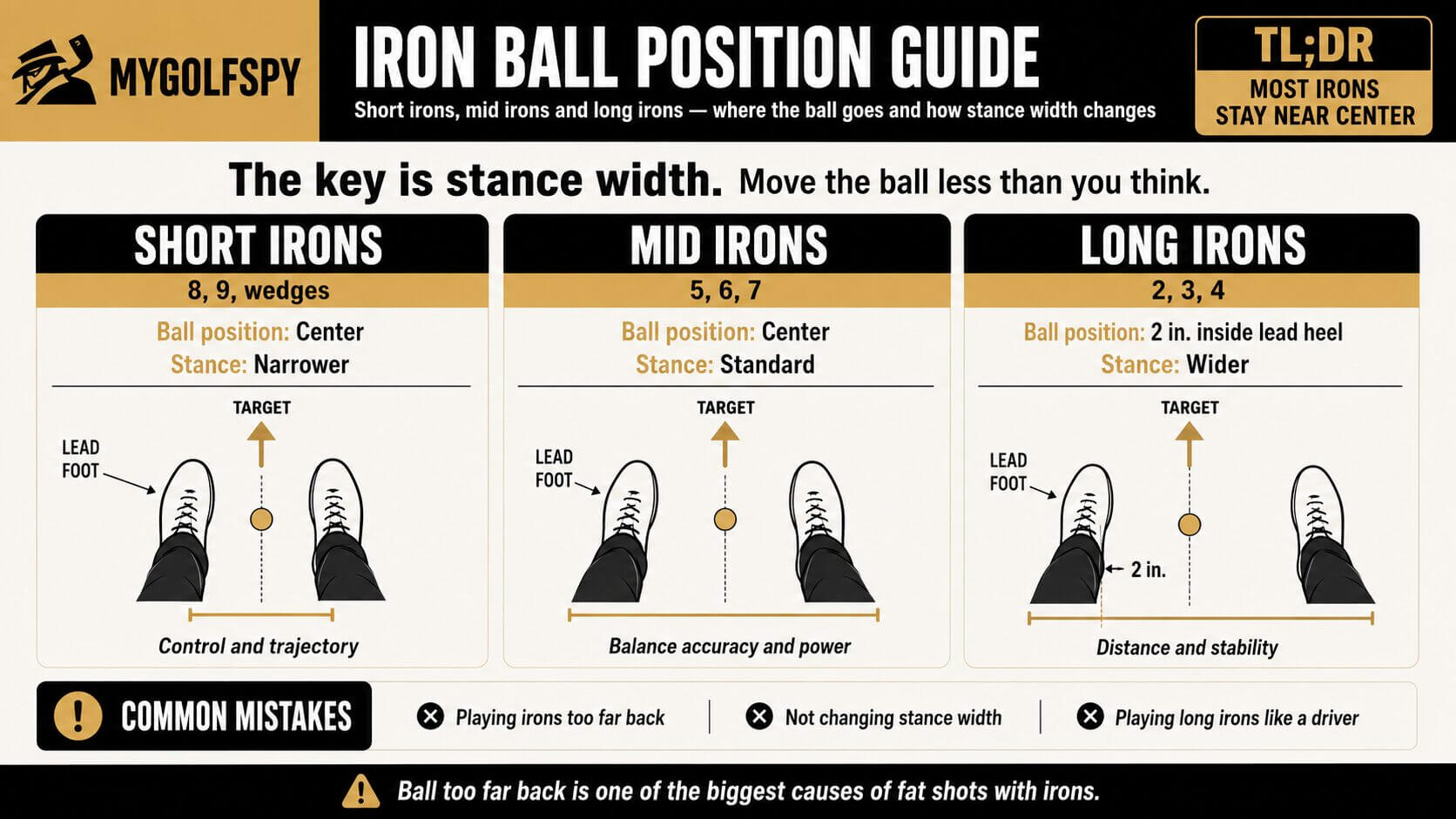
Short irons (8-, 9-irons, wedges)
There’s a common misconception among amateurs that the short irons must be played from the back of the stance. Don’t. The short irons should still be played from the middle of your stance but you’ll want to have a slightly narrower stance with your short irons.
Keeping the ball in the middle helps ensure a higher ball flight and plenty of spin. If you push the ball too far back, the ball flight may get too low and the clubface may be left open at impact.
Mid-irons (5-, 6-, 7-irons)
Keep the ball centered and the stance about shoulder-width apart. This position gives you the perfect mix of control, distance and balance in your stance.
Long irons (2-, 3-, 4-irons)
With a long iron’s length, you may need a little extra time to square the clubface for impact. Placing the ball two inches inside your lead heel (left heel for right-handed players) gives you the best chance to maximize distance and accuracy. You’ll need a slightly wider stance for stability and proper positioning.
Placing the ball in the middle of your stance could cause a lack of distance and consistency. Remember that long irons are not played off the inside of the lead heel like the driver. That position too far up could cause you to hit thin or topped shots.
Drills to improve ball position (How to work on this)
Now that you have the information to get better ball placement with your irons, it’s time to work on it. Like anything else in golf, you have to practice this concept for it to become second nature. Here are a few drills you can use.
T-square drill
Use a T-square setup at the driving range. Set one alignment stick pointing toward your target and then use another to run perpendicular to this to show where the golf ball should be in your stance.
The great thing about the T-square drill is that it also helps you visualize how wide your stance is.
The Stance Caddy is a great training aid for improving consistency in ball placement and setup. It is portable and easy to take out on the range, ensuring perfect ball placement every time.

Change it up
On the driving range, we usually hit 10 to 20 shots in a row with the same club. On the course, that’s not how the clubs are used. Next time you are on the range, hit one shot with a short iron, mid iron and a long iron. Try to hit just one golf ball each time and make the adjustment to the ball placement.
The more you practice this, the more natural this process of changing ball placement will become.
Tips for iron ball placement
Here are a few more tips to help you get your ball placement right. Remember that when the ball position is off even by an inch, it can have a significant impact on how far and how straight your ball flies.
- Don’t make big changes: Many players move the ball too much depending on the iron. Leave the majority of the irons in the middle of the stance with just slight adjustments.
- Adjust the width of your stance: Don’t forget to change the width of your stance. You need more stability on the longer irons and a more compact stance on the short irons.
- Avoid too far back: One of the most common mistakes is placing the ball too far back, causing a fat shot.
- Use your divots as reference: Check your divot after a good (or bad) swing. You want to hit the ball first and then have the divot following the path of the golf ball. Adjust the ball position accordingly if your divots seem off.
Common ball placement mistakes
The biggest mistake you’ll see golfers make with ball placement for irons is playing the irons too far back in the stance. Amateur golfers get this concept that the driver is forward and the irons are back.
However, if you take the proper stance and you want the low point of the swing to match up in the perfect spot (just in front of the ball), the iron ball placement is likely more forward than you think.
Other mistakes include:
- Playing the long irons too far forward like a driver
- Not adjusting the width of your stance when changing to shorter clubs
- Overcompensating the ball position to fix issues with the golf swing like a slice or a hook

Ball placement for uneven lies
Golf ball position and placement is never the same throughout your entire round of golf. If you come across any of these uneven lies, here are a few adjustments you can make.
- Uphill lies: Move the ball slightly forward to avoid fat shots.
- Downhill lies: Move the ball slightly back for cleaner contact.
- Sidehill lies: Adjust to avoid hitting the ground before the ball.
Adjusting ball placement to control ball flight
Once you have your standard ball placements down, you can play around a bit when needed. Moving the golf ball forward or back impacts ball flight and can be useful at times.
For instance, if you are playing from soft, wet turf, you might want to move the ball slightly back for better contact (with less chance of striking the ground first). When you are playing on hard, dry ground, if you move the ball up a little, you may get a cleaner strike and a bit more distance.
In addition, if you want to hit lower shots, playing the ball back and leaning a little on the lead side is a good strategy. Experiment at the driving range with ball position to fully understand how much of an impact It has on your game.
Final thoughts
The best advice is to head to the driving range and systematically practice the correct ball placement for iron shots. The best golfers pay attention to these details and know that even small adjustments can make all the difference.








Southern Mike
3 months ago
I play Hybrids all the way down to 7 iron loft. Same positioning recommended, or no ?