


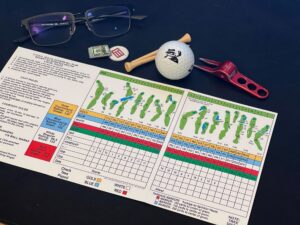

You’ve no doubt seen numbers for “course rating” and “slope rating” on a golf scorecard. Do you know what they mean or how they can impact your game? We will explain these two very different ratings and how they influence your handicap index and the way you should approach a golf course.
What is Course Rating?
The course rating is a numerical measure of the golf course’s difficulty for a scratch golfer. Simply put, under normal playing conditions, it’s what the typical scratch golfer shoots at this golf course.
Course rating is determined by golf associations which use a formula to compare the relative difficulty of various courses. When determining course rating, things like length, topography, obstacles, altitude and many other conditions that impact play are considered.
If a course rating is 73, for example, a scratch golfer would be expected to shoot 73. The range for course rating is between 67 and 77 for most courses. Thus, a 67 course rating is a sign of a slightly easier golf course.
What Is Slope Rating?

Slope rating measures the difficulty of a golf course for bogey golfers, compared to scratch golfers. The way a scratch golfer approaches the course is one thing but with the average slope rating, we can get an idea of how the course plays for the average or “bogey” player.
Slope rating is also determined by golf associations that rate the course.
The scale for the slope rating system ranges from 55 (least difficult) to 155 (most difficult). A higher slope rating means a golf course is more difficult for a bogey golfer. The average slope rating is 113.
Difference Between Course Rating and Slope Rating
Slope rating and course rating are designed to measure the difficulty of the course.
The main difference is that the course rating measures the difficulty for a scratch player, while the slope rating is for a bogey golfer.
| Feature | Course Rating | Slope Rating |
| Purpose | Difficulty for scratch golfers | Difficulty for bogey vs. scratch golfers |
| Range | Typically 67-77 | 55 to 155, with 113 as average |
| Factors | Course length, obstacles, etc. | Difficulty difference between golfer types |
| Representation | Single number (e.g., 72, 67.5, 73.1). | Single number indicating relative difficulty (e.g., 125, 131, 110). |
How Do Course and Slope Rating Affect Your Golf Game?
Now that you understand the basics of course rating and slope rating, let’s see how this impacts your game.
Tee Selection
To determine from which tee you should play, you likely look at the total yardage. On very difficult golf courses, your regular tees (from a yardage perspective) may still have a very high course or slope rating. It helps to understand that length isn’t the only way to measure the difficulty of a course.
Handicap System
The most significant impact that course and slope ratings have on your game is how they are used in the handicap calculation. Both slope rating and course rating are included in the formula for calculating handicap differential.
Handicap Differential=(Score−Course Rating/Slope Rating)×113
If you shoot a low number on a difficult golf course, you may shave a few strokes off your handicap index. Conversely, if you play an easier course and take a few extra shots to get the ball in the hole, your handicap could go up more than you might think.

Golf Course Example
To help make course and slope ratings a little easier to understand, here is an example of Pebble Beach Golf Links and the ratings from a few different tees.
- U.S. Open Tees: The course measures 7,075 yards with a course rating of 75.9 and a slope rating of 148. With 155 being the highest possible slope rating, this is a tough course for the bogey golfer (or any golfer!).
- Gold Tees (Men): The course spans 6,454 yards with a course rating of 73.4 and a slope of 137. Notice that the course and slope ratings decrease as the distance gets shorter.
- Gold Tees (Women): A total of 6,454 yards, but with a course rating of 78.2 and a slope rating of 146. Women’s course and slope ratings are based on a female scratch or bogey golfer.
Pebble Beach has additional tees, of course, but you can see from this example how the course rating teams evaluate each tee. Significant changes and adjustments have been made based on length and playability.
FAQ
Is slope or rating more important?
Slope rating and course rating are equally important in determining the difficulty of a golf course. Slope rating and course rating are considered when calculating handicaps.
Is the 128 slope rating hard?
The average slope rating is 113, making 128 harder than average but not nearly as hard as the 155 maximum for slope rating.
What is considered a hard Slope Rating?
An average slope rating is 113, therefore anything more difficult than that is considered harder than average. The maximum slope rating is 155. Pebble Beach from the U.S. Open tees has a slope rating of 148.
Conclusion
At this point, you should better understand what those course and slope rating numbers mean on your scorecard. The World Handicap System considers all of this information when calculating your handicap. You won’t need to know formulas. However, having a general idea of the scale can help you answer questions about your game. Maybe you played a great round, but your normal 88 was a 93. Why? Look at the course and slope ratings and see if the course may have played a little harder due to the rating.








ROB PERSON
3 years ago
As a newer golfer, there is so much more to golf than I’ve ever expected. For me it was always look at the card, this hole is this many stroked to par, hit the ball, mark down score. Play 5 rounds, add the totals, divide by 5 = handicap. Wash, rinse, repeat, right? Wrong!
Some business-centric individuals decided we can make more money by pitching this formula and that formula to ruling bodies and golf courses to entice people to play based on the rating its given. Now it’s the standard. Why make it over complicated, isn’t golf hard enough as it is?