


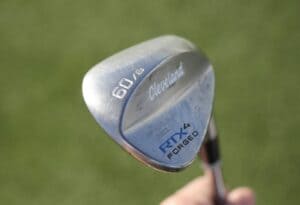
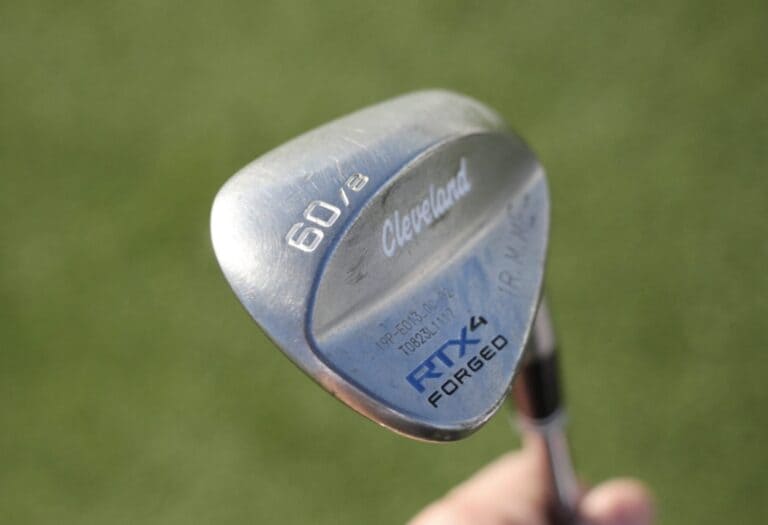
Even as an avid golfer, the idea of bending a wedge to change the loft is a daunting concept to me.
In fact, I raised my hand during one of our recent MyGolfSpy meetings and admitted that I sort of understood why pros did this but didn’t completely grasp the idea.
Thankfully, we have a team of experts here and I get to pass on the gospel of club bending.
If you are looking for more of an introduction into loft, lie and bending, you can check out this beginner’s guide on the subject before delving into some of the specifics here.
Now let’s get into why PGA Tour pros (or anyone else) would decide to bend a wedge.
The Wyndham Clark example
Wyndham Clark has used two different wedges to arrive at the same 59-degree loft.
There is a method to the madness.
One of his Vokey WedgeWorks A Grind wedges starts at 58 degrees and gets bent a degree weaker. The other starts at 60 and gets bent a degree stronger. According to Titleist, he chooses between them depending on course conditions.
If the final loft is identical, why bother?
Because changing loft also changes how the sole sits against the ground. Two wedges that finish at 59 degrees can offer different amounts of bounce.
That’s one reason those seemingly strange specs appear in PGA Tour equipment lists.
Bending can help a player reach a particular yardage, retain a preferred sole grind or adjust turf interaction. There are multiple reasons to do it.
Loft is only part of the wedge
So three elements help explain the decision: loft, bounce and grind.
Loft is angle of the face. Bounce is the relationship between the sole and the ground at address, helping the club resist digging. Grind is how material is shaped or removed from the sole to influence how the wedge moves through turf and sand.
When a wedge is bent stronger (reducing loft), bounce decreases. When it is bent weaker (adding loft), bounce increases.
A one-degree loft adjustment changes bounce by one degree as well. That relationship is central to Clark’s two options.
It means a player can’t treat a loft adjustment as an isolated change to the face.
For Clark, the 58-degree head produces his higher-bounce option. The 60-degree head produces his lower-bounce option.
That allows him to keep the A Grind family and his desired loft while changing the bounce available for different conditions.
The lower bounce option would typically suit firmer, faster conditions. The higher bounce would be better for softer conditions.
It also helps to understand what the A Grind actually is. The standard version of this sole design has four degrees of effective bounce and a narrow, smooth sole designed to slide beneath the ball with little resistance in firm, tight conditions.
The design grew out of work between Vokey Tour rep Aaron Dill and 2006 U.S. Open champ Geoff Ogilvy. Dill modified Ogilvy’s L Grind by smoothing away a defined grind line on the sole, producing a design that moved through firm turf more freely.
That gives Clark a particular type of turf interaction he wants to retain. It also means the A Grind starts as a low-bounce option that demands precise delivery. It isn’t designed to provide the same resistance to digging as a higher-bounce alternative.
This provides more context around why Clark wants to protect that grind so much while maintaining his proper distance gap.
The number stamped on the sole tells you where each head started. It doesn’t tell you the final specification.
The preferred grind might not come in the desired loft
A player might like how a particular wedge moves through the ground but wants a loft that isn’t offered in that grind.
Billy Horschel is an example of this. His setup has featured a 60-degree V Grind bent to 62 degrees. He used that configuration for his 2024 Corales Puntacana victory and runner-up finish at The Open that year.
The V Grind was offered in 58- and 60-degree lofts. Its design combined forward bounce with relief in the heel, toe and trailing edge. According to Titleist, Horschel preferred its contact and flight characteristics to narrower, lower-bounce options he had tried.
Bending gave him a route to 62 degrees while retaining that sole design.
That’s the missing piece in the question: “Why doesn’t he just choose a 62?” A 62-degree head from another grind isn’t necessarily the combination he wants.
Stock lofts don’t cover every distance gap
There’s another straightforward reason to bend: the player’s desired specification can fall between stock offerings.
Justin Thomas’s SM11 wedges are stamped 46, 52, 56 and 60 degrees, adjusted to playing lofts of 47.5, 52.5, 57 and 60.5 degrees.
Those half-degree specifications illustrate how far a finished Tour setup can depart from the numbers on the heads. The equipment list establishes his lofts; it doesn’t establish the individual fitting reason behind every adjustment.
For golfers building their own sets, the useful principle is to measure the resulting distances. Vokey identifies consistent full-swing distance gaps as a goal of wedge selection.
An evenly spaced sequence of stamped lofts is a starting point. A fitter still needs to establish whether those clubs produce the carry distances and shots the player needs.
What should amateurs take from this?
Bending can be useful when a fitting identifies a specific problem: a distance gap, a preferred grind at an unavailable loft or a bounce requirement.
The important question is what the adjustment accomplishes.
Before changing a wedge, establish its measured loft and the shots it currently produces. Then evaluate the adjusted club’s distance and turf interaction. A qualified fitter or club builder should also confirm what adjustments are appropriate for that particular head.
Clark’s setup reminds us that choosing the final loft is only one part of choosing the wedge.







Leave A Reply