


The most revealing equipment stat from the 2026 PGA Tour season?
Mallet putters accounted for 33 of 38 victories.
If you are a MyGolfSpy reader, you probably know the Reader’s Digest version of how this happened. Our testing has repeatedly shown how blades get outperformed by mallets and zero-torque putters, so it only makes sense that Tour pros would trend in the direction of blades becoming less of a standard and more of a niche offering.
Still, this is a stunning stat to see. Consider that a decade ago (the 2015-2016 Tour season), mallets accounted for roughly one-third of victories. Now they are up to about 87 percent!
This season, the TaylorMade Spider Tour X alone won 11 times with seven different players, making it the most successful individual putter model. The Spider Tour family collected 13 victories total including major wins by Rory McIlroy and Aaron Rai. Scotty Cameron finished with nine wins across seven models while Odyssey and PING produced six apiece.
So this isn’t one manufacturer distorting the results. We’re talking about a category-wide demolition here.
And then add this: Among the top 50 players on the Tour in 2026, only seven use traditional blades. Nine of the top 10 players in the Official World Golf Ranking use mallets (Matt Fitzpatrick is the lone exception, if you’re wondering).
The numbers draw a pretty obvious conclusion: Blades are getting left behind.
You probably already know this. However, I thought it was worth revisiting the details of why this happened because I think there are a couple of missing pieces that don’t get talked about enough.

Google is changing how content is shown. Add MyGolfSpy as your preferred source to ensure you don’t miss the latest gear news, instructional tips and buying guides.
Mallets learned how to behave like blades
The old blade-versus-mallet distinction was relatively clean.
A heel-shafted blade typically offered appreciable toe hang, a center of gravity closer to the face and a release pattern suited to players who wanted to feel the head rotate. A mallet generally came with a single-bend shaft, minimal toe hang and a deeper center of gravity.
A mallet was stable but it could feel resistant to rotation. That wasn’t suitable for Tour pros.
On top of that, mallets were viewed as clunky, ugly or nontraditional. There was a significant barrier to entry. For a time, a Tour pro using a mallet was akin to a cry for help (or at least waving the white flag).
Enter modern mallets which have largely broken the relationship between head shape and face-rotation profile.
The Spider Tour X, for example, can be built with a short-slant neck that creates meaningful toe hang. Scotty Cameron’s Phantom family offers multiple neck configurations that alter toe flow without giving up the mallet chassis. Odyssey does the same across its #7, Rossie, Jailbird and other shapes.
A player who grew up releasing a plumber’s neck blade can now move into a mallet without being forced into a face-balanced configuration. The neck location, hosel geometry and shaft axis can be manipulated to provide a more comfortable/familiar rotation during the stroke.
That is the development that made widespread Tour adoption possible.
The player is receiving more MOI in a putter that can be configured to preserve the “in-stroke characteristics” he already trusts.
Quite simply, there are fewer compromises now.
And once players started to have success, a lot of the other hold-ups I referenced earlier started to crumble.
Stability is valuable but alignment may be even more important
Everyone talks about MOI. It is the easiest part of the story to market because it can be expressed as a number.
Its practical benefit is obvious as moving mass away from the center of the face reduces the head’s response to off-center impact. The resulting differences in face angle and ball speed are smaller than they would be with a compact blade.
But Tour players aren’t routinely missing the center by half an inch. These guys are good, as the old commercial said.
The stability benefit is meaningful, especially across four tournament rounds, but that doesn’t fully explain the mallet trend by itself.
I’m a big believer that the additional real estate given to alignment matters just as much.
The larger head of a mallet has allowed designers to create longer sightlines, perpendicular edges, contrasting sections and shapes that frame the ball. The innovation with alignment has been a game changer.
There is also a mental shift here and that can positively affect both aim and the player’s perception of face angle.
This distinction is important in my eyes. A putter can produce excellent launch and speed consistency and still be useless to a golfer who aims it poorly. But a shape that helps a player aim correctly can improve performance without changing the stroke mechanically.
The Spider Tour X has become dominant largely because it is more compact than some of the largest traditional mallets but it still provides a wide body and TaylorMade’s “True Path” alignment structure. It gives players a stronger visual without looking like an enormous game-improvement product.
Size, CG placement, hosel options, alignment and familiar insert performance. Add in (more than a few) Scottie Scheffler wins, and that explains the mallet popularity.
The blade’s remaining advantage is increasingly emotional
Don’t get me wrong—blades aren’t completely dead.
Some players aim compact heads better. Some prefer the feedback of a more concentrated mass behind the face. Others want a shorter sightline, less visual information or the particular flow created by a traditional heel-shafted design.
A player who has looked down at an Anser-style shape for 20 years may perform better (or think he does) with it simply because the picture is familiar. Our testing would say that is highly unlikely but a player may still feel like a blade is the best choice.
Having said that, it’s now more of an emotional decision for players to choose a blade.
The modern mallet has so much more flexibility with none of the sacrifices players used to have to give up.
That is why the traditional blade lost so much ground.
It isn’t necessarily because Tour players suddenly need more help. In fact, they don’t. It is because the mallet category stopped asking them to choose between stability and everything else they valued.
So those are my thoughts. What’s on your mind? Let me know below in the comments.
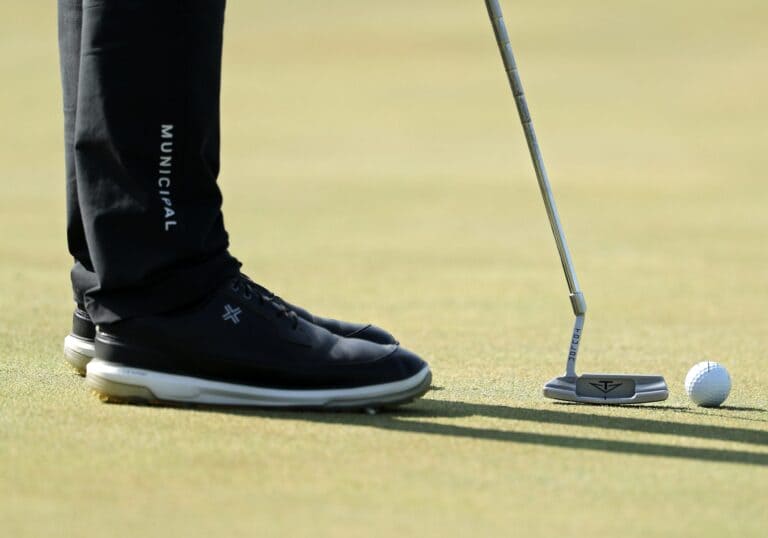
Top Photo Caption: Patrick Rodgers uses a blade during the 3M Open. (GETTY IMAGES/David Berding)









Dean D
2 weeks ago
Would have been nice to compare the Spiders in your last putting comparison. Old Ray Cook mallets circa 1980 were chunky & didn’t align better. Today’s mallets are so much better.
Putter fitting makes very little sense to me. Try several models at your local pro shop on an actual green & buy from where you play. The real world test is superior to fake greens. That or a large golf store – the generous exchange policies at Golf mart & similar allow you to switch putters if you made the wrong choice.
I’m a fan of buying the exact putter that feels best not something made for you 3 weeks later.