



One of the big debates has been what role the Presidents Cup plays in the larger American team golf landscape. Is it meant to operate in a vacuum as a standalone event? Or should it be part of a collaborative effort toward the U.S. gaining an edge in the Ryder Cup?
My opinion?
The Presidents Cup should be a training ground for young U.S. talent needing experience in team competition.
Let me explain.
The Ryder Cup vs. Presidents Cup conundrum
The elephant in the room here is obvious: the Ryder Cup means a lot and the Presidents Cup does not.
The Americans are 13-1-1 in the Presidents Cup, a contrived event the PGA Tour created to compete with the Ryder Cup. I was six years old in 1998 when the International side last won this event. The Internationals just don’t have the depth of talent to compete with the U.S. side. The event doesn’t have any juice.
Meanwhile, the Americans have been decidedly bad in the Ryder Cup, going 3-9 over the last 12 editions. The Ryder Cup began organically and it’s deeply important to the Europeans because of Seve Ballesteros and other legends who decided the event meant more to them than just about anything else in their career. The Ryder Cup always has the juice, even if it hasn’t been even the last few decades.
Interestingly, the U.S. has long held the “advantage” of getting to simulate the Ryder Cup every other year by playing in the Presidents Cup. But, like a lot of things in life, what looks good in theory doesn’t always hold its weight in reality.
The problem is that the Tour runs the Presidents Cup. The PGA of America and a collaborative body known as Ryder Cup Europe run the Ryder Cup. There is no cohesion between those entities.
We’ve long established that the PGA of America might as well be the New York Jets front office when it comes to running the U.S. team for the Ryder Cup. Random one-off captaincies that were disasters (Tom Watson, Keegan Bradley, etc.), haphazard plans that get ditched (creating a task force then not following through on its plans) and incredibly shortsighted venue selections (going to Hazeltine twice in 12 years) are their calling cards the past 10-15 years. Now we have Jim Furyk as the captain for next year’s Ryder Cup (how inspiring!). The PGA of America wants to make money; competition is secondary.
The Tour would kill for some competition at the Presidents Cup. They want the International side to win so people can care about this. It’s obvious they will never change the format by adding women which would be a home run—ultimately, the Tour doesn’t want to showcase talent that isn’t their own and helping out women’s golf isn’t in the mission statement.
Is there synergy between these two entities? Not at all. In a perfect world, new leadership role candidates would cut their teeth as Presidents Cup vice-captains before ascending to Presidents Cup captains. If successful, they would graduate to the Ryder Cup.
Nothing like that happens.
And on the player side? Every young American rising star should automatically be on the Presidents Cup team. There should be a certain number of mandatory spots for U.S. players who are 27 or younger (which is kind of the cut-off for being young nowadays). Give us a couple of players each time who will gain experience to give them reps toward the Ryder Cup.
But, to my earlier point, these two events operate individually. The Presidents Cup doesn’t want to be an experimental minor league and the U.S. Ryder Cup side values ticket sales and TV ratings over winning the event.
Why the Presidents Cup should go young anyhow
Take everything I said and grab a grain of salt.
Even after all of that, I still believe the Presidents Cup should focus on young talent. Here is why.
Brandt Snedeker is this year’s U.S. Presidents Cup captain. He may only get one shot to be a team captain. Maybe, maybe not. We don’t know since there is essentially no tangible plan for U.S. team golf.
Snedeker wants to win. He doesn’t want to be known as the American captain who lost a Presidents Cup, let alone a home Presidents Cup.
So, as is his right, he would like the very best 12 players on the team. Who cares about the American golf future? He wants to win right now. If that means including veterans who may be playing in their final team event and have rarely had success in the Ryder Cup? Then that is what he is going to do.
Why add Jackson Koivun, Michael Brennan or Michael Thorbjornsen if, to some people, they aren’t technically some of the best 12 players on the American side? Get in a less risky option, someone with experience.
“I’m not into, ‘Oh, let’s just take a young kid because we need a young kid on the team.’ That doesn’t make any sense to me,” Snedeker said recently.
You know who it makes sense to? Literally everyone else, save for the veteran players who will get passed over.
Let’s count the reasons why the U.S. Presidents Cup team should be an incubator for young talent.
- Marketing—The Tour gets a free run to give young guys a stage. This is a chance to introduce players like Koivun, Thorbjornsen and others to the world. It’s a platform to market emerging stars. The Tour should use it.
- Competition—If Americans take younger players who are getting their first kick at team competition on this stage, it’s reasonable to think there could be more volatility to the Presidents Cup. The young players could be great or they could struggle. Their floor could be lower than a veteran who has done the U.S. team golf dance several times. And this is a feature, not a bug, for the Presidents Cup, which really needs excitement and drama.
- Development—The Americans get a chance to see what they have. New players get acquainted with team culture (and help build it, too). The U.S. Ryder Cup has a losing culture so let’s get fresh blood into the rotation.
So, yes, I am a huge proponent of adding young players to the team. This should honestly be a slam dunk.
It’s good for the Presidents Cup, it’s good for the Ryder Cup, and it’s good for golf fans.
Which young players should make the team this year?
Let’s put what I’m saying into practice.
Here is the U.S. team points race to see which 12 players will be included. The top six guys are in bold because they are in an automatic qualifier spot. Those are solidified on Aug. 23 after the BMW Championship.
- Scottie Scheffler
- Cameron Young
- Russell Henley
- Sam Burns
- Ben Griffin
- Collin Morikawa
- Chris Gotterup
- J.J. Spaun
- Xander Schauffele
- Wyndham Clark
- Justin Thomas
- Jacob Bridgeman
- Akshay Bhatia
- Harris English
- Ryan Gerard
Gotterup, 27, is going to be on the American team. He’s won three times this season and is easily within the top 10 players in the Data Golf rankings. You can mark that one down in permanent ink.
This is a great development for the U.S. team but I’m a little worried that the other captain’s picks will be retreads.
Here is the team I would take to Medinah—a team that has an eye on the present and the future. Keep in mind this absolutely won’t happen, but I’m saying this is what I would do.
- Scottie Scheffler
- Cameron Young
- Russell Henley
- Sam Burns
- Ben Griffin
- Collin Morikawa
- Chris Gotterup
- Xander Schauffele
- Justin Thomas
- Wyndham Clark
- Jackson Koivun
- Michael Thorbjornsen
Let’s talk about these captain’s picks after Gotterup.
Schauffele is still a bona-fide top-10 player in the world by nearly every measure. He’s 7-5-0 in the Ryder Cup, one of the few successful veteran players. You have to put him on this team.
Thomas is 17-7-4 in Presidents Cup/Ryder Cup competitions. He’s in very solid but not outstanding form. I want him on the team because he is a key piece and loves team golf. We need more guys like him.
Clark won the U.S. Open and Byron Nelson this year. He’s top 20 in Data Golf and had a great summer. This is one where you could convince me to go in another direction but it feels like Clark fully earned his spot.
This leaves two picks for two young guys: Koivun (21) and Thorbjornsen (24).
Beyond Koivun’s win at the 3M Open, making the FedEx Cup playoffs and the fact he is already top 30 in Data Golf, you have to trust the eye test. Statistically, he was the best amateur in 16 years. He’s on that Scheffler/Rahm track. He will be a part of American team golf for a long time. Give him the start in a home Presidents Cup where there isn’t that much pressure.
Thorbjornsen is also having an awesome summer including a win at the Rocket Mortgage. He has loud traits. He’s on the precipice of making the Tour Championship and is ridiculously talented. High ceiling guy. Put him on the team.
Along with Gotterup, you have three young stars on the team, each being three years difference in age. I love it.
These picks exclude a few guys:
- Michael Brennan—The 24-year-old Wake product just won the Wyndham Championship but he is pretty far behind Koivun and Thorbjonsen statistically.
- Patrick Cantlay—Decent Ryder Cup record so maybe he should be on but he’s been just OK throughout the year and I’m tired of looking at him in these team competitions.
- Ryan Gerard—Consistent all year and a 27-year-old talent but doesn’t have the ceiling of Koivun or Thorbjornsen.
- J.J. Spaun—Good player but he’s a veteran we have to cut to give the young guys a spot.
- Maverick McNealy—Same as Gerard but Mav is three years older.
- Rickie Fowler—Quietly having a nice season but he has a terrible team golf record and it’s time for the next generation to have a shot.
- Akshay Bhatia—Fits the youth movement mindset but he had a dreadful summer.
So I stand by the team I have listed, barring some major changes from the FedEx Cup playoffs.
What are your thoughts? Should the U.S. go with a youth movement?
Let me know below in the comments.
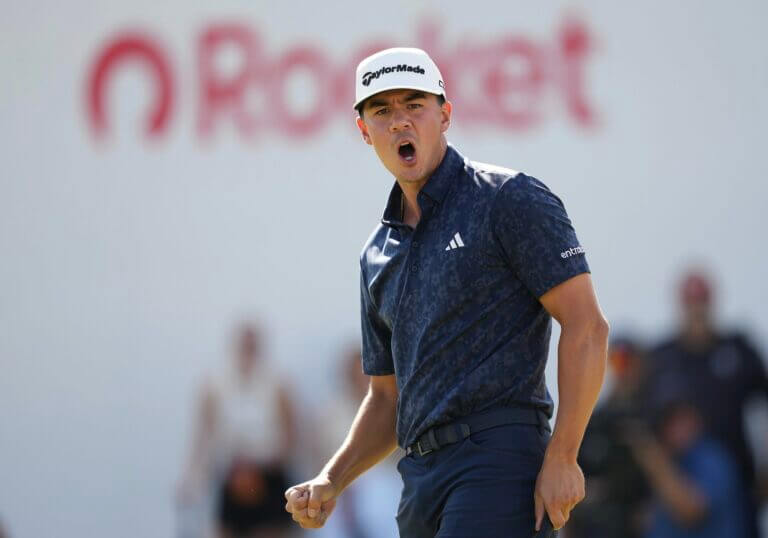
Top Photo Caption: Michael Thorbjornsen is a rising star in American golf. (GETTY IMAGES/Raj Mehta)








Sean
2 months ago
They should just scrap it. It’s a worthless competition that no one seems to care about.