



I came across a wild stat earlier this week. I honestly didn’t believe it was true.
Andy Johnson of The Fried Egg posted that, by the time the 2027 Masters begins, there will be no major champions under the age of 30 in all of men’s golf.
Wait, what? Read that back one more time.
That’s right. The youngest player in golf with a major title to his name? Collin Morikawa, who turns 30 in February.
Scottie Scheffler turned 30 in June. Rory McIlroy is 37. Jordan Spieth is 32. Justin Thomas is 33. Jon Rahm is 31.
All five of those players won multiple majors in their 20s. Combined, they won 15 majors in their 20s—but they aren’t in their 20s anymore.
Underdog winners of 2026 like Aaron Rai (31), Wyndham Clark (32) and Ryan Fox (39) are all veteran PGA Tour players.
And the top stars who are under 30—Cameron Young, Ludvig Aberg, Viktor Hovland, Sam Burns and others—have yet to win a major.
There is this platitude we like to say in golf about how young the game is getting. “Oh, these young guys come out of college so polished and prepared for pro golf.”
There is validity to that but these young guys are not winning the biggest events in golf. They haven’t for a long time now.
The average age of a PGA Tour player used to be older. In 2004, it was 36. That age fell considerably until 2017. Since then, the average age has gone up and then stabilized, landing around 32-33.
What hasn’t been stable is the impact of the younger players.
In the mid-2010s, several players in that 20-26 age bracket were establishing themselves as the best players in the world.
McIlroy was 25 when he won his fourth major. Spieth was 23 when he won his third major. You get the idea
Coming back to the 2020s, why are all these majors now being claimed by golfers in their 30s? Where did the Rorys and Jordans go? Why are the young stars of today unable to establish themselves in the same way?
I have three theories. At the end of the story, I would love to hear your theories.
1. The technology boom effect in pro golf has finally normalized
Once upon a time, there was the first generation of players who grew up playing solely with what I’ll call “advanced” equipment. As in they didn’t grow up like previous generations having to transition from balatas to Pro V1s or from persimmon drivers to titanium.
Guys like McIlroy and Spieth were still fairly early in junior golf when golf’s tech boom hit. The big 460cc titanium drivers and life-changing Pro V1s were all they really knew. They didn’t have to relearn how to play with different equipment which was an advantage.
So, in theory, there was a momentary youth movement where a bunch of these young guys came into power in the mid-2010s.
They were just better than most Tour veterans, pros who grew up with persimmons and then adapted to the newer equipment somewhere along the way. Experience wasn’t as valuable.
But it wasn’t just the clubs and balls—younger players of that era were more willing to be early adopters with Trackman, Strokes Gained data and other technology that helped them optimize their games. The old guard transitioned slower.
Now the Tour is basically comprised only of guys who grew up with great equipment and all these tech advances so today’s veteran player is no longer at any disadvantage. The typical golf prime of someone thriving in their early to mid 30s—which, historically, has been pretty stable over many eras—has been restored since experience is now a differentiating factor.
We’ve gone back to the future.
And speaking of experience …
2. The young golfers of today have less mature games when it comes to shot shaping and other nuances that major venues demand
If you were training a 12-year-old kid to be a pro golfer in the modern game, you would teach them speed above all else.
It’s a power game predicated on distance. Virtually every top player in the game is long off the tee. Create maximum speed and then figure out the rest.
This mentality has grown more prominent the last 10 years. Just about every young player on Tour can crush it by maxing out on their speed efforts. Do you see young players who rely more on their short game than their tee-to-green game? It’s rare.
That speed-first mentality works, especially on a normal PGA Tour course where distance is king.
But when you get on a course like Royal Birkdale or Shinnecock, the test is multi-faceted. There is a lot more feel to the game. Different shot shapes are a requirement, not a luxury.
So, naturally, golfers with more experience will rise to the top in those environments.
And some of those golfers, like a Ryan Fox, did not grow up in a time when speed was a pre-requisite. They learned different ways to get the ball in the hole.
In that way, the Tour veteran’s game is more mature relative to the younger players who have to learn those skills on the fly as their careers evolve.
3. There is less incentive to leave college because of NIL and PGA Tour U so everyone’s timeline for major contention is being pushed back
There is not much reason for college golfers to leave school early.
In the past handful of years, they have been able to monetize their efforts because of NIL (name, image and likeness).
Direct access to the PGA Tour has never been better because of PGA Tour University, the feeder system to the pros. You can go right from college to the highest level based on your play in school.
And these college programs are outstanding. From facilities to coaching, they prepare guys for the pros better than just about any other resource.
So take a guy like Spieth. Back in 2012, he turned pro when he was 19. In today’s landscape, he probably would have stayed at the University of Texas until the age of 21 or 22.
Last season’s top college player, Jackson Koivun, turned 21 before becoming a pro this summer. Aberg stayed at Texas Tech until he was 23. It was to his benefit! He came out of school as a seasoned pro.
These two or three years of extra seasoning for college players are great for their development but it also means that they are preparing to be better pros in their late 20s and early 30s rather than peaking in their early 20s.
The timeline has been shifted back. Some guys do turn pro early (Akshay Bhatia, Blades Brown, etc.) but the vast majority want to embrace the college route because it provides way more safety.
What do you think?
Those are my three theories for why young major champions are becoming extinct.
What are your theories? Let me know below in the comments or email me at [email protected].
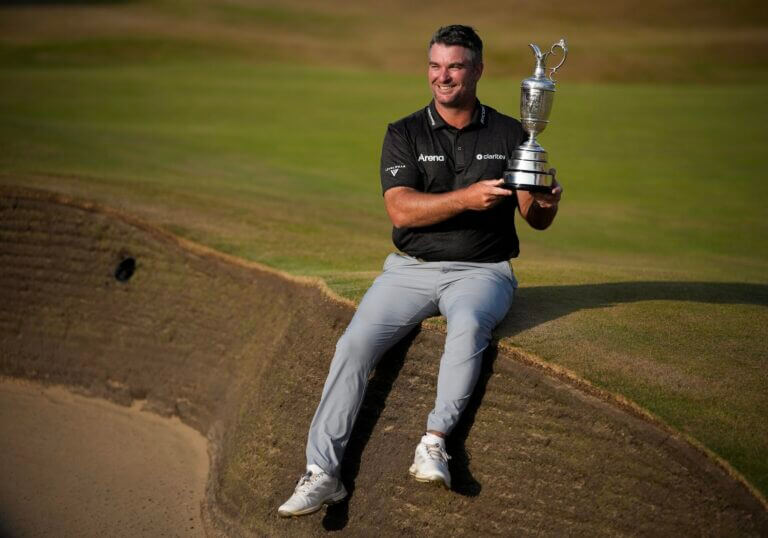
Top Photo Caption: Ryan Fox celebrates his Open Championship victory. (GETTY IMAGES/Tracy Wilcox)









7handy
3 months ago
Technology has no doubt improved and kept ball speeds up for the “older” gents. They can still hit bombs into their 40s (e.g. Gary Woodland) which puts more emphasis on their short games, course knowledge, etc… there are lots of little things the older guys have figured out through the years that give a slight edge. I think the days of young guys outdriving the older ones by 30 yards are over, and that neutralization will keep older guys in their primes for much longer. Everyone is improving no matter the age. Just a matter of if the ball falls in for you that week.