


When a golf ball gets wet, it spins less and launches higher but it doesn’t necessarily fly shorter. How much it changes depends a lot on the ball.
Most golfers run into moisture more than they think. Morning dew, a light drizzle, a damp fairway or wet rough all put water between the clubface and the ball and that’s exactly where spin is made.
If you’ve read our wet wedge spin results, you’ve seen this question from the club side: keep the ball the same, change the wedge and see which models hold their spin when moisture shows up. This test is different. Here we kept the wedge the same and changed the ball, running 48 of them dry and wet to see which covers and constructions handle moisture best.
This data comes from the full-wedge portion of our 2026 Golf Ball Test. We tested 48 balls over more than 80 hours in July in the Scottsdale, Ariz., area. Alongside our driver, iron and 35-yard wedge testing, we hit full sand wedge shots at 90-mph clubhead speed with every ball both dry and wet.
What changes
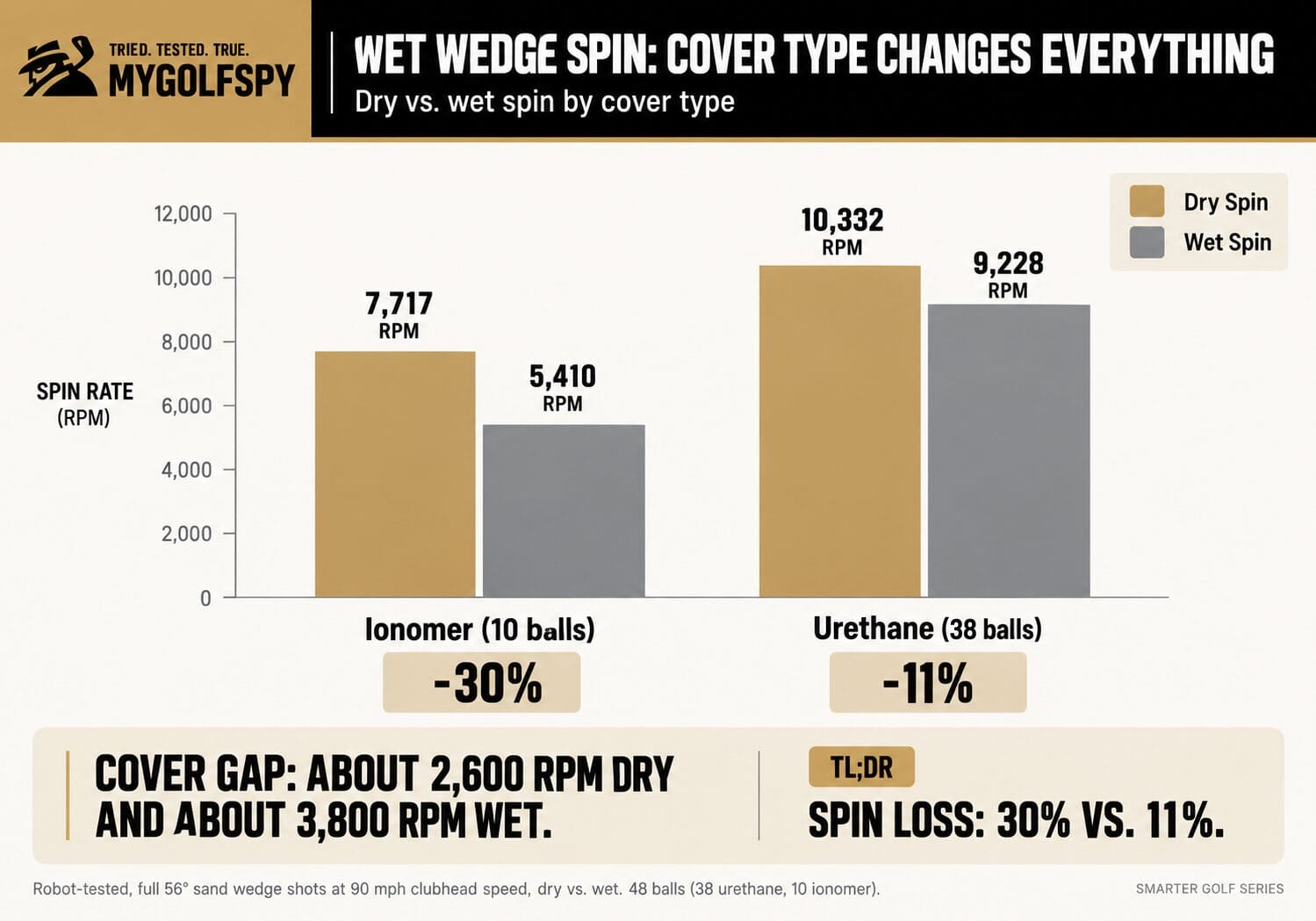
Nearly every ball lost spin when it got wet. Ionomer balls lost about 30 percent of their dry spin on average, and urethane balls lost about 11.
Dry urethane balls out-spun ionomer balls by about 2,600 rpm. Wet, the gap grew to about 3,800 rpm.
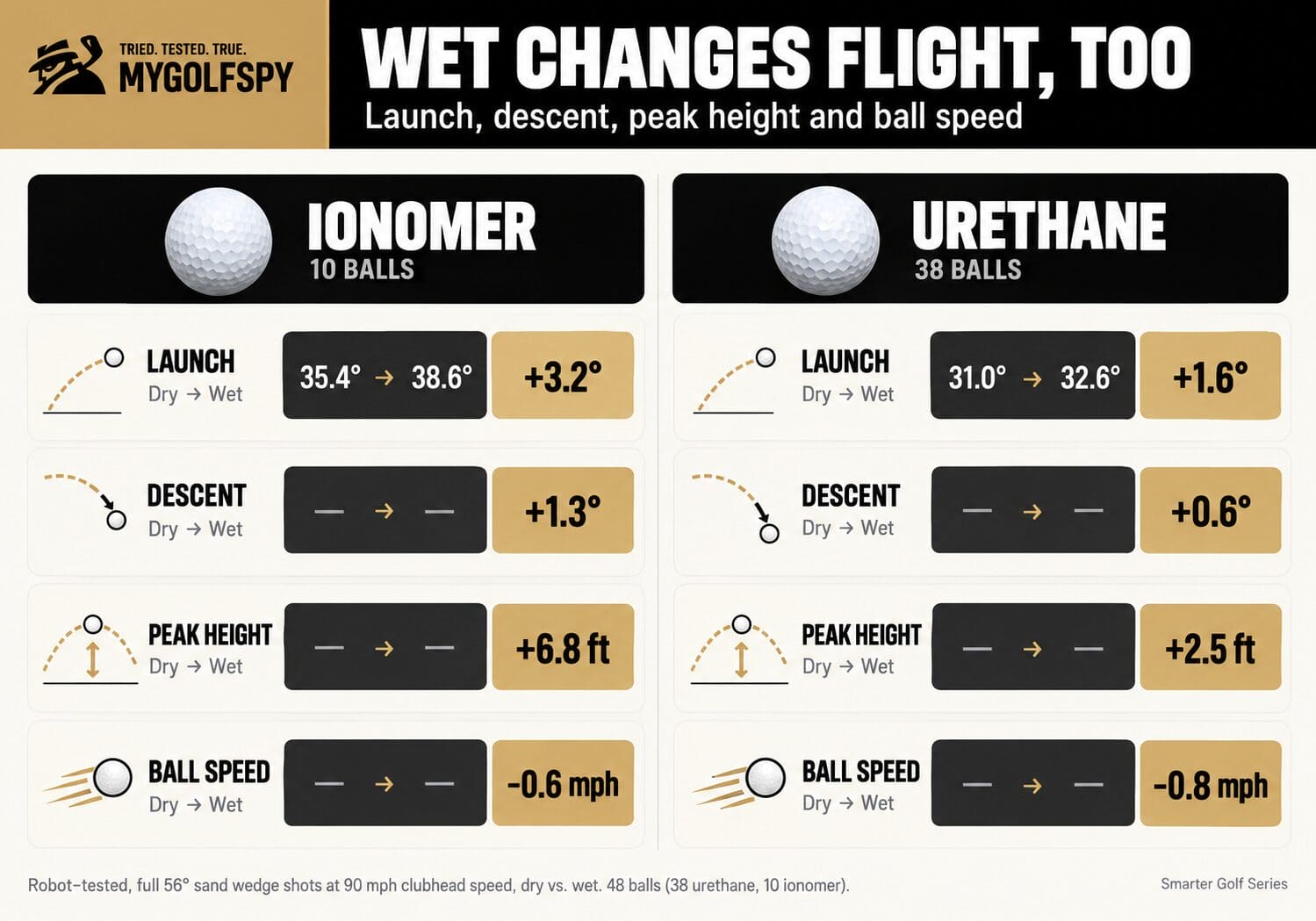
The rest of the flight changes along with it. Water reduces friction at impact so the ball launches higher and comes down steeper on average. Launch angle rose and ball speed dropped for nearly every ball.
Ionomer balls changed the most in launch, descent and peak height. Ball speed dropped by less than a mph for both cover types.
What doesn’t change
A wet ball doesn’t fly meaningfully shorter. Carry changed by less than a yard on average for both cover types and accuracy barely moved.
- Carry: Ionomer balls gained 0.2 yards (98.8 to 99.0). Urethane balls gave up 0.9 yards (100.2 to 99.3). No individual ball’s carry changed by more than 1.9 yards.
- Dispersion: Average offline distance changed by about 0.1 yards for both cover types.
- Rollout and total distance: With less spin to check the ball on landing, it releases more. Calculated rollout grew for all 10 ionomer balls and for 34 of the 38 urethane balls. Average ionomer rollout went from 5.6 to 7.7 yards and average urethane rollout from 4.3 to 4.8 yards. That left ionomer total distance about two yards higher (104.5 to 106.7) and urethane total distance about a third of a yard lower (104.5 to 104.1).
The Callaway Supersoft is the extreme case. It lost 41 percent of its spin (7,661 to 4,501 rpm), its carry went up 0.8 yards (99.4 to 100.2) and its calculated rollout grew from 5.6 to 8.7 yards.
The takeaway is that wet conditions change how the ball stops, not how far it flies.
Which balls handle it best
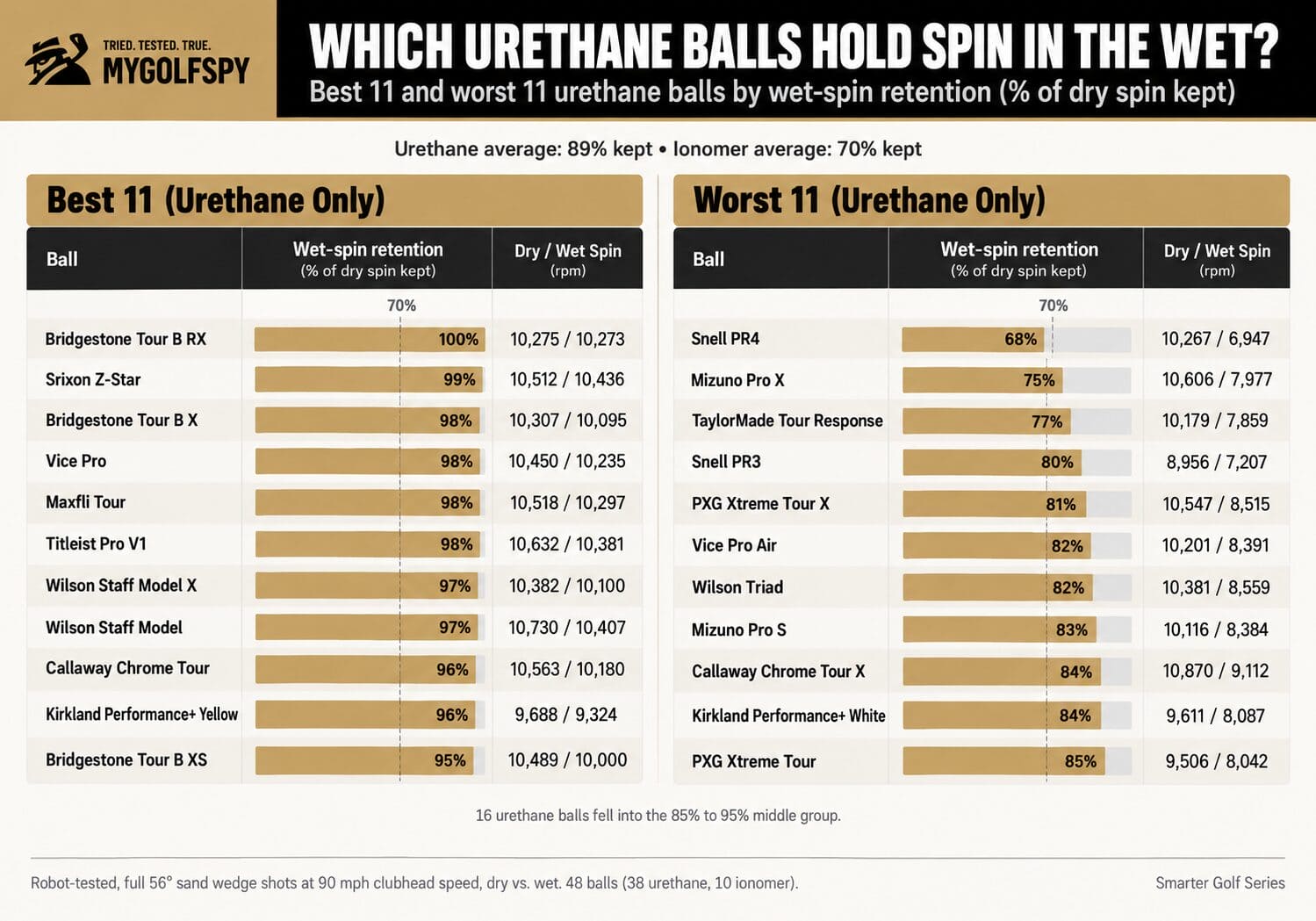
Cover type sets the baseline but a urethane cover doesn’t guarantee performance when wet. The typical urethane ball kept about 90 percent of its dry spin and the spread was wide. Here’s how the 38 urethane balls broke down:
- Barely affected (11 balls, kept 95% or more): Bridgestone Tour B RX, Srixon Z-Star, Bridgestone Tour B X, Vice Pro, Maxfli Tour, Titleist Pro V1, Wilson Staff Model X, Wilson Staff Model, Callaway Chrome Tour, Kirkland Performance+ Yellow and Bridgestone Tour B XS.
- Lost the most (11 balls, lost more than 15%): Snell PR4 (-32%), Mizuno Pro X (-25%), TaylorMade Tour Response (-23%), Snell PR3 (-20%), PXG Xtreme Tour X (-19%), Vice Pro Air (-18%), Wilson Triad (-18%), Mizuno Pro S (-17%), Callaway Chrome Tour X (-16%), Kirkland Performance+ White (-16%) and PXG Xtreme Tour (-15%).
What about ionomer balls?
Ionomer balls lost about 30 percent of their spin on average compared with about 11 percent for urethane. Wet, the 10 ionomer balls averaged 5,410 rpm against 9,228 rpm for urethane.
- Lost the most: Callaway Supersoft (-41%) and Titleist TruFeel (-37%)
- Lost the least: Srixon Q-Star Ultispeed (-18%) and Bridgestone e12 Straight (-22%)
For golfers who play these balls, the practical effect is less stopping power on wet greens, not lost distance.
What this means for your game
- Expect less check and a higher flight on wet days. The average urethane ball gives up about 1,100 rpm and the average ionomer ball about 2,300 rpm so approach shots fly higher and come down steeper but release more once they land.
- Don’t assume a “tour ball” handles water well. Within the urethane group, losses ranged from essentially none to about a third. If you play in damp conditions often, check your ball’s wet number before you commit to it.
- Pair it with the right wedge. A ball that keeps its spin and a wedge that keeps its spin is the combination that holds up in the wet. See our wet wedge spin results to match one to the other.
- Dig into the full data. Our Golf Ball Selector lets you compare all 48 balls from the 2026 test.
Things to keep in mind
Small differences between balls shouldn’t be over-read. The patterns, like ionomer versus urethane and the large gaps between the best and worst urethane balls, are the findings to rely on. For the full test methodology, see our 2026 Golf Ball Test.
The bottom line
Water changes how a golf ball stops, not how far it flies. Nearly every ball launched higher and spun less. Ionomer balls lost about 30 percent of their spin and urethane balls about 11 percent and carry changed by less than a yard on average. The more useful finding is how much the balls differed from each other. Some urethane balls barely noticed the water and others lost about a third of their spin. If you play in wet conditions, it’s worth knowing which kind you have in the bag.





MikeB
3 weeks ago
Thanks for an interesting article. Were your tests of rollout conducted on a range wet with dew, or was the rollout an estimate from the launch monitor? Here in NC, fairways wet with dew usually generate less rollout, even with a dry ball. I don’t doubt that the lessened spin on wet balls increases rollout on both wet and dry fairways, I am just wondering about the amount of rollout. Also, when the fairways are wet with dew the greens are too. This seems to help the ball check as it softens the greens. I play urethane balls, usually the Bridgestone Tour B RXS. It checks up well when I do my part.