Support our Mission. We independently test each product we recommend. When you buy through our links, we may earn a commission.
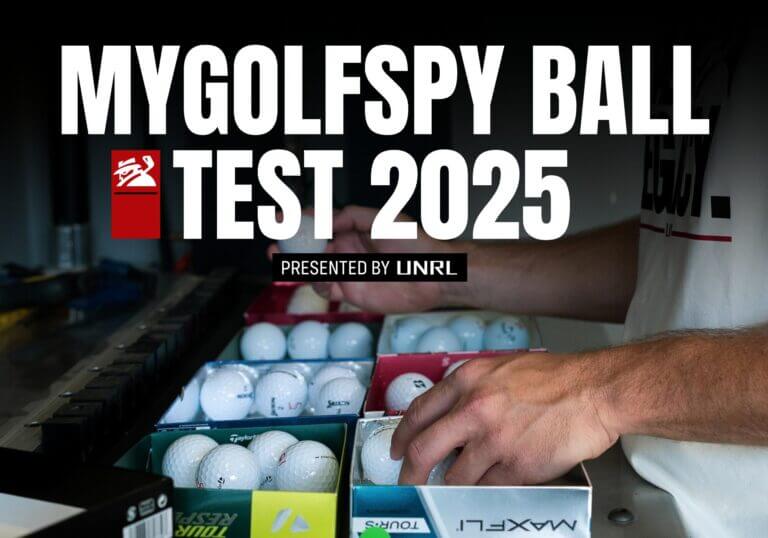
Spin isn’t “good” or “bad”—it’s a tool. The right golf ball is the one whose spin profile matches your swing. Lower driver spin can add carry and tame curvature; too little spin can make shots fall out of the air.
Higher iron and wedge spin helps you stop the ball on the green. Too much of it can balloon your flight. In the MyGolfSpy 2025 Ball Test presented by UNRL, the biggest separations show up in wedge spin (full and 35-yard shots), while driver and mid-iron spin differences are tighter.
Use the tables below to see which balls are at the extremes for your swing speed and then choose the profile that complements your game.
For fast swingers, the driver spread is almost 850 rpm, big enough to change flight windows. The Srixon Z-STAR Diamond sits at the top while Callaway Supersoft anchors the low end. With irons, the gap is even larger: nearly 1,300 rpm between Z-STAR Diamond and Bridgestone TOUR B RXS.
| Highest Spin | Spin (rpm) | Lowest Spin | Spin (rpm) |
|---|---|---|---|
| Srixon Z-STAR Diamond | 2,967 | Callaway Supersoft | 2,113 |
| Srixon Z-STAR | 2,942 | Srixon SOFT FEEL | 2,303 |
| Bridgestone TOUR B X | 2,890 | TaylorMade SpeedSoft | 2,343 |
| Highest Spin | Spin (rpm) | Lowest Spin | Spin (rpm) |
|---|---|---|---|
| Srixon Z-STAR Diamond | 7,173 | Bridgestone TOUR B RXS | 5,365 |
| Callaway Chrome Tour X | 7,126 | Callaway Supersoft | 5,854 |
| Titleist Velocity | 7,103 | Vice Pro Air | 5,949 |
At mid speeds, the driver spread is slightly smaller but the iron gap is large, over 1,300 rpm between Titleist Tour Soft and ERC Soft. That difference can decide whether a ball hops forward or checks quickly on approach shots. Mid-speed players may benefit most from mixing profiles: lower driver spin for distance, higher iron spin for control.
If you’ve noticed the trend already, the Z-Star Diamond is in the top three for iron and driver spin for both high and mid swing speed players. The same can be said for the Callaway Supersoft on the low end of the spin scale.
| Highest Spin | Spin (rpm) | Lowest Spin | Spin (rpm) |
|---|---|---|---|
| Callaway Chrome Tour X | 2,783 | Callaway Supersoft | 1,972 |
| Srixon Z-STAR Diamond | 2,691 | Srixon SOFT FEEL | 2,147 |
| Wilson Staff Model X | 2,670 | TaylorMade Tour Response | 2,157 |
| Highest Spin | Spin (rpm) | Lowest Spin | Spin (rpm) |
|---|---|---|---|
| Titleist Tour Soft | 6,749 | Callaway ERC Soft | 5,428 |
| Srixon Z-STAR Diamond | 6,716 | Callaway Supersoft | 5,430 |
| Wilson Staff Model X | 6,615 | TaylorMade Tour Response | 5,555 |
The standout here is how some tour balls spin dramatically higher than distance models, even for slower players. Chrome Tour X and TP5 reach 3,300–3,500 rpm off the driver while Supersoft drops under 2,600 rpm.
That extra spin can help certain players get the ball airborne but it can also exaggerate slices or ballooning. With irons, the 1,200-plus rpm gap between Tour Soft and Tour Response highlights a tradeoff: higher-spin urethane balls give slower players much-needed green-holding ability while low-spin models may roll out too far to stop reliably.
| Highest Spin | Spin (rpm) | Lowest Spin | Spin (rpm) |
|---|---|---|---|
| Callaway Chrome Tour X | 3,490 | Callaway Supersoft | 2,589 |
| TaylorMade TP5 | 3,328 | TaylorMade Tour Response | 2,740 |
| Bridgestone Tour BX | 3,327 | Srixon SOFT FEEL | 2,761 |
| Highest Spin | Spin (rpm) | Lowest Spin | Spin (rpm) |
|---|---|---|---|
| Titleist Tour Soft | 5,532 | TaylorMade Tour Response | 4,264 |
| Srixon Z-STAR Diamond | 5,420 | Callaway ERC Soft | 4,292 |
| Callaway Chrome Tour X | 5,350 | Vice Pro Air | 4,323 |

Wedges are where golf ball spin rates separate the most. On full shots, the gap is 1,500-plus rpm, enough to be the difference between a ball zipping back or releasing past the pin.
At 35 yards, the spread is massive: TP5 at 6,026 rpm versus Velocity at just 2,058. If you want your wedge shots to stop quickly, you may need a high-spin urethane ball. If you don’t rely on spin and prefer rollout, ionomer balls like Velocity or Supersoft will get the job done.
| Highest Spin | Spin (rpm) | Lowest Spin | Spin (rpm) |
|---|---|---|---|
| Callaway Chrome Tour X | 10,148 | Vice Pro Plus | 8,613 |
| Wilson Staff Model X | 9,847 | Bridgestone TOUR B X | 8,686 |
| Kirkland Performance+ v3.5 | 9,828 | Mizuno Pro X | 8,865 |
| Highest Spin | Spin (rpm) | Lowest Spin | Spin (rpm) |
|---|---|---|---|
| TaylorMade TP5 | 6,026 | Titleist Velocity | 2058 |
| Bridgestone TOUR B XS | 5,998 | TaylorMade SpeedSoft | 3,177 |
| Wilson Staff Model X | 5,992 | Pinnacle Rush | 3227 |

The 2025 ball test shows spin differences between golf balls can be just as impactful as switching clubs. Your choice should be based on numbers that work for your game.

World-class testing requires world-class equipment. This is the gear we trust to help us fulfill our Most Wanted testing.

Britt Olizarowicz is a scratch golfer, former teaching professional and one of MyGolfSpy’s leading voices on equipment testing and golf performance. She has spent more than 15 years working at private clubs in New York and Florida and now specializes in translating test data and swing mechanics into practical advice for everyday golfers. Britt began playing at age 7 and has never left the game. When she’s not writing, you’ll find her on the course, playing pickleball, cooking, running or out on the boat with her family.
| Driver Callaway Triple Diamond Max | 5 Wood Callaway Epic Speed |
| 4 Hybrid Titleist TSR2 | Irons Titleist T-250 (6-PW) Titleist T-350 (5) |
| Wedges Titleist Vokey SM10 (52, 56, 60) | Putter Scotty Cameron Newport |
1 year ago
Funny that this is never a part of the club fitting to ask what ball people play it have been fit for
1 year ago
So tired of the spin discussion! I swing 93 mph with the driver and 77-83 mph with irons and with these numbers I should be playing a different ball with every swing. Personally, you have to hit a ball far enough to use your irons and then your short game and putting should be the reason you play a ball. Data overload has over taken golf and most sports. Can we really tell the difference with these small incremental differences? We should drop the decimals and round up!
In the end, you have to get the ball in the hole.








Scott
1 year ago
Again. You need to differentiate between the yellow 3.5 kirkland and the white. They are made in different countries.