



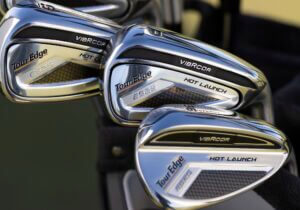
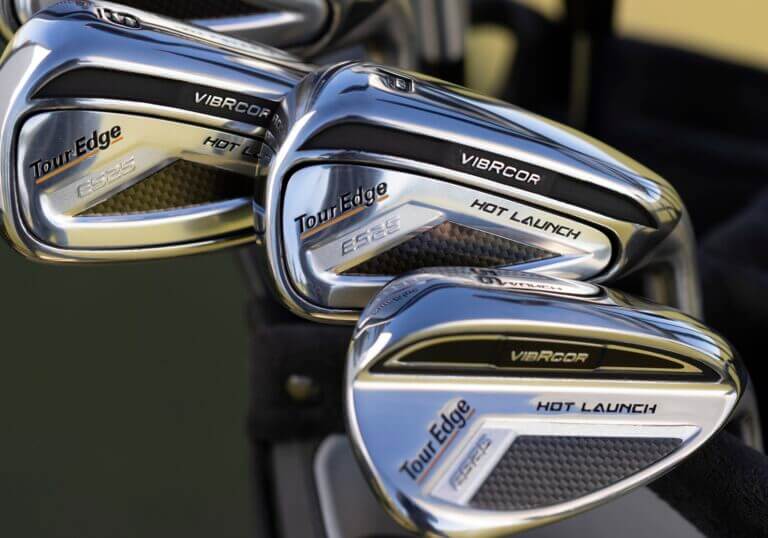
What separates the most expensive game-improvement iron from the least expensive? Sometimes, less than you’d think. In our 2025 Most Wanted Game-Improvement Iron test, we evaluated distance, accuracy and forgiveness to see how every model stacked up.
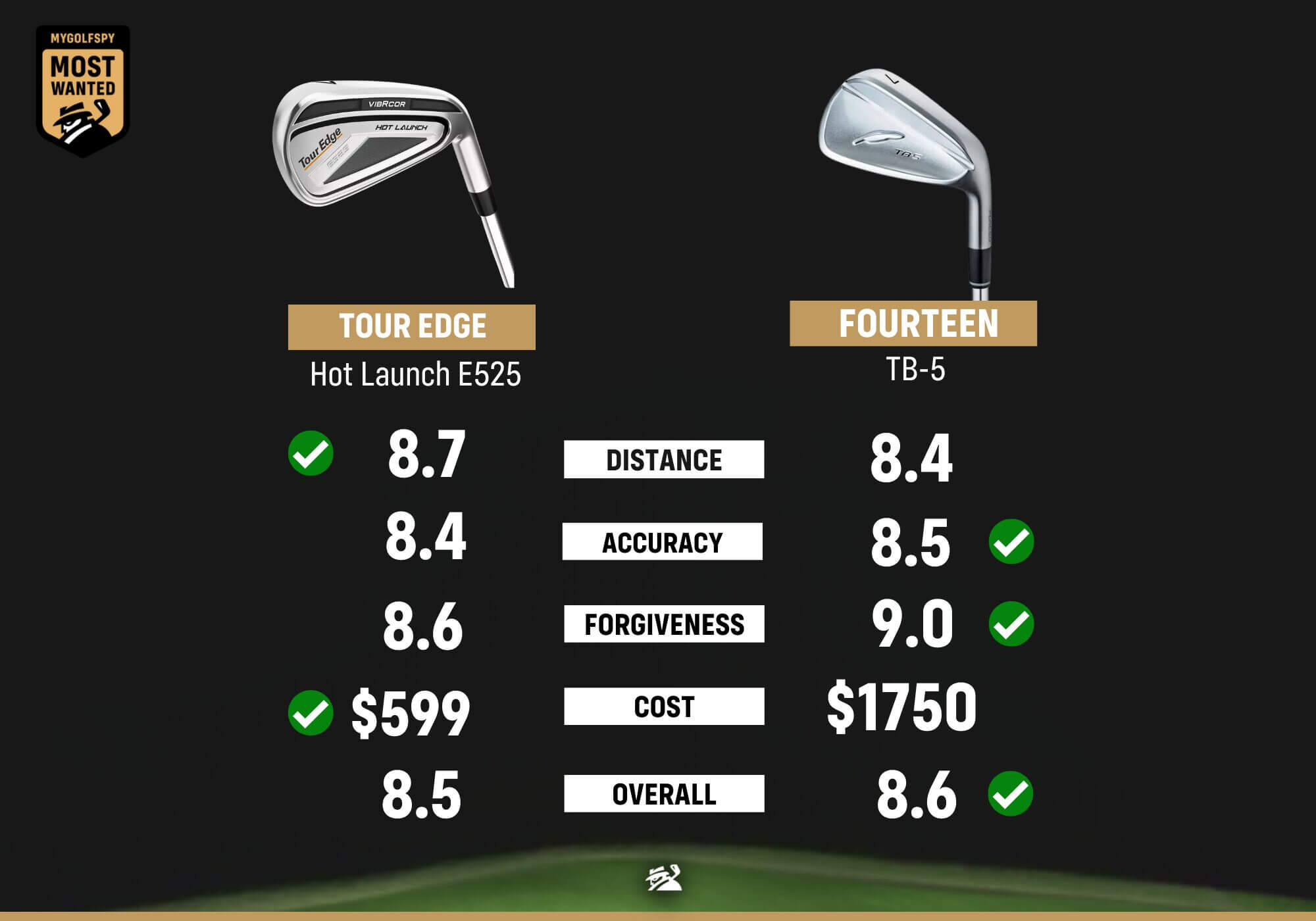
The Tour Edge Hot Launch E525 came in as the least expensive option while the Fourteen Golf TB-5 was the priciest. But a higher price tag doesn’t always guarantee better performance.
What do these irons have in common?
The Tour Edge Hot Launch E525 and Fourteen Golf TB-5 irons sit at opposite ends of the price spectrum but they share some common ground.
Forgiveness-first designs: The E525 uses a wide hybrid-style sole, perimeter weighting and Ridgeback Technology to keep mishits playable and shots on line. The TB-5 doesn’t look like a classic GI iron but its “Theater Blade” design and balanced weighting earned it top marks for forgiveness in MyGolfSpy’s testing.
High-launch performance: Both irons are built to help players get the ball airborne. The E525 lowers the center of gravity and uses variable face thickness to promote higher launch while the TB-5’s sole grind and soft steel construction allow for clean turf interaction and consistent trajectories.
Targeted at mid to high handicaps: The E525 is aimed squarely at players who need confidence and help with carry. The TB-5 caters to mid- and higher-handicap golfers who value shot-to-shot consistency, even if they don’t want a bulky look at address.
Why is the Fourteen TB-5 so much more expensive?
The TB-5 is built very differently from most game-improvement irons. Each head is forged from soft S20C mild steel rather than cast. The forging process requires more labor and tighter manufacturing tolerances.
Fourteen designs and produces clubs in smaller batches, with limited distribution compared to major brands. That lack of scale drives up per-club costs.
Finally, the TB-5 comes from a Japanese boutique manufacturer that prioritizes precision and materials over price.
Which is the better value?
Value isn’t just about price. It’s about what you get for your money. And, in this matchup, the edge goes to Tour Edge.
At $559.99, the Tour Edge Hot Launch E525 was one of the most affordable irons in our 2025 test. Despite its budget price, it earned strong reviews for forgiveness and consistency, helping mid- to high-handicap golfers launch the ball higher and keep shots in play.
The Fourteen Golf TB-5, on the other hand, costs around $1,750 for a set. While it finished with a solid overall score of 8.6, its numbers in distance, accuracy and forgiveness were not significantly better than much cheaper options.
Which is the better value?
If you want boutique craftsmanship and a forged head with a unique design story, the TB-5 justifies its premium price for a very specific player. For nearly everyone else, the Hot Launch E525 delivers similar performance for less than one-third of the price.

Don’t see what you are looking for?
If neither of these irons fits your golf game or your budget, look at our complete Best Game-Improvement Iron Test.







OpMan
10 months ago
TB-5 is not “game improvement” FFS
that is a standard mid-sized modern single piece mid-cavity high-quality forged blade.
The other thing is a large headed multi-material speed club
Don’t get why you guys do these silly comparisons all the times with things that aren’t really comparable in equal terms
Fake
10 months ago
“Designed for mid-handicap players who love a blade look but need significant forgiveness” sounds they’re focusing on a game improvement player to me.
But I only play Miura irons, so I wouldn’t really know about such things. And a 2 degree driver on account of my incredible power and accuracy.
OpMan
10 months ago
It’s still a fairly thin iron but with a lot of offset, that’s all it is, slightly stronger loft for the modern game, but compared to the other one, it’s not even the same!
Enjoy your overpriced overhyped average performing junk Miuras LMAO