


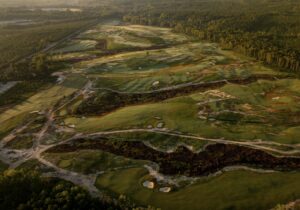
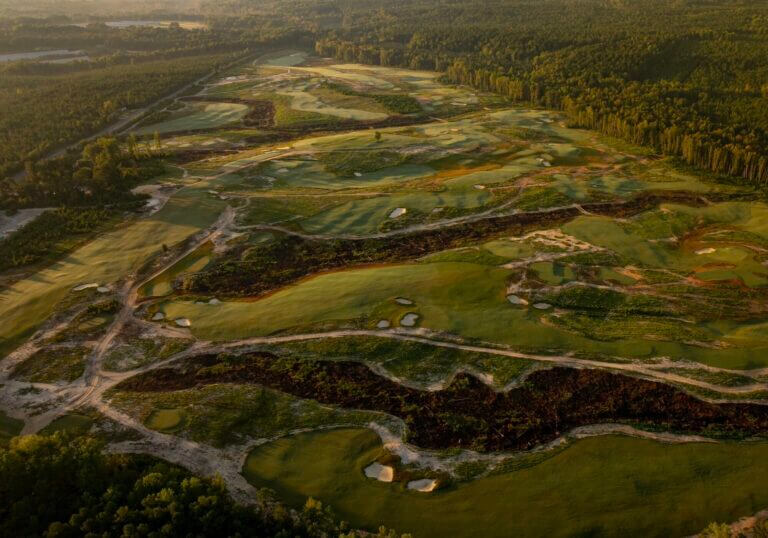
I recently had the opportunity to play Bounty Club, Justin Timberlake’s new ultra-exclusive course located about 12 minutes north of downtown Nashville.
Honestly, it was one of the best golf experiences I’ve had in the past few years.
Designed by King-Collins, Bounty Club is bold, strategic, visually arresting and absurdly fun (despite its propensity for punching you in the face). The course immediately jumped into my top 15—bordering on the top 10—among those I’ve played in the United States.
And barring a miracle on par with me suddenly hitting my driver like Rory McIlroy, I will probably never play it again.
I say all of this as a starting point for one of the mounting tensions I feel in the modern golf landscape.
We are living through a wildly exciting renaissance in golf-course architecture but the most interesting layouts being built are reserved for a minuscule percentage of golfers.
The game is booming in nearly every metric but I increasingly feel as if ordinary players are left looking through the gates.
Part of my job at MGS is to be a voice for the average golfer. I feel like this is a moment to do that.
The numbers behind a concerning trend
According to the National Golf Foundation (the source for all the numbers below), nearly 150 course projects are under construction or in active planning across the United States.
More than half of them are private.
This just doesn’t add up, right? That number is disproportionately high given how member-only clubs represent about 28 percent of the country’s existing golf course supply.
Less than eight percent of American golfers belong to private clubs.
Yet the majority of new courses are private.
Beyond this, there is another large chunk of new courses that are public but belong to destinations/resorts the average U.S. golfer will rarely visit. Having Landmand, Gamble Sands and Bone Valley at Streamsong is tremendous but those are remote destinations that require a lot of money and time to reach.
The private golf projects are plentiful and exciting. Coore and Crenshaw are building a second course at the Kingsley Club in Michigan. Tiger Woods’ design firm is creating a member-only course at Tributer Resort in MyGolfSpy’s home state of Virginia. New private clubs continue to emerge, particularly across Florida, South Carolina and Texas.
Architects are being given compelling land, healthy budgets and the freedom to create dynamic golf that awakens your imagination. From a design perspective, is this the best new construction environment the industry has enjoyed in decades? I would say so. There were a lot of utilitarian, execution-test courses built when I was growing up. We’ve thankfully flipped the page on that era.
But who exactly is this architecture renaissance serving?
According to the NGF, golf in the U.S. had more than 29 million on-course participants in 2025 and more than 500 million rounds were played nationally. The game is still in a remarkably strong position. The post-pandemic boom hasn’t tapered off just yet. I feel that every time I visit my local courses.
However, those new golfers are trying to find tee times while the country has roughly 2,000 fewer courses than it did during the previous participation peak in the early 2000s.
Supply just doesn’t add up to the demand, particularly when talking about affordable public golf.
We’re in a crunch here. Just getting a tee time at a decent public facility can be very difficult.
And it should be noted that closures since 2006 have heavily affected facilities charging less than $40 more so than other types of facilities. The courses that got whacked were largely the ones average players could afford. The repeatable places you can visit multiple times per week.
We need to be building more public golf courses to account for this; instead, private and destination golf are dominating the new construction landscape.
That is a problem.
The “missing middle” of American public golf
Let’s not get it twisted. This article isn’t an attack on private golf or the Bandon Dunes of the world.
I’m not blaming Bounty Club or any other private facility for existing. It’s awesome they exist!
Private money is fueling some of the most ambitious architecture in golf. These projects employ architects, shapers, superintendents, caddies and hospitality workers. They preserve large pieces of land and can push design forward in ways that influence the rest of the industry.
Bounty Club is not pretending to be anything other than highly exclusive. It was designed as an invitation-only experience for a small local and national membership. That is its business model which will probably be highly successful.
The issue is not that wealthy golfers have great places to play.
The issue is that the broader industry has not matched that investment at the public level.
American golf course construction may be thriving in the private and public resort/destination sector but it has a rotting middle class beyond those categories.
Sure, we can all cite meaningful public golf projects of varying statures. The Patch at Augusta. The Park in West Palm Beach. Candyroot Lodge, the course that just came online in South Carolina.
But there just aren’t enough places for the weekend hacker. The ratio of private to public projects within the current construction pipeline is badly out of balance.
The reasons are obvious. Namely, urban land has become prohibitively expensive. Even if a developer acquires the property, affordable green fees won’t produce a competitive return on the land. A course charging $60 for 30,000 annual rounds generates $1.8 million in gross golf revenue before paying for labor, maintenance, water, equipment, insurance, utilities and debt.
Selling hundreds of houses on that acreage is usually much more profitable but that comes with its own tangled mess akin to when Roy McAvoy puts on every training aid he owns at once.
Many beloved urban munis exist only because cities acquired their land decades ago. If those courses did not already exist, they would be almost impossible to build today.
And whereas a private or destination/resort course will have multiple dependable revenue streams, the margins are tighter than a Scottie Scheffler nipped wedge when it comes to public golf.
Of course, city golf doesn’t necessarily exist to maximize profit. Courses can be treated like parks and recreation, a service to the community, not a profit-driving enterprise. But committing perhaps $15 million to $30 million for a new course is politically strenuous. Consider the case of Midland County, Texas, which recently estimated that a proposed municipal course would cost $12 million to $18 million with irrigation alone accounting for $4 million to $7 million.
Officials then have to explain why that acreage and money should support golf instead of housing, traditional parks or other public services. It’s usually a losing battle. Golf’s historical reputation as an affluent, land-intensive activity makes that argument even harder. Oh, and golf uses an insane amount of water, which is an increasingly precious resource in regions like the Southwest.
Having said all of this, there are solutions.
- Start with renovating existing courses—The Patch is an incredible template here. The cheapest urban golf course to build is the one already there.
- Build shorter courses—Golf courses no longer need to be 18 holes and 7,200 yards. Forget tradition. Shorter courses require less land, fewer resources and still serve the community just as well.
- Focus on unlikely land sources—Several existing urban courses survived precisely because their land was difficult to develop conventionally. Former landfills, quarries, reclaimed industrial properties and other constrained sites offer possibility. Harborside International in Chicago, Langston in Washington, D.C., Granite Links outside Boston and Chambers Bay near Tacoma, Wash., demonstrate how golf can help reclaim interesting land.
We keep hearing that golf wants to become younger, more diverse and more welcoming. The participation numbers suggest meaningful progress has been made. More beginners are entering the game and women and junior golfers represent growing portions of the golfing population.
But all of this progress will be hindered if these new golfers don’t have affordable, enjoyable places to play.
A simulator can introduce someone to the game. A driving range can help that person become comfortable swinging a club. Alternative golf like PopStroke or Topgolf can make someone curious.
None of them can entirely replace walking onto an actual course and discovering why golf becomes a lifelong obsession.
I hear way too often from golfers living in population centers that they can’t find tee times, rounds cost too much or courses are jamming too many people onto their properties.
Golf really needs to get creative to address this.
Nashville is a perfect example of what I’m talking about
I live in Middle Tennessee which has a long list of tremendous private clubs. The Golf Club of Tennessee is 20 minutes from my house. Troubadour Golf and Field Club is all the rage. There are several places like Belle Meade Country Club, Hillwood Country Club and others that are excellent. Add Bounty Club to the mix.
And then you look at the moribund public golf scene …
Nashville’s municipal facilities are serviceable at best and only a few worthwhile public options exist outside the urban core.
But the region’s population growth and enthusiasm for golf have outpaced (several times over) the quality and availability of its public supply.
There should be room for both things to happen at once: Bounty Club can become a nationally celebrated private course while Nashville makes a serious investment in accessible golf.
Maybe that is about renovating existing municipal facilities, building compelling short courses, expanding practice areas or creating public-private partnerships that make construction financially realistic.
Not every public project needs to become the next Bethpage Black. I’m not asking for that.
Just give people nine interesting holes, a putting course, a place to practice and a modest clubhouse. Make it affordable, walkable and welcoming. We’re thinking hyper minimalist here. I point to recently renovated Percy Warner Golf Course as a shining light of what I’m looking for in public golf.
Thoughtful architecture does not require 500 acres, a celebrity investor or a six-figure initiation fee.
The boom should benefit everyone
Golf has spent the past several years celebrating its resurgence. Equipment is selling. Tee sheets are packed. Private developments are moving forward and architects have opportunities that would have seemed unlikely a decade ago.
This should be a moment of enormous optimism. And, for the most part, it is.
But (and this may be controversial), I don’t think golf should be measured purely by new golfers entering or rounds played. And it definitely shouldn’t be measured by the sheer number of spectacular courses being built.
One of the most imperative measures is whether an ordinary family can afford to play on Saturday morning. It’s like the test of taking your family of four to a baseball game. Can it be done within reason? Are you spending $100 or $400?
I’m grateful Bounty Club exists. Playing it reminded me how imaginative and exhilarating modern architecture can be.
It also reminded me how frustrating it is that experiences like it are increasingly concentrated behind locked gates or far-flung destinations.
Golf’s current construction boom is producing extraordinary courses but can we get a little something for the mere mortals?
The problem isn’t that America has stopped building golf courses. It’s that we have largely stopped building the kind of course an ordinary golfer can afford to play every Saturday.
What are your thoughts? Let me know below in the comments.
Top Photo Caption: Candyroot Lodge is the latest public golf destination course. (Courtesy Candyroot Lodge)









Daren
2 weeks ago
A few comments. One about Bethpage, another about 9 holes.
You mentioned Bethpage in your article.
Bethpage State Park’s golf courses were a WPA (Works Progress Administration) project. During the Great Depression, President Franklin D. Roosevelt’s New Deal created the WPA to generate employment. Under the direction of Robert Moses and the Bethpage Park Authority, a WPA relief labor force of over 1,000 men was brought in to build the public park.Key facts about the WPA’s work at Bethpage include:The Courses: The WPA workforce constructed three new courses (the Black, Red, and Blue courses) and heavily modified an existing private course into the Green course.The Clubhouse: The park’s massive brick clubhouse was also built using federal relief funds and labor.
The Designer: The WPA hired legendary golf course architect A.W. Tillinghast to design and oversee the development of the courses.The Red, Blue, and Green courses opened to the public in 1935, followed by the world-renowned Bethpage Black Course in 1936. (A fifth course, the Yellow course, was added much later in 1958)
9 holes.
I’ve seen course use double tees for 9 holes course, turning them into 18 hole rounds. Its a smart use of space that public tracks should consider to cut down on cost / maintence and water.