



Did Cam Young Blow Up The USGA Ball Rollback?
Golf Balls

Did Cam Young Blow Up The USGA Ball Rollback?

Support our Mission. We independently test each product we recommend. When you buy through our links, we may earn a commission.

Did Cam Young Blow Up The USGA Ball Rollback?

Cam Young is winning with a ball that likely conforms to the USGA’s 2030 rollback. The story behind it suggests the math doesn’t work the way the governing bodies have been selling it.

When word got out that Cam Young’s Pro V1x Double Dot would likely conform under the USGA’s revised Overall Distance Standard, the easy read was that an elite player tripped into a Trojan horse. He’s bombing it 375 yards down the 72nd hole at TPC Sawgrass. He’s won The Players, the Wyndham and the Cadillac Championship. He’s doing all of it with a ball Titleist designed to be lower flying and lower spinning. The ball also, apparently, threads the needle on the rollback rule the USGA hasn’t even implemented yet.

Uh oh? Oopsie?

The fundamental question raised is this: Did the USGA get it wrong when it claimed that distance lost to the rollback would be linear with swing speed?

I’d wager that what we’re learning from Cam Young and his Double Dot has become an uncomfortable discussion point for the people who created the 2030 test conditions and the underlying assumptions to justify them. The governing bodies’ assertions from Day One have been that, on percentage, golfers would experience equivalent dips in distance as a result of the rollback.

What we’re learning suggests something different entirely. The swing profile that makes Double Dot work for Young is exactly the swing profile most likely to fare best under a rollback. The gap between him (and others who generate similar launch conditions) and the rest of the PGA Tour isn’t going to close. It’s going to widen. That’s the asymmetric outcome the USGA’s distance math hasn’t previously acknowledged. Young doesn’t lose much of anything. The same is likely true for Bryson DeChambeau. The guys who don’t hit it as high and don’t spin it as much? Good luck, fellas. Remember to diversify your bonds.

A refresh on Cam Young’s ball

Pro V1x Double Dot is a CPO (custom performance option). Like Left Dot, it’s a Tour-only option. It’s a lower-compression, lower-flying and lower-spinning take on Pro V1x. A not insignificant detail: it’s likely the lowest-flying and lowest-spinning ball within the larger Pro V1 family.

As far as known golf ball performance levers go, dropping compression typically costs you a little speed. In Young’s case, the lower flight and tighter spin profile balance the speed loss.

In Titleist’s mini doc on Young’s fitting, JJ Van Wezenbeeck, Titleist’s Senior Director of Player Promotions, noted that his launch dropped from nine degrees to something well shy of optimal with Double Dot. The fix was an 11-degree GT3 (lofted down 0.75 degrees). That took Young’s launch from nine to 11 degrees with only a 100-rpm bump in spin (2,400 to 2,500). That’s a really tidy fitting outcome and it tells you something about how the ball plays.

Worth noting: Young is a high ball hitter. Bringing flight down doesn’t mean hitting stingers all day. It’s about lowering flight toward optimal. The same is true for the spin reduction. The ball gives him more efficient flight and tighter dispersion. The reduced spin shows up most obviously with the irons. Young says, “This ball is easier to control with the irons. It doesn’t spin as much, and it just allows me to be better with my distance control.”

I suppose that’s another detail that gets lost in the rollback debate. While the entire conversation is about reducing distance off the tee, the two most important factors when fitting a golf ball are flight and spin (not speed/compression). In their most aggressive rounds, a Tour player is going to hit his driver 14 times at most. The majority of the rest of the full swing shots are going to be with irons and wedges. It’s the reason Titleist suggests fitting the ball to the irons and the driver to the ball. That’s exactly what we see in the video.

For context, Young ranked 17th in driving distance at 313.2 yards before he switched to Double Dot. He’s averaging 312 yards this year and gained roughly 120 spots in fairway accuracy. He’s sixth on Tour in Strokes Gained: Off the Tee. The 375-yard bullet down 18 at Sawgrass was the longest drive on that hole in the Shotlink era.

All that with the heavy suggestion that the ball he’s doing it with would be conforming under the new rule.
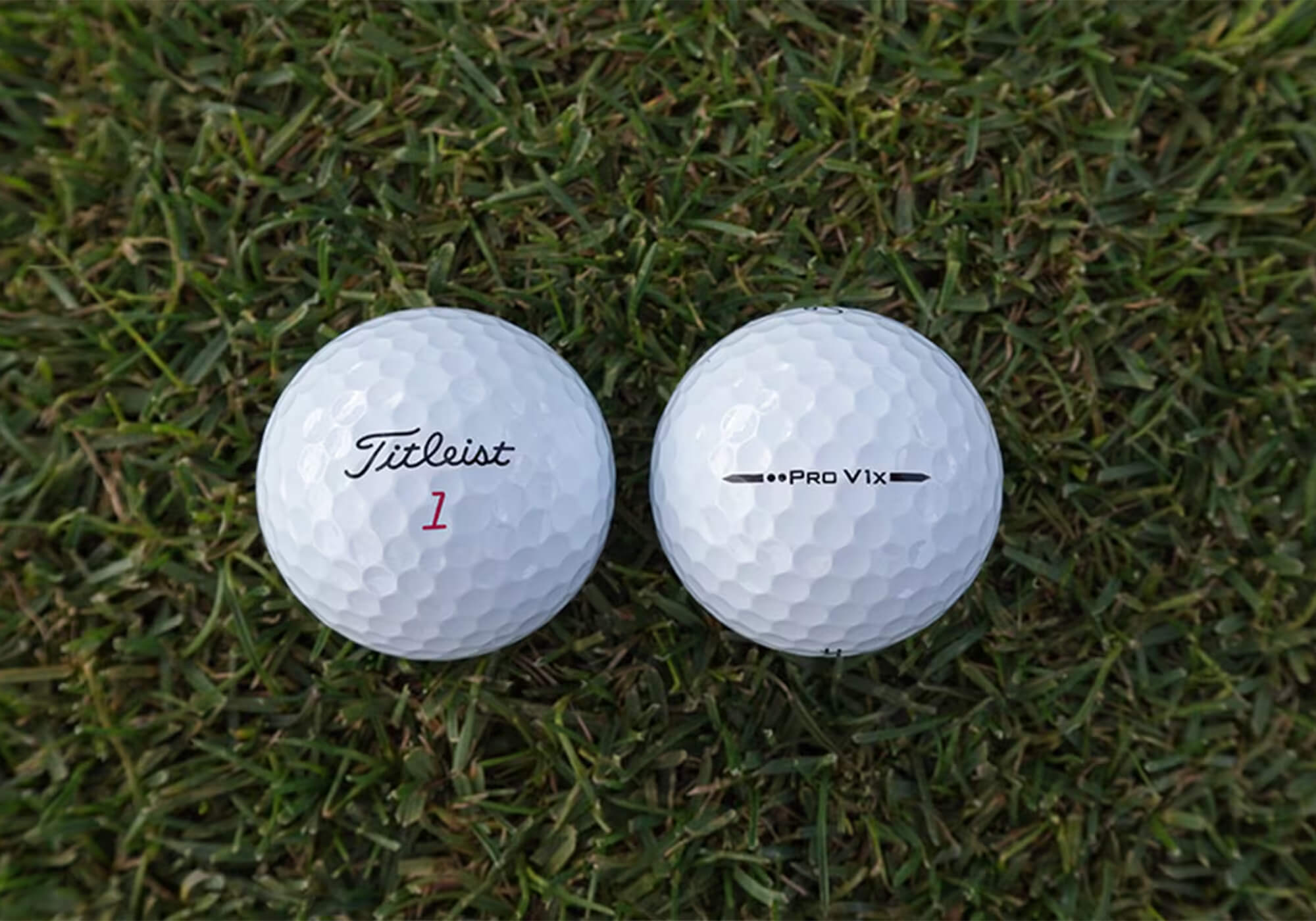
Threading the needle

The fact that Double Dot also happens to thread the needle on the new USGA test conditions is part happy accident, part engineering inevitability. The new test parameters have been on the table for years. Manufacturers know what’s coming.

Worth a quick point of clarity: there is no 2030 conforming list yet so nobody can state with total confidence that a ball is conforming. The USGA has been quiet on the specifics of Double Dot, although there is reason to believe it has been tested. PGA Tour testing suggests it would.

The reality, and this is the part nobody really wants to say out loud, is that what’s optimal for Cam Young right now happens to align with what’s likely to be optimal under the rollback. That’s not so much coincidence as it is a design space. And, yeah, it means other Tour players who don’t operate in Young’s flight windows are going to suffer more. Which is what the USGA has said wouldn’t happen.

What the new test conditions actually do

For the uninitiated, the USGA’s current Overall Distance Standard tests golf balls at 120-mph clubhead speed, 10-degree launch and 2,520 rpm of spin. The conformance limit is 317 yards with a three-yard tolerance. Effective January 2030, the test conditions change to 125 mph, 11-degree launch and 2,200 rpm. The 317-yard limit stays put.

Higher speed, higher launch, lower spin. Same ceiling.

The new window lives in a remote corner of the launch-and-spin chart. That’s not where most Tour players live. It isn’t where most weekend chops live, either. There are probably fewer than a handful of guys on Tour who reliably play golf within that space. The new conditions appear to reward a particular kind of swing.

Whether you want to call it a loophole, a workaround or a design reality, the unlock isn’t speed. The unlock is the flight and spin profile that gets you to 317 yards (or just under) at the new test conditions.

That’s exactly what Double Dot does. Take a little speed off via lower compression and, for Young, recoup it through a lower-flight aerodynamics package and a lower-spin profile (which is driven, in part, by the lower compression). The result is a tour-caliber ball that conforms to a more restrictive test. Which is to say: less distance under the proposed test but nearly equivalent distance for a select group of players who play through high-launch and high-spin windows.

The asymmetry problem

The USGA’s underlying assertion, and the one that’s been broadly communicated to golfers, is that distance loss under the rollback will land roughly proportionally. The longest hitters lose the most. Average golfers lose a few yards. Slow swingers basically don’t notice. Nice and clean and linear. The kind of thing you can sell at a press conference.

What’s lost in the conversation is that while speed matters, flight and spin matter just as much, arguably more.

As an extreme example to hopefully put some real-world context to how this works: we’ve talked plenty about the driver speed penalty with low-compression golf balls (aka “soft is slow”). It’s also true that for a specific player launch and spin profile, Callaway’s Supersoft (a super-low compression offering that’s invariably slower off the driver), under a narrow set of conditions, can be longer than something like Pro V1x Left Dash (one of the firmest and fastest balls on the market). If the only lever you’re pulling is speed, the math doesn’t survive across the population of golfers.

In Golf Digest’s recent CEO roundtable, the moderator framed the original assumption: longest hitters lose most, shortest lose least.

Acushnet CEO David Maher’s response was direct: “We don’t see it that way.”

Maher noted that Tour testing shows non-uniform impact, with high-speed, high-launch players affected one way and lower-speed, lower-spin players affected another. Titleist’s data, per Maher, aligns with the Tour’s. Which is to say: not aligned with the USGA’s.

Maher also offered numbers that don’t get cited enough. The mean of the fastest one percent of measured clubhead speeds on the PGA Tour was flat from 2019 to 2021 and declined in 2022 and 2023. The mean of the fastest five, 10, 20 and 50 percent has been flat since 2017. Average course playing length on the PGA Tour has been under 7,200 yards every year since 2004.

The premise driving the rollback (that distance is running away unchecked) is doing more rhetorical work than statistical work. To put it another way: the USGA is offering a cure for a problem that may not be serious enough to need it.

The result of a rollback on Tour is going to be uneven. Some players will lose 12 yards. Some will lose more. Others, particularly those with swing profiles like Cam Young, will lose less. Possibly a lot less. That isn’t a hypothetical concern. It’s an emerging Tour fairness problem brought to light by Double Dot. At the Tour level, it’s a problem that has a lot of money attached to it.

So much for the renaissance

One of the friendlier arguments for the rollback, the one that doesn’t lean on yard-loss data, is that it will usher in a return to shotmaking. Working the ball. Shaping shots. Reanimating the soul of the professional game, etc.

Lovely thought. It’s also at odds with reality.

Cam Young’s results suggest the workaround for a rollback ball is lower spin and ultimately tighter dispersion. Which is to say: straighter shots, not more imaginative ones. The optimization path for a rollback environment isn’t curve. It’s control. If anything, manufacturers are going to lean further into low-spin constructions to keep Tour players competitive within the new test envelope.

If the underlying complaint is that pro golf has become too distance-centric and too narrow stylistically, creating a rule that will likely encourage more golfers to swing for the same narrow corner of the launch chart feels like an absolutely bonkers approach. The game gets more uniform, not less.

What does the USGA do now?

The OEMs are well down the road. Titleist, Callaway, TaylorMade and the rest have spent two-plus years building toward the 2030 spec. At least one of those balls (Double Dot apparently among them) is already on Tour.

The way I see it, the USGA has three options. None of them is particularly fun.

Option 1: Hold the line. Push the rollback through as scheduled. The likely outcome is that Tour pros experience uneven distance loss, the long bombers find new technical workarounds (because the design space is bigger than the USGA seems to have modeled it to be) and the public spends a few years arguing about it. The renaissance doesn’t materialize. The game gets a little shorter and a little more uniform. There’s also likely to be less parity on the leaderboards from week to week as the distance divide widens.

Option 2: Tweak the test conditions again. This is probably the most defensible move and also the one that says, in effect, “We got it wrong the first time.” Manufacturers who’ve already retooled are not going to love being asked to retool again. Delay beyond 2030? Maybe.

Option 3: Scrap it.

Pulling the plug on the rollback would be a meaningful institutional admission that the underlying premise needed more pressure testing than it got. Don’t hold your breath.

For now, what do we have? A Tour-only ball that Cam Young will tell you he’s playing for his own optimization, that happens to conform to a not-yet-active rule. A set of test conditions that were sold as fair and uniform that the PGA Tour’s testing says are neither. The asymmetry argument the USGA has dismissed since Day One is now at the forefront of the conversation. The CEO of the company that sells the most golf balls in the world is on record saying his data and the Tour’s data don’t match the USGA’s.

The Tour, which historically picks its fights carefully, seems increasingly willing to fight this one. If Double Dot becomes the template and if more Tour players start finding their way into balls like it (and they will, because that’s what optimization looks like), the pushback won’t stay polite for long.

Young probably didn’t blow up the rollback all by himself. But his results, his ball and his fitting story laid out the case the USGA didn’t want made in public, with timing the USGA can’t really do anything about.

The rest is what the USGA decides to do next.

Let us know where you land. Was the rollback wrong from the jump, a good idea executed poorly or a fix that was never going to do what its proponents wanted?


For You

For You

Masters Tickets Masters Tickets
Golf Talk
Jun 2, 2026
How To Stack The Masters Ticket Lottery In Your Favor
News
Jun 2, 2026
How Long Does It Take To Break In New Golf Shoes?
News
Jun 2, 2026
Can A Mouthpiece Make You A Better Golfer?
Tony Covey

Tony Covey

Tony Covey

Tony is the Editor of MyGolfSpy where his job is to bring fresh and innovative content to the site. In addition to his editorial responsibilities, he was instrumental in developing MyGolfSpy's data-driven testing methodologies and continues to sift through our data to find the insights that can help improve your game. Tony believes that golfers deserve to know what's real and what's not, and that means MyGolfSpy's equipment coverage must extend beyond the so-called facts as dictated by the same companies that created them. Most of all Tony believes in performance over hype and #PowerToThePlayer.

Tony Covey

Tony Covey

Tony Covey

Tony Covey

Tony Covey


    This site is protected by reCAPTCHA and the Google Privacy Policy and Terms of Service apply.

      WiTerp50

      2 weeks ago

      I canceled USGA when it was obvious they were more concerned with TV and advertisers than the average golfer that is their membership. There are so many simple ways to restrain the excellent athletes. Yadda, yadda, narrow fairways from 280-330 yards. Water the fairways to reduce run. Local rules to limit driver shafts to 42.5 inches. How many ways make far more sense than guessing what changes to the golf ball will work?

      Reply

      WC

      3 weeks ago

      Get control of the equipment. Reduce the size of the driver. Keep the materials of the heads to be only 1 material, in other words, the whole head is either steel, titanium or carbon. It can be any of the 3 but which ever is used by the manufacturer the whole drive has to be that one material. For irons, remove the cavities in the irons and make the irons solid material.

      Reply

      Beak

      3 weeks ago

      While Cam Young has already found a ball that may conform and doesn’t hurt his play, Titleist has 3.5 more years to further develop balls that conform and fit more elite players. Not only that, but they also have the technology to make clubs that optimize the launch conditions for the balls they are creating. As do the other major club/ball companies.
      The problem for the average golfer is the lack of real information on whether the balls will actually affect non-elite players. It would be helpful if MGS tests the ball Cam hits at swing speeds 90 and below and see if it makes a difference.
      If I was a DTC ball maker having to test and retool over the next few years, I might just continue to make balls and sell them to the rebels like myself who will not conform until I run out of balls purchased prior to 2030. If not, I plan to buy a lot of balls in 2029…
      The USGA and R&A are way too interested in preserving the old historical courses for their money making tournaments. Trust me, I can make any old course play hard for the pro’s. It won’t take trying to limit ball flight to accomplish either.

      Reply

      Mike

      2 weeks ago

      Great points! I’m watching the best in the world sit at what, -5 after 54 holes with the CURRENT array of golf balls (if that score is too “low” for you, you have mental issues). The usga (they don’t deserve to be in caps) completely blew it…AGAIN. How exactly would Rory driving the ball 15 yards shorter “save” older golf courses? Put strategic bunkers in the fairways like Aronimink has. Poof! I saw a ton of guys end up there on numerous holes, had to struggle to make pars.

      When will the usga bluebloods realize that nearly all amateurs play a completely different game than the pros (drier / 9 iron to a par 5???). Even Tiger favored bifurcation. I literally burn any correspondence I receive from the usga.

      Reply

      Greg

      3 weeks ago

      Let the game evolve as it always has. When the game went from the feathery to the gutta percha in the mid 19th century, reactionaries said the sky was falling. Yes, cancel the rollback.

      Reply

      Nick

      3 weeks ago

      Great article highlighting the madness of roll-back. It’s never made sense why the solution to less than 1% of players playing on less than 1% of courses is to change the game for everyone.
      Manufacturers, coaches and players will always find ways to optimise any new set of rules and they can adapt faster than the rule-makers. If you’re worried that a course is too easy for the best athletes then either add more hazards where they hit it or just sit back, relax and admire their skill.

      Reply

      Dave H.

      3 weeks ago

      Another great story from Tony C. on an important topic. Two thoughts….1. I think it’s absurd that hacks are expected to play the same ball as the pros. That works in football and hoops but not in golf. If the USGA & R&A win the day, have Titleist, et al make a tour ball and one for the rest of us. Of course we should play by the same rules but equipment, no way. 2. If the governing bodies win the day (not a given), I can easily see a run on the old ball leading up to 2030 with guys hoarding the old ball and then selling it on eBay for a pretty penny.

      Reply

      Mike

      2 weeks ago

      I have hundreds of virtually new premium balls that I’ve found over the years. I will play them till my supply runs out. So will everyone at my club. Screw the usga. Actually, remove them from the professional golf circuit, it would so benefit the game.

      Reply

      Bob

      3 weeks ago

      The crying over golf balls going to far was never a concern for US Open courses.

      Reply

      Chris Groner

      3 weeks ago

      The “problem” should never have been labeled as that. Pro Golfers are paid by sponsors (equipment and tournaments) and the financial success has to do with entertainment, not pure sports. I watch pro golfers because they are elite, with special skills. No one is going to pay to see me, a 20 handicap hacker. Futzing with the equipment isn’t the answer. As we see in this article, it just creates confusion. What does put a limit on distance is softer fairways and higher rough. This penalizes bad shots and rewards good ones, kind of like real golf. If a pro can hit it 270 into a 10 yard wide fairway with 6 inch secondary rough around it, that pro deserves to be rewarded. All the hand wringing over making courses obsolete ignores all the ways already available. Let the greatest players show off their talent. Remember, the NBA has never suggested raising the rim because players can dunk.

      Reply

      Dean D

      3 weeks ago

      If the new ball knocks 1 yard off Cam Young’s drives that says it’s not really fixing anything for anyone at an enormous cost. I’ve always been a longer hitter but entering my late 60’s losing 20 yards instead of 15 for no benefit of tour driver lengths seems stupid. As a low ball hitter maybe it’s a 25 yard penalty. I know the ball & drivers are 20-30 yards longer than when I started playing with persimmon & balata. Now that I need the extra yardage the regulators want to steal it back?

      Reply

      Brian Jergenson

      3 weeks ago

      I’ve been a big supporter of the USGA for years, but boy did they f@&% this up. A 460 cc driver has a big face (trampoline) and the ball goes 300 yards. A 230 cc driver has a face (trampoline) half the size and the ball goes 225 yards. And they think the golf ball is the problem ! The smaller the face surface, the less it can flex, the shorter the ball flies. The next thing they’re going to say is that the earth really is flat after all !

      Reply

      Donn

      3 weeks ago

      So they changed the wrong parameter? Sounds like a snafu worthy of any California or Minnesota state agency, or every state’s DMV new computer program rollout.

      How many golf 18s are there in the USA? How many TOUR events? Muck around with the ball? The club? Or the tiny percent of ultra-luxury courses that host a TOUR event? Let the TOUR and the owners of the tiny few number of lux courses fix it among themselves. Leave the rest of us alone. When a junior tour (such as Korn Ferry, Web.com, Nationwide, Buy.com, Nike) player graduates to the big TOUR, congratulations and hope they can adjust their psyche.

      Reply

      FEDUPCALIFORNIAN

      3 weeks ago

      Great post Donn. Well said.

      Reply

      Tom S.

      3 weeks ago

      Another option would be for the PGA Tour to say “To hell with the USGA. We are going to publish our own set of rules, and let the golf marketplace decide whether to follow our rules or the USGA rules.” There has never been a decree from God that the PGA Tour must follow USGA rules. They are well within their rights to create their own set of rules, as well as their own equipment standards. Just as an aside, if you really want to roll back distance, force every Tour player to play woods made from wood. Eliminate metal altogether. MLB does the same thing. Every level of baseball uses aluminum bats, except MLB. Golf can do the same.

      Reply

      Smokey

      3 weeks ago

      Choose courses with hole designs that limit the number of times a driver gets used per round for the pros. If there are more par 4 and par 5 holes that run out of fairway by 280-300 yards and have features that punish you for cutting the corner, then the Tour will see more iron play. You can literally watch evidence of this in Brad Dalke’s latest video on his Texas US Open Qualifying tournament round. The man hits 320 yard bombs with a stock swing and only pulled the big stick out 4 times. He was consistently using a 2 or 3 iron from the tee, even on par 5 holes, because the course made that the smart decision.

      The ball isn’t the problem. Fairways that end or turn at 280 yards don’t affect the vast majority of amateur golfers club choice but it will materially affect a Tour level player. If you then follow that dogleg turn with a bunker forcing a 350 yard carry in the direction that the corner would be cut, with trees and narrowing the fairway in-between, guess what the smart play becomes? A long iron or high-lofted wood that can’t roll past 280.

      Courses that want to host PGA or DP World Tour events should be making these course changes now so that any new trees have time to grow into the obstacles they need to be. Or the organizing bodies need to help supply the funding for the work that is so obvious a beginner like me can come up with the solution.

      Reply

      OGCB

      3 weeks ago

      Great write up Tony. I imagine that there’s a lot of hand wringing, head scratching, and finger pointing that’s now going on within the USGA and R&A. It’s a joke and I’m all for scrapping the idea. The sport is evolving and engineers and players are getting better at optimizing. Just embrace it and enjoy the ride.

      Reply

      Mike in Pittsburgh

      3 weeks ago

      We need a ball roll-up! Balls struck at clubhead speeds below 100 mph need to go FARTHER!! Stop penalizing slow swinging old farts by making balls that conform to the laws of physics! Build a 12-part ball with a layer of stupidium that senses when the ball is struck at low speeds, but fires up a higher rebound effect than is physically possible. And make them go straight, unless we are aimed at the rough. Is that too much to ask?? Of course, this could make putting a bit more challenging, with a tap-in rocketing down the fairway 300 yards…

      Reply

      Al Jamieson

      3 weeks ago

      It might have been easier to look at clubs instead of balls. A smaller driver head , like the 975 D, would be worth a try

      Reply

      Matt Vincent

      3 weeks ago

      Well said , why complicate the process . The Pros gear isn’t what we use anyway , limit there size of driver head and lets us amateurs decide what we want to use .

      Reply

      Skraeling

      3 weeks ago

      Cancel it.

      Who actually wants this besides the USGA/R&A?

      If distance is a problem for certain courses… then why not just have a field standard ball that hits whatever spec they need that everyone has to use a la nascar style?

      Reply

      albatrossx4

      3 weeks ago

      One monster drive does not prove anything, his average has dropped, the pro’s have the time and get pampering to get perfectly suited equipment, but lets look at reality, the big issue is carry, not overall, if every player can carry a bunker at 300 the bunker is useless, and the course will need to spend money to change that, one way is increase the length of the course—–This in the long run is NOT SUSTAINABLE. The ruling bodies need to address this, they waited to long, but it still needs to be done, when the opponent to the existence of golf argue against the use of water, chemicals and land, can we as golfers continue to poke this bear with more and more land etc?

      Reply

      Jason S

      3 weeks ago

      The Virtual Roundtable just proved how out of touch the R&A and USGA are as well as how much they don’t actually understand the issue and how things are actually going to happen. Sasho proved that.

      Reply

      Will

      3 weeks ago

      USGA: out of touch old men offering a solution that doesn’t work for a problem that doesn’t exist. Cancel the rollback.

      Reply

      R.C. Allison

      3 weeks ago

      Since the average age of the USGA board is 55, you can call them old if you want to, but they don’t even qualify as Boomers. I would say they are a bunch of middle aged X’ers who are too young to remember when Arnold was driving par 4 greens with rocks and sticks. If you want to change the game, change the courses with tight fairways, deep rough, and more hazards, that make shot making more important than distance.

      Reply

      Gary Ahlert

      3 weeks ago

      You said it best!! Cancel the rollback. Rather than help and improve the game of golf the R&A and USGA have quite simply caused more harm to golf than any other cause or entity I can think of.

      Reply

    Leave A Reply

    required
    required
    required (your email address will not be published)

    This site uses Akismet to reduce spam. Learn how your comment data is processed.

    Masters Tickets Masters Tickets
    Golf Talk
    Jun 2, 2026
    How To Stack The Masters Ticket Lottery In Your Favor
    News
    Jun 2, 2026
    How Long Does It Take To Break In New Golf Shoes?
    News
    Jun 2, 2026
    Can A Mouthpiece Make You A Better Golfer?