


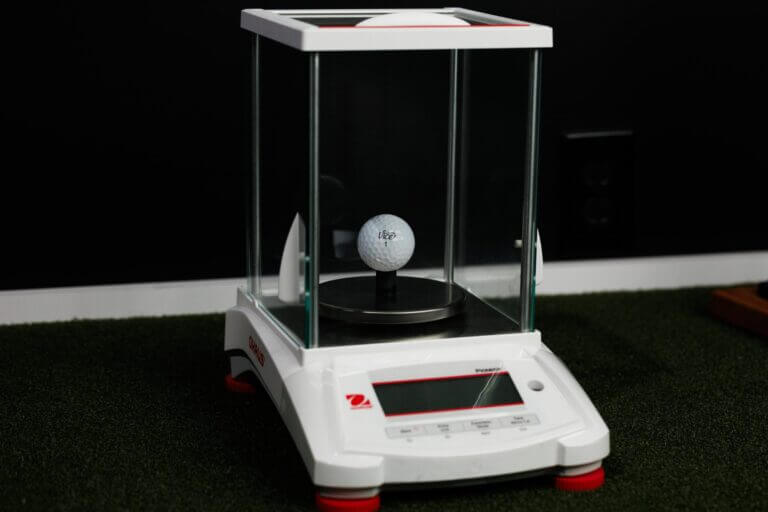
Compression is one of the most misunderstood numbers in golf. It measures how firm a ball is, from roughly 35 (very soft) to 110 (very firm), and most golfers have picked up a rule of thumb about it: slow swingers need soft balls, fast swingers need firm ones and compression is mostly an iron thing because that’s where you feel it.
Some of that holds up, some is overstated, and some is backwards. The iron belief gets the most attention so that’s the one I wanted to test. It turns out compression matters more off the driver than off the 7-iron and the two effects run in opposite directions.
The short version
With a driver, a firmer ball is faster and carries farther and the advantage grows as swing speed rises. With a 7-iron, a softer ball carries slightly farther. Here is the effect of adding 10 points of compression:
| Per 10 points firmer | Driver, 115 mph | Driver, 85 mph | 7-iron, 65 mph |
|---|---|---|---|
| Ball speed | +0.85 to 1.0 mph | +0.2 mph | −0.14 to −0.20 mph |
| Carry | +2.3 to 2.6 yd | About 1 yd or less | −0.2 to −1.2 yd |
| Spin | +60 to +110 rpm | +60 to +110 rpm | +150 to +270 rpm |
Spin figures are for urethane balls and are shown as a range across swing speeds.
The driver: Firmer is faster
Off the driver, the firmer ball was faster in every year and at every swing speed we tested. At 115 mph, a 100-compression ball carries about 12 to 13 yards farther than a 50-compression ball. Compression also explains most of the ball-speed differences between balls at mid and fast speeds: 70 to 88 percent in our data.
Very few golfers swing 115, though. At 85 mph, the advantage shrinks to a yard or less of carry per 10 points, and none of the total-distance differences were statistically significant. Firmer balls still gain a little speed there but they give some of it back in extra spin and less roll.
That also undercuts the “slow swing, soft ball” rule. Our ball test found no swing speed where a “right” compression suddenly kicks in. The effect changes gradually instead. A slower swing doesn’t make a soft ball faster off the driver. It just shrinks the firm ball’s edge.
The 7-iron: Softer goes slightly farther
With a 7-iron, each 10 points of added compression brings roughly 150 to 270 rpm more spin and a launch angle 0.1 to 0.3 degrees lower. Once spin, launch and ball speed are accounted for, compression adds nothing further to carry. Its effect comes entirely through how the ball spins and launches.
The result is a small carry penalty for firmer balls. Balls rated 72 or softer out-carried balls rated 95 or firmer in 11 of 12 iron comparisons by 0.3 to 4.5 yards. Callaway Supersoft was the fastest ball off the slow swing speed iron in 2023 and 2026 and among the slowest off the driver.
Where the “irons” idea holds up
Compression moves spin about twice as much off an iron as off a driver. Going from a soft urethane ball to a firm one adds 440 to 600 rpm with a 7-iron versus 85 to 260 rpm with a driver. If you care about how a ball spins coming into a green, compression matters more there than it does for iron distance.
So what should you do with this information?
If you swing the driver around 105 mph or faster, a firmer ball is worth a serious look. That’s where compression pays off most and a dozen yards of carry is hard to ignore. Just make sure the extra spin it adds with your irons suits the way you attack greens.
Below that, the effect gets smaller, but it doesn’t reverse.
In our testing, a firmer ball was as fast or faster off the driver at every speed we measured and some of the longest balls for slower swingers were on the firm side. So I wouldn’t steer a slower swinger toward a soft ball for distance. The gap is small enough that feel, short-game spin and price are all fair reasons to choose but a soft ball isn’t the distance play.
The 7-iron is the one place softer earns an edge and it’s under a yard per 10 points of compression.







Leave A Reply