


Between teaching kids golf for years and now teaching my own kids to play, I’ve seen a lot of things that work and plenty that don’t.
I also think there are two very different types of parents when it comes to junior golf.
There’s the parent who wants their kid to love a sport they can play for the rest of their life. Golf can help kids learn how to handle frustration, communicate with people, make decisions, be honest and how to persevere when things aren’t going particularly well. Maybe they become really good players. Maybe they don’t. Either way, there’s a lot they can get from the game.
Then there’s the parent who sees golf primarily as a path to a college scholarship or maybe even the PGA Tour or LPGA Tour.
If you fit squarely into that second group, some of this probably isn’t going to apply to you. If you’re more like me and simply want your kids to become golfers and hopefully love the game, these are five mistakes I’d try to avoid.
1. Putting too much emphasis on the perfect grip
You can spend a lot of time trying to get a four-year-old into a technically perfect golf grip. I’m not convinced it gets you very far.
For most young right-handed kids, I want the left hand on top and the right hand on the bottom. If we can accomplish that, we’re off to a pretty good start.
A 10-finger grip is fine. A little space between the hands isn’t the end of the world either.
Young kids don’t have much hand strength and the clubhead feels heavy to them. I’d much rather have a kid with a slightly imperfect grip who can control the club and wants to keep playing than one with a perfect overlap who can barely move the clubhead.
As kids get older and their hands get stronger, grip changes become much easier to make. You don’t have to solve everything when they are five.
2. Worrying more about swing plane than stance
A young kid’s golf swing can look pretty strange and that doesn’t necessarily mean you need to fix it.
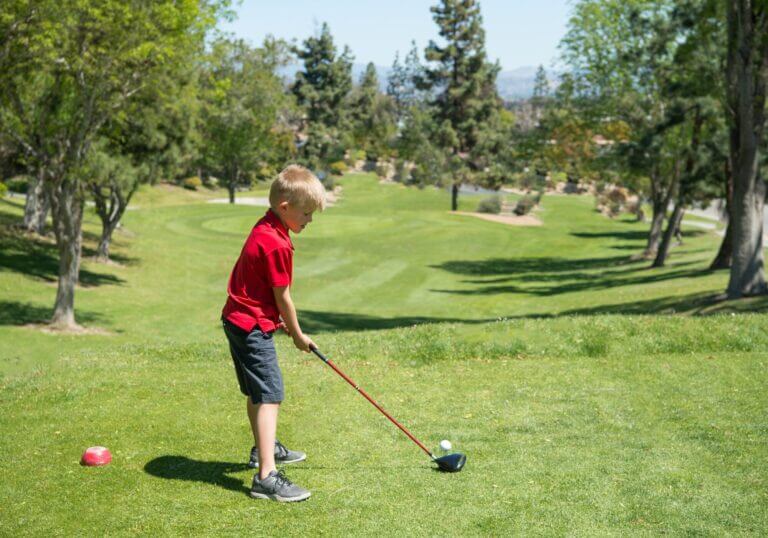
The club is heavy. They’re standing farther away from the ball than they do in most other sports and they don’t yet have the strength or coordination to put the club in all the positions an adult golfer can.
Early on, I care more about giving them something consistent to start with.
“Set your feet.”
If they can get into a decent stance, stay balanced and start from roughly the same place each time, you’ve given them something they can actually repeat.
Once you start getting too involved with swing plane, hand position and where the shaft should be halfway back, things can go downhill quickly. The swing will clean itself up as they get stronger and gain control of the club.
3. Trying to fix more than one problem at a time
We know this is a problem for adult golfers and it’s even more of a problem for kids.
They need things to be simple.
Pick one issue, let them work on it and give them a chance to feel like they accomplished something before you move on. I like taking a quick video because kids can see the difference. Show them what it looked like before, show them what changed and let them be proud of getting better.
Kids learn quickly. One problem at a time is plenty.
And if you aren’t a great player yourself or you simply don’t know what they should be working on, take them for a lesson instead of guessing. Stay and watch, then ask the professional what you can help with when the lesson is over.
“What should I remind them of when you aren’t here?” is a completely fair question.
That’s much better than giving your kid three different swing thoughts because you aren’t quite sure which problem matters most.
4. Making every shot a lesson
This may be the hardest one for parents, especially if you know exactly what your kid just did wrong.
Sometimes you have to keep it to yourself.
If every topped shot is followed by a correction and every missed putt turns into a discussion about technique, golf starts to feel a lot less like golf.
There has to be a point where you stop teaching and let them play.
Let them choose a club. Let them hit a bad shot. Let them figure out that trying to go through the tree probably wasn’t the best decision. Let them make a 15-footer and enjoy it without immediately turning it into a discussion about what they did correctly with their stroke.
Not every golf shot needs feedback.
5. Taking the fun out of it too quickly
Once kids start learning the game and getting a little better, it’s easy to start thinking of them as little golfers instead of kids.
Suddenly there are tournaments, practice schedules, score goals and expectations. Some kids love that and want more of it. Others may just want to play.
Pay attention to which one you have.
Even now, some of the most fun days I have on a golf course are playing a scramble with friends, getting in nine holes at twilight from a different tee box or playing a short par-3 course where nobody is taking things too seriously.
Kids need those days, too.
They don’t always need to post a score. They don’t always need to play from the same tees and they certainly don’t always need to be working on something.
If every trip to the golf course starts feeling like preparation for the next tournament, it’s pretty easy to forget why they wanted to play in the first place.
Let them compete if they want to compete. Let them work hard if they want to get better. Just don’t be in such a hurry to make golf serious that you take away the parts they liked about it to begin with.





Paul C
2 months ago
As someone who coached youth football (ages 6-14) for years this article is fantastic. Even at older ages they’re still kids who need fun.
I’d add 6, don’t be your kids main teacher. If my kids decided to play football and I was coaching. I will not coach them, I’ll coach and older or younger team and jump up or down or take a year or two off, when they got to age group. First, I’m sure they’ll ask me questions that I’ll answer, but I think having someone say something a 2nd or 3rd way, or a different method is one of the greatest learning tools out there. Let the kids think for themselves and make a decision that’s best, not just a sport lesson but a life lesson.
Mike
1 month ago
Great points. I’m a mid-handicapper so I quickly realized that I was not in a position to teach my child all the correct mechanics. However, I was able to guide her on course strategy, nutrition, proper (functional) clothes to wear, etc. But I left the real teaching to a pro. I like to think my way worked since she made her high school varsity golf team as a freshman.