



A new study from Foresight Sports (yes, the launch monitor people) says Streamsong is America’s favorite golf destination.
While we know from experience that the golf at Streamsong is superb and the facilities are impeccable, the study itself raises some questions.
For example, the study says the median hotel rate at Streamsong is $89 per night. Additionally, the study finds there are 33 “destination-grade” golf courses within a 35-mile radius of Streamsong.
We’ve been to Streamsong and those two findings alone leave us with questions. We’re guessing you have questions, too.
As with any study, it’s worth diving into the particulars.

Is Streamsong really No. 1?
The Foresight study gives us something it calls the “Golf Vacation Index.” It’s a 0-to-100 scale based on five metrics, each weighted according to overall importance. Course Quality is the most heavily weighted, counting for 26 percent of the score. It looks at top 100 public course ratings from Golfweek and Golf Digest. If a course is rated No. 1, it gets a 100. If it’s rated 100, it gets a 1. If it’s not in the Top 100, it gets a zero.
Search Demand and Golf Course Supply each count for 21 percent of the final ranking. Search Demand counts the average monthly Google searches for an area and ranks by percentile. Golf Course Supply counts the number of publicly accessible 18-hole courses within a 35-mile radius, normalized for places like Bandon or Pebble, which are on the coast.
Playable climate, meaning the number of “golfable” days, counts for 17 percent of the total score. That’s the number of days per year between 55 and 95 degrees. Price, meanwhile, counts for 15 percent. It should be noted that price, in this case, has nothing to do with the cost to play golf. It focuses solely on the median hotel price per night for the area, not necessarily the resort itself.
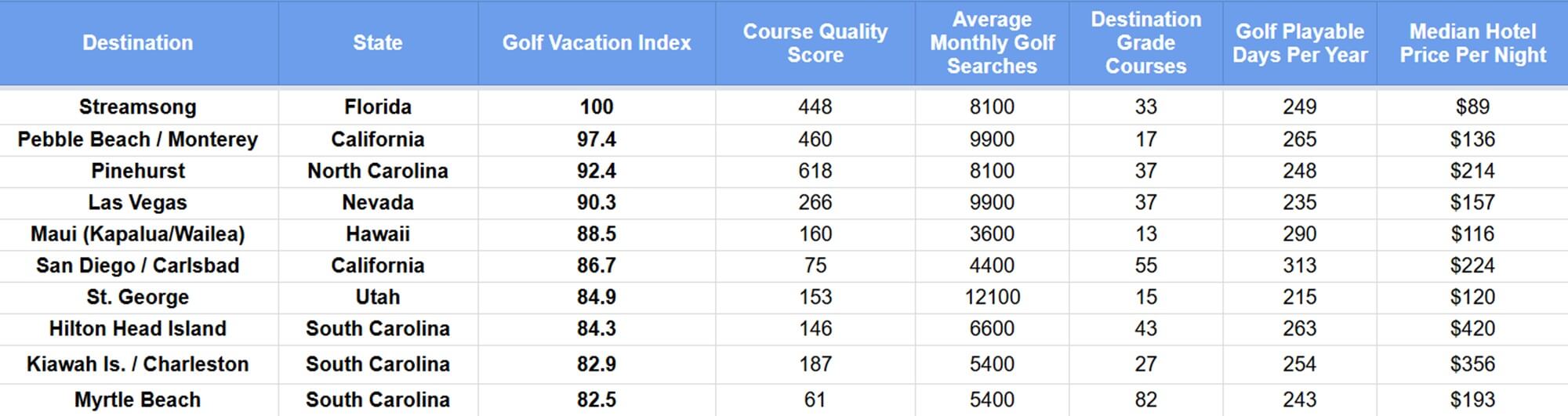
Based on these metrics, Streamsong scored a Golf Vacation Index (or GVI) of 100. That simply means it was the top-rated in the study, not that it’s “perfect.” Pebble Beach finished second with a 97.4 GVI while Pinehurst came in third at 92.4.
A deeper look at the numbers, however, tells a different story.
We have questions
Two specifics in the Streamsong rankings jump out at us. First is the most obvious: the $89 median per-night hotel rate. If you’ve ever stayed at the Streamsong lodge during high season (or even in the depth of summer), you know that’s not accurate. However, if you count hotels and motels in that 35-mile radius plus the fact that summer rates at those locations are considerably lower, you can see where the $89 number may have come from.
Anyone from central Florida can tell you that playing golf in July or August, while less expensive, can be, ahhh, just a tad humid.
The second issue is with the number of “destination” courses. The study says there are 33 destination-grade public access courses within 35 miles (as the crow flies) of Streamsong. It counts full-sized 18-hole courses only but doesn’t quantify them for quality or conditions. The only thing differentiating Streamsong Red, Blue or Black from Sanlan or Bartow is the national top 100 rating.

If you cast a critical eyeball on the vagaries of the study and add perspective, you can make a compelling case that Pebble or Pinehurst is a better overall destination. Again, there’s no questioning the quality of Streamsong’s golf. Pebble, for example, scores higher in course quality than Streamsong (more Top 100 courses), higher in search demand percentile, higher in playable climate and higher in golf availability. Where it “loses” is in price where is scored 20 percentage points lower.
However, the fact that Pebble has no real off-season while Streamsong does means you should take that particular score with a grain of salt or even the entire saltshaker.

About the weather
There’s no doubt you can score a hell of a deal at Streamsong for July or August and find a nearby hotel in that $89 range. You might die on the course but you can get a bargain.
Pinehurst is no summer picnic, either, but it’s not quite as oppressive as central Florida. July and August are pretty humid and afternoon thunderstorms are common (as they are in Florida) but, overall, the summer heat is more manageable. Additionally, Pinehurst has much deeper bench strength when it comes to courses. You could put together an incredible itinerary and never actually play any of the 10 Pinehurst resort courses.
For a summer trip, Pinehurst would rank ahead of Streamsong and Pebble in terms of budget and depth of course selection. It’s a hard-to-beat combination.

Pebble, being Pebble, and the weather being what it is, never really has an off-season. The best deals (which are really more about availability than anything else) can be had from mid-November through early February. Lodging rates are lowest in January but rain is more likely.
Additionally, the course roster in the Monterey area is vastly underappreciated. Pebble, Spyglass Hill and Pasatiempo are world-class. Add in the Links at Spanish Bay (cannot wait for the redesign to open!), Poppy Hills, Del Monte, Pacific Grove, Bayonet and Black Horse and you have a pretty impressive roster to choose from. The fact that the study shows 33 destination-grade courses near Streamsong but only 17 near Pebble is more than a little eyebrow-raising.
Some surprises from the study
Las Vegas finished fourth overall, largely due to high monthly average searches. That’s likely because people are going to Vegas for other reasons and want to play a little golf while they’re there.
Kohler/Sheboygan, home of Whistling Straits, had by far the highest Google Search rate, averaging over 40,000 searches per month during the study period (July ’25 through July ’26). Another Wisconsin destination, Sand Valley, was a distant second with over 18,000 searches per month. Bandon was next at just over 12,000.
Bandon finished with the highest course quality score in the study. That score, however, had to be weighted because it’s on the coast, like Pebble. Half of its 35-mile radius is the Pacific Ocean. Pinehurst and Sand Valley finished second and third in course quality.
The lowest-ranked GVI location was Lanai, the small Hawaiian island just southwest of Maui. It features the Jack Nicklaus-designed Manele Golf Course but it ranked so low in every category that the study didn’t bother to even give it a GVI. Next lowest was Sun Valley, Idaho. Its GVI was 19.6.
Traverse City in Michigan also surprised us by finishing in the bottom half with a 44.1 GVI. That score, however, indicates why the 35-mile radius is random and arbitrary. Golfers will fly into Traverse City and then scatter to destinations like Arcadia Bluffs and Forest Dunes (50 to 90 miles away) or to the Boyne properties, 60 to 70 miles north. The 35-mile limit gave Traverse City a Golf Quality score of only 21.4.

It’s your turn
As mentioned, this study comes to us from Foresight Sports. We’re just the messenger, friends. However, as an organization dedicated to data, we can certainly applaud the effort as a great first step. We love the notion of a Golf Vacation Index. It has the potential to be an excellent way to evaluate golf destinations and decide where your hard-earned money should go. Clearly, the methodology needs a little work but that doesn’t mean the study is worthless. It just means we have to think critically about what we’re looking at.

With that, let’s turn it over to you. What are your thoughts on the study (click here for the detailed insight) and how do the rankings stack up against your experiences?









Julius
3 weeks ago
I played Streamsong in October 2024 – I think it is an amazing place. The 5th course was not open yet when we were there but the facilities and services are top notch. We also played TPC Sawgrass and Blue Monster on that trip, but Streamsong was the best all around for multiple night stay for example. Is it the best, I don’t know. But it would have to be in the top 3-5 anyway in the US which is full of great golf locations.