



Scotty Cameron is releasing a limited-edition run of Phantom Black putters this summer and the new black color is probably the least interesting thing about them.
Don’t get me wrong. The Tour Black finish is beautiful. I love how the black PVD coating on the stainless-steel components complements the misted black anodized aluminum sections. Black putters have the potential to be really shiny and unsightly in bright sun if the finish is too glossy. These are not.
Scotty Cameron got the black finish right with these Phantoms.
For some, this new finish will be enough to justify a purchase. Those who liked the Phantom heads but not the stock silver finish have probably already entered their credit card security codes.
The black look does make the Phantom Black putters (more?) visually attractive but when you dive a little deeper, you’ll see that what Cameron has done to these Phantom Black heads is far more involved than just painting them black.
(Almost) straight from the Scotty Cameron Tour Truck

The coolest thing about the new Scotty Cameron Phantom Black putters is that they are all based upon tour putters. I recently had a conversation with someone who works with tour players at Scotty Cameron and it was fascinating.
At some cynical level, I thought that what made a putter a “tour putter” was the presence of the coveted Scotty Cameron Circle T logo. Of course, I assumed that fitting a tour player involved more than that but I didn’t understand how much more was involved.
I won’t dive too deeply into what I learned about how tour players are fitted for putters because that is a story for another day. Regardless, it was interesting to hear about how some tour players just want a putter that fits their stroke. Others are more open to identifying areas of variability in their strokes, understanding that, if they can improve their putting mechanics, then they can also improve their putting.
But like I said, that’s a story for another day.
Phantom Black tour non-stock modifications

The Beyond the Black story behind the Scotty Cameron Phantom Black putters is two-fold. First, each head design is based upon tour player input and fitting data.
Why does the Phantom Black 5.5 have a top line when the stock model has dots? Because that is what a tour player wanted.
All four of the models are based upon fittings with Scotty Cameron staffers and non-staffers. They are a little cagey about which specific staffers influenced the specific models since not all are under contract.
Feel free to speculate in the comments about who you think influenced the specific head designs.

The second part of the story is that these four heads are the most popular Phantom variants with touring pros. Of all of the putters on the tour truck, these are the ones that end up in the most bags. Naturally, there will be some tweaks for the individual player but these are the ones that leave the truck the most.
I’m not saying the Phantom Black putters are “tour putters” but they are “tour putter adjacent.” Think of them as one Circle T logo away from costing thousands rather than $750.
Let’s take a look at the four models and see if we can figure out which tour player influenced the design.
Scotty Cameron Phantom Black 5.5

The tour modifications with the Phantom Black 5.5 are primarily alignment modifications. I mentioned that the top line dots were replaced with a short line. The more interesting alignment change is the addition of Phantom 7-esq alignment rails to the edges of the cavity flange.

The Phantom 5.5 is the most blade-like of the Phantom mallets. The traditional dots on the top draw the eye to the front of the putter. With just these dots for alignment, players are still going to see the rearward wings but their focus will be more on the blade-shaped front portion of the putter.

The addition of the cavity lines changes that. Now the player has defined lines for aiming the putter in the middle of the putter.
The front line can be used to aim as well but I was told that many tour players just use the top line or dot to identify the center of the face. Body contours and lines are used more frequently for targeting.


Scotty Cameron Phantom Black 7

The tour modifications on the Phantom Black 7 are stealthy. Like the Phantom Black 5.5, the Phantom Black 7 has a line on the top edge rather than dots. That’s the obvious change.
The less obvious change is the shaft modification.

The stock Phantom 7 has a single mid-bend shaft. The Phantom Black 7 has a double-bend shaft that is designed to mimic the look of a plumber’s neck at address.
A tour player was making a transition from a plumber’s neck blade to a mallet and wanted the same address look. The way the lines of the putter matched up with the lines of the neck let the player know they were square to target.

Naturally, the Phantom 7.2 with the plumber’s neck was an option, but that neck promotes too much toe hang. This double-bend design mimics the plumber’s neck look at address while making the putter face balanced.


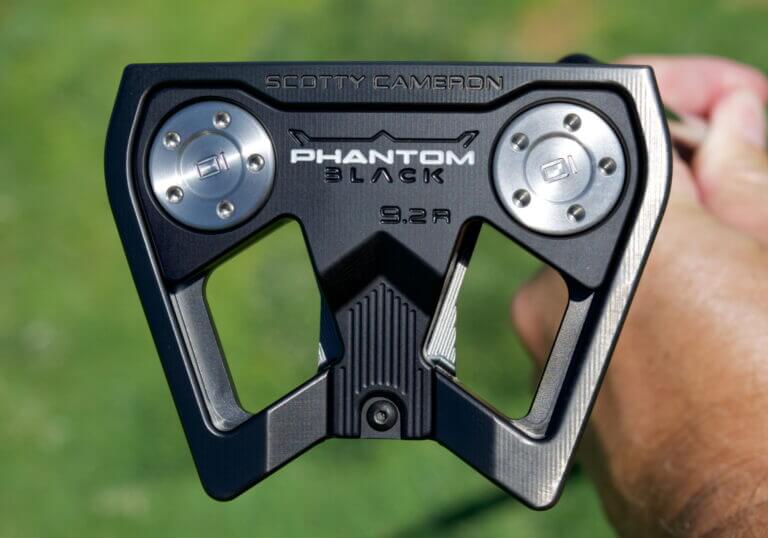
Scotty Cameron Phantom Black 9.2R

The Phantom Black 9.2R has a “009-inspired” neck. For those of you unfamiliar with the Cameron 009, it is the near mythological TOUR ONLY blade shape. The 009 neck is slightly shorter and attached closer to the heel than a traditional plumber’s neck.
Does this mean that the Phantom Black 9.2R is a 009 mallet? Probably not, but collectors will snatch this one up very quickly nonetheless.

Tour modifications extend beyond the neck as well. The “R” in the title refers to the overall rounded nature of the edges compared to the stock Phantom 9.
The purpose of rounding the edges and shortening the sight line is to move the focus at address to the front of the putter.
The idea is that the eye will linger on a sharp edge but slide off of a smooth one. This is why some putters are built with squared-off top edges and others are rolled.
If you putt better with a Newport than a Newport 2, it could be due to the Newport’s more rounded rear section not attracting your eyes..

Overall, this putter should be one that blade players experimenting with mallets will find very comfortable. My guess is that it will be first to sell out as well. 009 is a thing with Cameron collectors.


Scotty Cameron Phantom Black 11

The Phantom 11 is a great-looking head. It may be my favorite of the Phantom stock models, yet I felt zero compulsion to buy one. I love the shape of the stock head but I am not a fan of the arrow-shaped alignment lines. I found them distracting.
The dual lines on the Phantom Black 11 are a spectacular replacement.

I find the spacing between the lines to be just about perfect. Combined, they are wider than a single line would be but not as visually loud as three lines or even wider-spaced lines would be. The body color “line” between the white lines will also perfectly line up with the line on your ball should that be part of your routine.

To my eye, this alignment scheme integrates with the overall boxy shape of the putter better than the more angular arrows. They complement the milled body lines as well.


Final thoughts about the Scotty Cameron Phantom Black putters

Overall, I find this release to be fascinating. It’s so interesting to get a glimpse into the world of how tour players get fitted for putters. For the fitter, they have the almost impossible task of taking what a tour player is seeing and feeling when they putt and designing a putter that fixes issues while complementing strengths.
These four Phantom Black putters represent a small subset of the variations that are available to tour players. Tour golf is so competitive that even the slightest putting improvement is hugely important.
These elite athletes can make or lose a great deal of money with every putt. The fitter’s goal is to push the balance more toward the “make money” side of the ledger. The Phantom Black line shows us regular folks some of the tools in the fitter’s toolbox.

The Scotty Cameron Phantom Black putters all feature chain-link face milling. The feel is not quite as soft as it is with the new Studio Style line, but I find it a pleasant mixture of pop and softness.
The MSRP on the Phantom Black line is $750 and they will be in “select Titleist” shops worldwide on July 25. Hopefully, you will see these in your local shop. If you want one, don’t sleep on the decision. I don’t think they will last long.
To improve your chance of buying one, I recommend talking to your shop well before the street date.
Find out more about these and other Scotty Cameron putters at ScottyCameron.com









David P
1 year ago
The price makes it a big NO!