



PGA Tour players have access to just about any golf club they want.
For many, that means a bag filled with the latest drivers, irons and wedges.
For others, it means a 1-iron (which not even God can hit with a lightning bolt), a 7-iron pretending to be an 8-iron or a putter that looks like it belongs at a hockey rink.
The most interesting part isn’t that these clubs look different. It’s that there’s always a hyper-specific reason they made it into the bag.
Here are 10 of the weirdest clubs we spotted on Tour in 2026.
These selections were documented in play during the 2026 season. They may not all be in the same players’ bags today.
1. Sahith Theegala’s 8-plus iron
The club: PING Blueprint S 7-iron stamped as an 8-iron (yes, you read that correctly)
Most golfers have one 8-iron. Sahith Theegala has carried two.
Well, sort of.
Theegala struggled with his 7-iron enough that he asked PING to make him one that didn’t have a “7” on the sole. The company took a 7-iron head, removed the number and stamped an 8 in its place.
The club still has the length, loft and lie of a 7-iron. But instead of pulling a 7-iron from the bag, Theegala reaches for what he calls the “Ocho.”
Theegala also carries a conventional 8-iron, meaning his bag has included two clubs with the same number on the bottom. It’s one of the best examples of how much visuals can change a player’s outlook.
His bag has had other quirks, too. We previously explored them in Tour WITBs Usually Look the Same—Theegala’s Doesn’t.
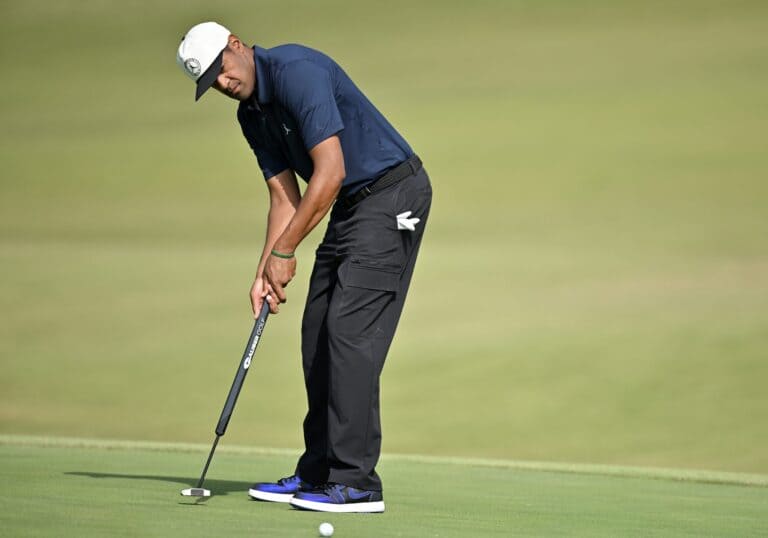
2. Tony Finau’s hockey-stick putter
The club: PING Scottsdale TEC Ally Blue Onset putter with Caliber Golf grip
If you caught a glimpse of Tony Finau putting at the Biltmore Championship in September and thought he had accidentally grabbed a hockey stick (a la Happy Gilmore), you weren’t alone.
Finau used a PING putter fitted with a Caliber Golf grip that extends nearly all the way down the shaft. The long, squared-off grip gives the club a distinctly different appearance from a conventional putter.
According to Caliber founder Tim Wright, Finau liked the setup enough to ask whether it was legal before putting it into play.
The square shape is intended to influence how the hands and wrists interact with the putter. Whether it helps is a matter for the individual golfer but there’s no question it stands out.
The grip is one of several variables worth considering when fitting a putter, along with length, weight, lie and head shape. Our Putter Fitting 101 guide explains how those pieces work together.
3. Aldrich Potgieter’s 1-iron
The club: PXG GEN8 driving iron, approximately 15 degrees
A 1-iron is a rare sight in professional golf. A 1-iron and a 2-iron in the same bag is even rarer.
Aldrich Potgieter carried both at the 2026 PGA Championship. His PXG 1-iron had just over 15 degrees of loft and took the place of a fairway wood at Aronimink.
This wasn’t an old-fashioned chicken stick, though. Potgieter’s club was a hollow-bodied driving iron with a graphite shaft and PXG used the head’s adjustable weighting to help tune its ball flight.
Potgieter even referred to the club as a 3-wood during a press conference. That tells you something about the role it was intended to play, even if it looked nothing like the fairway wood.
Potgieter moved into a full bag of PXG clubs for 2026. We looked at that equipment change and his performance in What Happens When Tour Pros Change Their Entire Bag?
4. Cameron Young’s fairway wood/hybrid creation
The club: Titleist GT1 hybrid with a fairway-wood shaft
Is it a hybrid? Is it a 5-wood?
Cameron Young’s club is a little bit of both.
When Young won the 2026 Players Championship, he carried a Titleist GT1 hybrid built with the same type of shaft used in his 3-wood. Titleist’s Tour team modified the hosel setup to accommodate a fairway-wood shaft in the hybrid head.
The goal was to create something that played more like a 5-wood while retaining the hybrid head. Young also used heavier weights in the forward position to help manage flight and spin.
It’s a reminder that the name stamped on a clubhead doesn’t always tell you how a Tour player has built (or intends to use) the club.
Young was also an exception among 2026 PGA Tour winners. As we explored in Only Three PGA Tour Winners Used a Hybrid Last Season, way more winners carried 7-woods or utility irons.
5. Collin Morikawa’s lob wedge with a 6-iron shaft
The club: TaylorMade MG5 lob wedge with a 6-iron shaft
Collin Morikawa is known for precise iron play. In 2026, he brought an unconventional piece of his iron setup into his lob wedge.
At the Arnold Palmer Invitational, Morikawa put a lob wedge in play with a shaft intended for a 6-iron. The move was a form of soft stepping—using a shaft designated for a longer iron in another club to alter how the shaft plays and feels.
TaylorMade’s Tour team built the wedge as an experiment to give Morikawa a noticeably different feel.
It’s not a suggestion that the average golfer needs to take apart their 6-iron and wedge but it is an example of how Tour players and fitters can experiment with a club’s feel when a conventional build isn’t giving them what they want.
For more on why shaft labels don’t tell the whole story, see our guide to six facts you need to know about golf shafts.
6. Aaron Rai’s seven-year-old driver
The club: TaylorMade M6 driver
A simple one here but it’s worth discussing.
A seven-year-old driver might not sound especially weird to the average golfer but it’s an outlier of epic proportions on the PGA Tour.
Sure, players may stick with fairway woods or other clubs for many years but drivers are almost always switched out by cycle or at least within a few years.
Aaron Rai used a TaylorMade M6 driver from 2019 to win the 2026 PGA Championship. Rai had tried other drivers but he repeatedly returned to the M6.
At Aronimink, he finished fourth in the field in driving accuracy, hitting 67 percent of fairways. A newer driver might have given him different numbers in a fitting bay but Rai had a club he trusted when a major championship was on the line.
The driver is only one part of Rai’s distinctive setup. We explored his equipment habits in Why Aaron Rai Uses Two Gloves, an Ancient Driver and Castle Tees.
He isn’t the only Tour player holding on to older equipment, either. We highlighted several more examples in The “Ancient” Clubs Presidents Cup Players Can’t Quit.
7. Joel Dahmen’s garage-born putter
The club: Hanna Golf Co. custom Denver mallet
Joel Dahmen’s putter might not look as strange as Finau’s hockey-inspired setup but its path to the PGA Tour is unusual.
At the Biltmore Championship, Dahmen put a custom Denver mallet from Hanna Golf Co. into play. The small Iowa company was started by Jared Doerfler who began making putters out of his garage.
Dahmen had purchased a Hanna putter early in the company’s history and later asked for a version of the Denver mallet to test. The company modified the appearance to suit his preferences and he put it in play.
On a Tour dominated by major equipment brands, a custom putter from a small independent maker is a refreshing addition to the list.
For recreational golfers considering a mallet, our 2026 Most Wanted Mallet Putter test offers a look at how a range of models performed. Dahmen’s custom Hanna was not part of that test.
8. Jason Day’s curved-face irons
The clubs: Avoda prototype irons
Most irons have a flat face. Jason Day spent part of 2026 playing prototype irons from Avoda with progressively curved faces. If that sounds familiar, it’s because Bryson DeChambeau brought attention to the design when he won the 2024 U.S. Open with his own Avoda irons.
The irons were customized for Day’s swing including the way he delivers the club with forward shaft lean.
The curvature is a striking departure from the flat face golfers are accustomed to seeing on an iron.
The even stranger part is that Day also paired the heads with graphite shafts, another relatively uncommon choice in a Tour iron set.
He worked extensively with Avoda on the design and used the irons during the 2026 season before switching into Callaway irons later in the year.
Day’s willingness to experiment is a benefit of being an equipment free agent. We looked at the choices available to players without full-bag deals in What Clubs Do Equipment Free Agents Choose to Use on Tour?.
9. Ben Silverman’s “thriver”
The club: PING G410 driver built to approximately 3-wood length
Why carry one driver when you can carry two?
Ben Silverman has used a setup that includes his regular driver and a second, shorter driver often called a “thriver.” His version combines a 12-degree PING G410 driver head with a shortened shaft.
The idea is to give Silverman another option off the tee: a club with a full-sized driver head but a shorter build for situations where he wants a different combination of distance and control.
It’s a different approach from carrying a mini driver. Rather than start with a smaller head designed for that purpose, Silverman’s setup uses a conventional driver head and adjusts the build to fit its job.
The trade-off is that the second driver takes up a spot another golfer might use for a fairway wood. If you’re weighing those options, our look at mini drivers versus 3-woods explores how golfers decide what that club needs to do.
10. Gary Woodland’s 6.4-degree driver
The club: COBRA OPTM Max LS-K prototype driver that measures 6.4 degrees of loft
Gary Woodland’s driver has a loft you’d expect to see in a long-drive competition.
The COBRA prototype he used to win the 2026 Houston Open measured just 6.4 degrees of loft (despite it being a nine-degree head turned down to 7.8 degrees in the loft sleeve). It also featured custom weighting including internal hot melt and lead tape on the head.
The unusually low loft works for Woodland because of the speed and launch conditions he produces. At the time of his victory, he was among the longest hitters on Tour. For most golfers, a driver with that little loft would be difficult to launch high enough to maximize carry.
Woodland’s setup is an extreme example of a bigger fitting lesson. Namely, the right driver loft depends on how you deliver the club. Our story on what happens when your driver has too little loft explains why copying a low-lofted Tour setup can cost amateurs distance.
The common thread
These clubs might look strange, carry an unexpected number or have a story that’s different from the typical Tour release.
But each serves a purpose for the golfer using it.
There’s no requirement that a golf bag look normal. It just has to help the player carrying it.
Let me know which of these clubs is the most interesting to you. Comment below!
Top Photo Caption: Tony Finau employed a bizarre putter this year. (GETTY IMAGES/Kenta Harada)








Leave A Reply