




When fans think about the Masters and what is required to be successful at Augusta National Golf Club, one of their first thoughts is that putting is extremely important.
The greens at ANGC are lightning fast and feature severe undulations. They are arguably the most difficult green complexes the pros face each year.
In that case, conventional wisdom should support that putting is a prerequisite to playing well at the Masters. If you don’t have your putter working, it’s “goodnight, Irene.”
But, strangely, over the past decade or so, putting success has very little correlation to whether a player wins the Masters.
In a counter-intuitive twist, it appears that two primary factors have caused this.
- The defensiveness required on the greens is an equalizer. Fewer putts are made from that 10- to 20-foot range, resulting in a muddying of the waters. This is not a new factor—green speeds have been fast for many years—but we have a greater understanding of this dynamic due to increased access to Masters stats that have come online the past handful of years. The average slope on a PGA Tour green is around 1.5 percent (breaking 1.5 feet over 100 feet) while the average slope on a green at Augusta National is 2.5 percent. It’s a big difference that results in fewer made putts altogether.
- Augusta is a ball striker’s paradise (though not a bomber’s paradise as accuracy has been rewarded more in recent years). The last eight Masters winners ranked in the top 25 of Strokes Gained: Tee to Green throughout the calendar year in which they won. And the Masters field hits about four percent fewer greens in regulation than players do at the average PGA Tour event, so the skills of approach play and scrambling are more highly valued than putting.
This isn’t to suggest that the ability to putt well is an irrelevant skill at the Masters. That would be taking things too far.
However, you don’t need a great putting week to win the Masters. You can even have a mediocre-to-poor putting week and win.
The stats behind this phenomenon
Over the past 10 years, there have been some traditionally poor putters who have won the Masters.
Sergio Garcia and Hideki Matsuyama have struggled with putting throughout their careers. Scottie Scheffler won the 2022 Masters at a time when he was experiencing difficulty on the greens.
But the greatest evidence here is that, in each of the last five years, the green jacket winner’s worst Strokes Gained category for the week was putting. None of them have ranked in the top 10 of Strokes Gained: Putting for the week. Last year, champion Rory McIlroy even lost strokes to the field on the greens.
The other four winners had decent putting weeks but won the tournament based on their other skills.
Here is the chart from our friends at Data Golf (please check out all their other Masters data, which is presented beautifully).
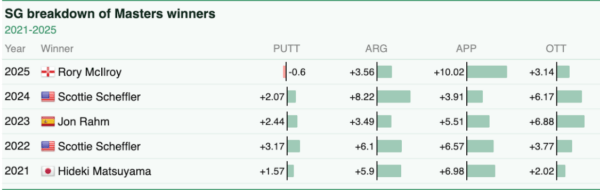
Even more interesting is that the other majors reward putting far more than the Masters does.
Consider that the average PGA Tour winner gains about five strokes over the field based on their putting. Since the Masters started tracking Strokes Gained stats a few years ago, the winners are not even gaining two strokes over the field on the greens.
In comparison, the 2021-2025 Open Championship winners have gained almost nine shots against the field on the greens.

You will see here that while putting has not been predictive of Masters success, being proficient around the greens is more important than it is at any other event throughout the year.
Data Golf theorizes there are a couple of reasons for this. If you’re a nerd, you’ll appreciate this:
“The higher around-the-green contribution may partly reflect the fact that players hit about one additional around-the-green shot per round at Augusta National, though they are also expected to hit roughly one extra putt. It’s also possible that because where players miss greens matters more at Augusta than a typical course, some approach shots might not get punished enough by the baseline strokes gained functions—meaning a portion of the variance labelled as around-the-green may actually belong to approach.
“In terms of how difficult Augusta plays relative to other courses, it is “easy” off the tee (lots of drivers, not many penalty areas) but challenging everywhere else. This means that from any given distance, we expect players to hit it further from the pin, hit fewer greens, and make less putts. In particular, fairway around-the-green shots, putts from outside 15 feet, and approach shots from less than 150 play very difficult at Augusta National.”
The TL;DR version of this story
I’ve thrown a lot at you here. Let me try to summarize.
Masters winners need to be accurate off the tee. They need to hit their irons well. They need to chip and pitch well.
Do they need to putt well?
Not really.
Since the Masters started offering Strokes Gained shot-by-shot data in 2021, we’ve learned that winners rely heavily on their ball-striking and scrambling traits.
Their putter? It’s more of a role player in the proceedings.
As for the rest of us, we’re just trying to debate whether we would win the Masters if we started every hole on the green.
Top Photo Caption: Rory McIlroy practices his putting on Tuesday prior to the 2026 Masters. (GETTY IMAGES/Thomas Lovelock)









Leave A Reply