


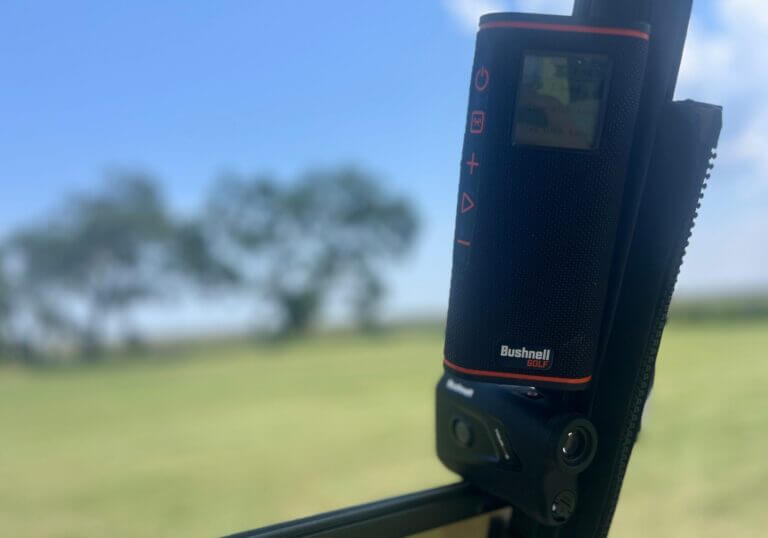
A few years ago, I bought a Bushnell Wingman View for our golf cart.
At the time, it wasn’t really just for me. It was for everybody. I was the only one in the family with a rangefinder and trying to shoot yardages for myself, two kids and my husband was not exactly helping pace of play.
The Wingman View solved that problem almost immediately.
It gave everyone front, middle and back yardages. It stuck to the cart with a magnet that has never made me nervous. It worked as a speaker. It was easy. It was fast. It became one of those golf products that just stayed in the cart because everyone used it.
What I didn’t expect was that I would eventually prefer it to a rangefinder.
GPS changed the way I looked at greens
Before using GPS regularly, I don’t think I had a great understanding of how much room I really had on greens.
I knew the pin number and the club I wanted to hit.
What I didn’t always know was how much green I had short of the pin, how much room I had behind it or whether the smarter play was nowhere near the flag.
The Wingman View made that obvious.
Front, middle and back yardages sound simple but they changed how I played. I stopped hunting pins quite as much. I started hunting greens and it helped my scoring.
Instead of standing over a shot thinking, “It’s 142 to the flag,” I started thinking, “The front is 132, the middle is 146 and the back is 158.” I had more confidence that the club I had in my hand could land within that range.
For most amateur golfers, that is a much better way to play.
The Wingman View will also give you yardages to hazards, bunkers and other targets. I don’t use that feature all that often. You can also use the Bushnell app on your phone to get more detailed numbers but I don’t love bringing my phone out during a round.
For me, the value of the Wingman View is simple: I get the numbers I need without doing much.
Then I got a pin number again
Recently, my son and daughter have started walking the course more. My daughter has a Garmin kids’ watch and my son has a Shot Scope rangefinder.
A few holes into a round, my son was standing near me and I asked him for a yardage to the pin.
It was the first time I had a true “to the pin” number in a long time.
Secretly, I loved it.
There is something about one specific number that I like. But it also changes the way I play.
With GPS, I’m usually thinking about a zone. With a rangefinder, I’m thinking about a number.
Those are not the same thing.
By the end of the round, I had asked him for a few more yardages. That was when I realized I probably needed to bring a rangefinder back into play for a few rounds and see what happened.
The rangefinder changed my strategy
As soon as the rangefinder came back into play, I noticed a few things.
First, I got more aggressive.
Not reckless, exactly, but definitely more target-focused. A front, middle and back number makes me think about the whole green. A pin number makes me think about the flag.
Second, I cared more about exact shot placement.
If I needed to lay up short of a bunker, carry a corner or hit to a specific area, the rangefinder made that easier. I started planning a little more instead of just looking at the general number and playing.
I noticed the biggest difference on par 3s.
With GPS, I’m usually looking at front, middle and back. That makes me think about the green as a whole.
With a rangefinder, everything gets more specific. That can be helpful when the pin is accessible or when I feel like I can be more aggressive. It gives me a clear target and helps me commit to the shot.
It can also be dangerous. Sometimes that exact pin number makes you think the flag is the target when the better play is still the middle of the green.
If I could only choose one
If you told me I could only have one (rangefinder or GPS), I would choose the GPS.
For the way most amateur golfers play, I think GPS yardages are more useful more often. The pin is not the target nearly as often as we think it is. The green is the target. Sometimes the safe side of the green is the target.
GPS helps you see that.
A rangefinder gives you precision. GPS gives you context.
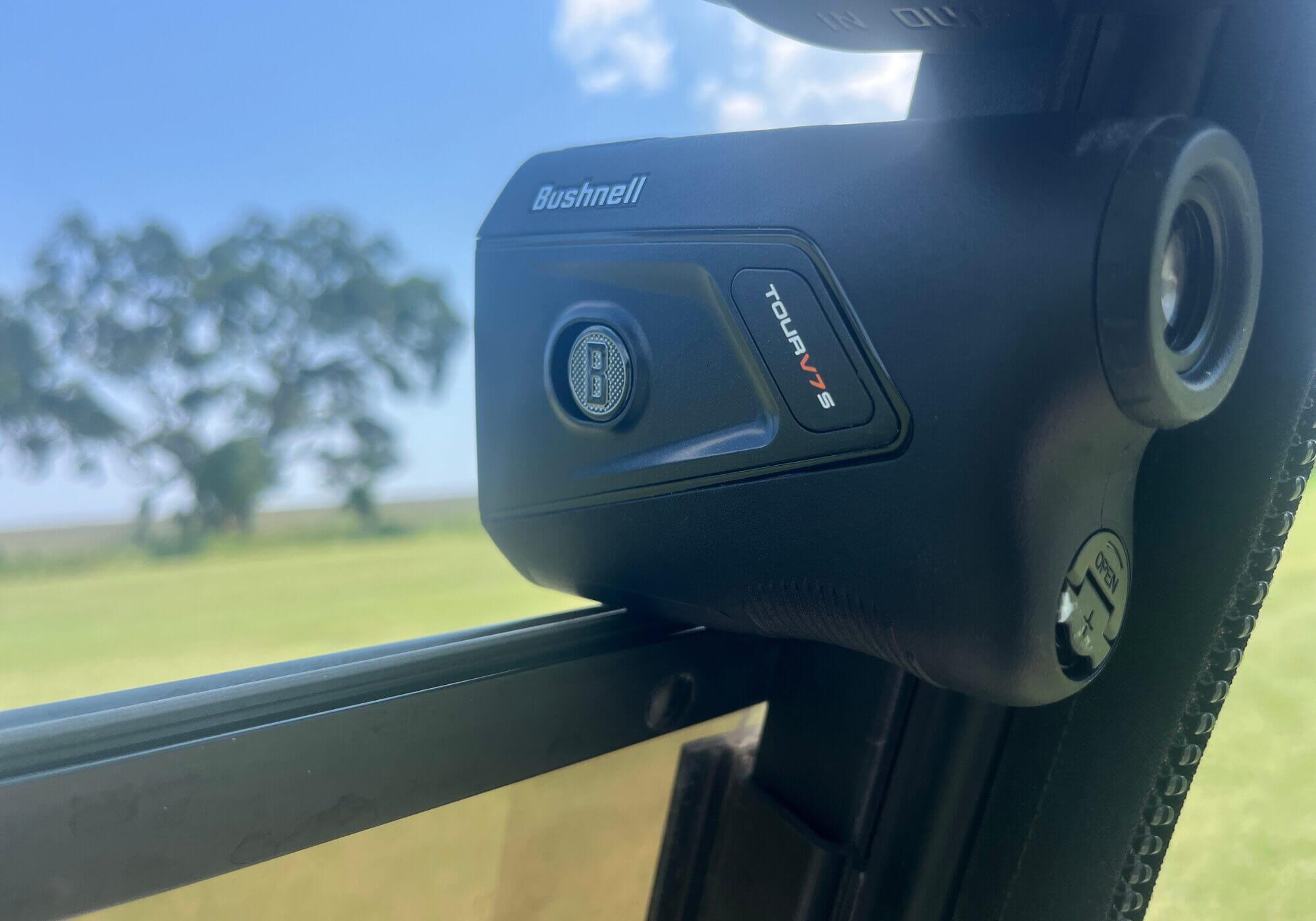
The best answer is probably to have both but, if I had to pick one, I would rather have front, middle and back yardages than one exact pin number. I should mention that the Tour V7 Shift is the best rangefinder I have owned. Previously, I had budget rangefinders that took longer, couldn’t find targets as easily and just didn’t have the same ease of use.
The Wingman View made golf simpler for me. The Tour V7 Shift makes it more precise.
Now I’m trying to find the right balance between the two.
Anybody else with me on this or are you completely the opposite? Do you trust the rangefinder more than GPS, or has GPS changed the way you play?









Ash
3 months ago
The Precision Pro Titan rangefinder shows pin, front, back yardages on screen. It’s also a top class rangefinder by itself and the pin lock is excellent. The paired phone app shows a hole map w hazard.distances. icing on the cake is the app notifies you if you may have lost it or left it on the cart and shows you a map of its last seen location! I agree that I feel a bit lost without the gps numbers.