


If you want more distance off the tee, finding the longest golf ball sounds simple: sort the 2026 MyGolfSpy Golf Ball Test by total distance and start at the top.
The problem is that the ball sitting at No. 1 may not be the one you should play.
Some balls get their distance through lower spin and more rollout. Others carry farther. Some give you almost the same driver distance while performing considerably better with an iron or around the green.
So, for each swing speed, I looked at the ball that went farthest and then asked a more useful question: What are you giving up to get that distance and is there another ball worth considering?
One important note before we get into the results. Total distance includes estimated rollout and we found that TrackMan’s algorithm tends to assume relatively firm ground conditions. Carry is generally the more dependable number when comparing balls, especially if your home course tends to play soft.
| Driver Swing Speed | Longest Total Distance | Why You Might Look Elsewhere |
|---|---|---|
| 115 mph | Snell PR4 | Maxfli Tour X gives up very little tee distance while adding strong iron distance and greenside spin |
| 100 mph | Titleist Velocity | Much of its advantage comes from rollout and it gives up significant greenside spin |
| 85 mph | Titleist Pro V1 | You may not need to look elsewhere. Chrome Tour X becomes interesting if carry and greenside spin are priorities |
Longest golf ball for high swing speed: Snell PR4
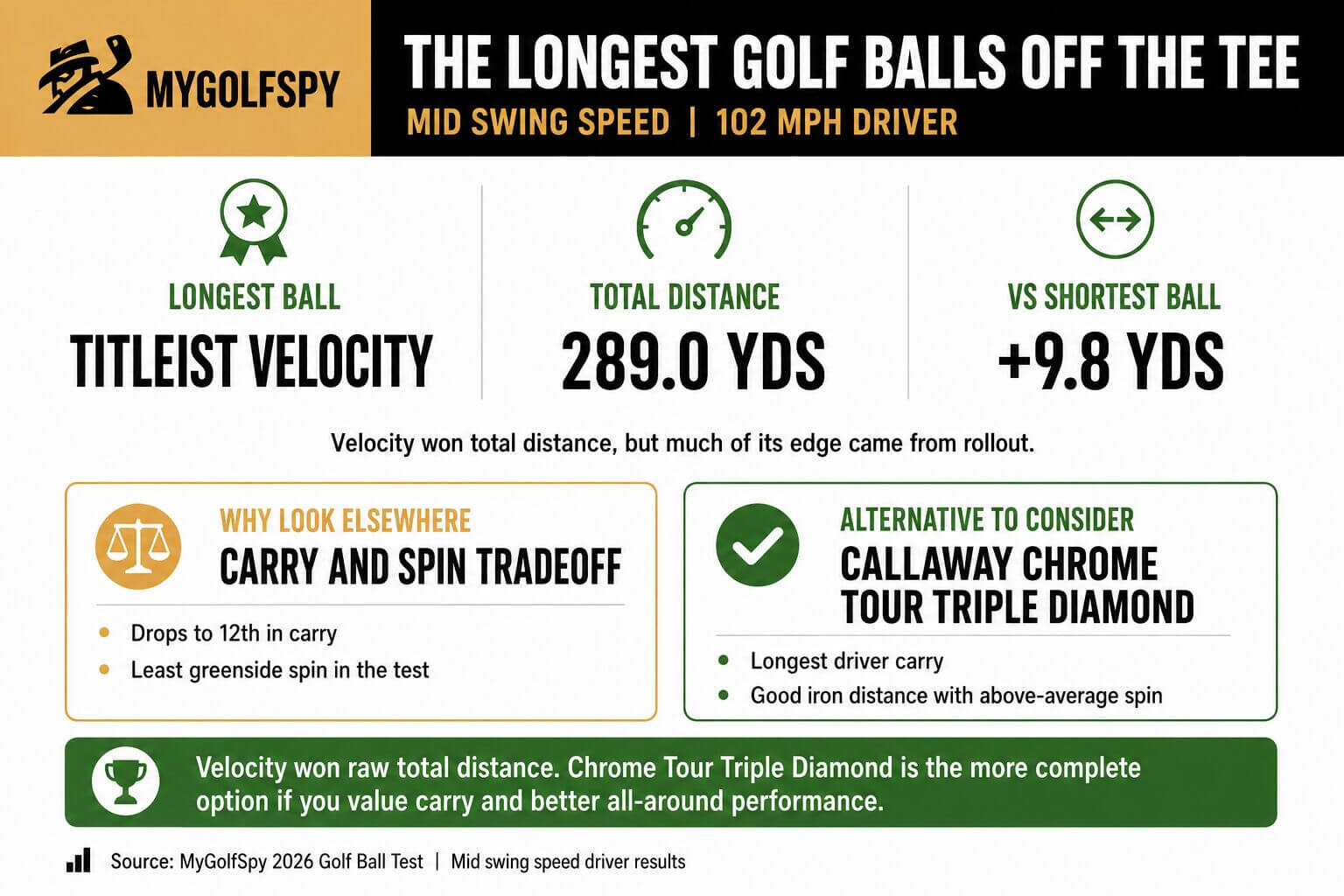
The Snell PR4 measured longest for high swing speeds but this wasn’t a runaway win. Seven balls finished in the leading statistical group and the Maxfli Tour X, TaylorMade Tour Response and Titleist Pro V1x were all within three yards.
The PR4 did it with slightly below-average driver spin. It produced 2,281 rpm compared to a test median of 2,311 rpm while also producing one of the higher trajectories among the longer balls.
Why I’d also look at the Maxfli Tour X
The Maxfli Tour X was within three yards of the PR4 and was also one of the fastest balls in the high-speed driver test. More importantly, it was one of the longest firm golf balls with an iron. In the 35-yard wedge test, Maxfli Tour X finished just behind the three highest-spinning balls.
You aren’t moving to the Maxfli because it’s longer than the PR4. It wasn’t. You’re considering it because you can keep almost all of the tee distance while getting a ball that also showed strong iron-distance performance and plenty of greenside spin.
Longest golf ball for mid swing speed: Titleist Velocity
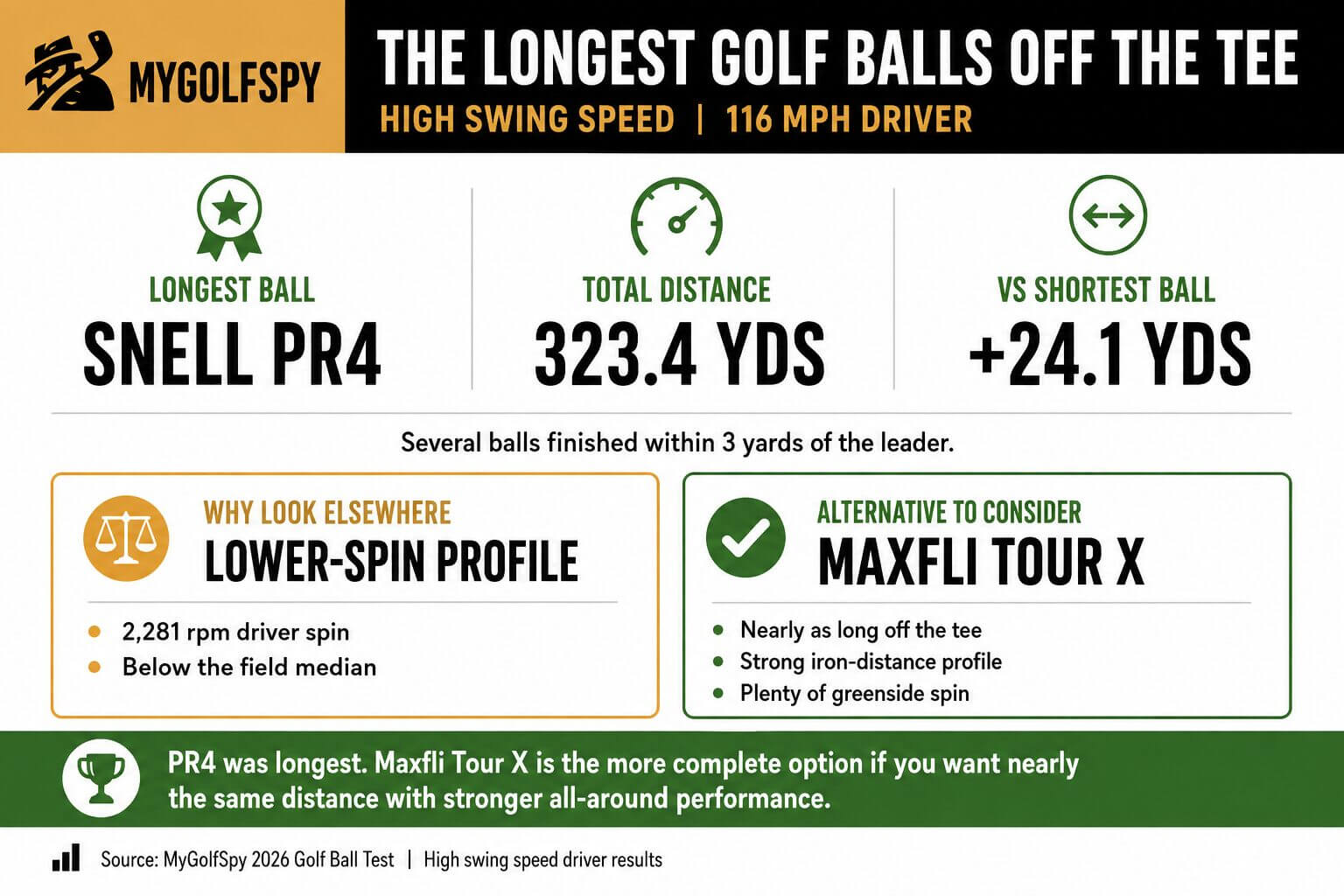
The Titleist Velocity led the total-distance chart at 100 mph.
Velocity dropped from first in total distance to 12th in carry. Across the entire field, ionomer balls gave up about two yards of carry to urethane models but gained about three yards back through rollout. Rollout is also the portion of the total-distance calculation that you should trust the least.
Then we get to the short game.
Velocity produced the least greenside spin of any golf ball in the 35-yard wedge test by a wide margin. It generated barely half as much spin as the highest-spinning Chrome Tour X.
If you play firm golf courses and want as much rollout as possible, Velocity does exactly what a distance ball is supposed to do.
Why I’d also look at Callaway Chrome Tour Triple Diamond
If we’re staying focused on distance off the tee, Chrome Tour Triple Diamond makes an interesting case. It was one of the longest balls in total distance but, unlike Velocity, it also led the entire mid-speed field in carry.
The argument gets stronger when you move to the irons. Chrome Tour Triple Diamond was in the top half of the field for iron distance and it had above-average iron spin.
With Velocity, you’re maximizing the final number on the driver-distance chart. With Triple Diamond, you’re getting one of the longest balls off the tee, more of that distance through the air and a better combination of distance and spin with your irons.
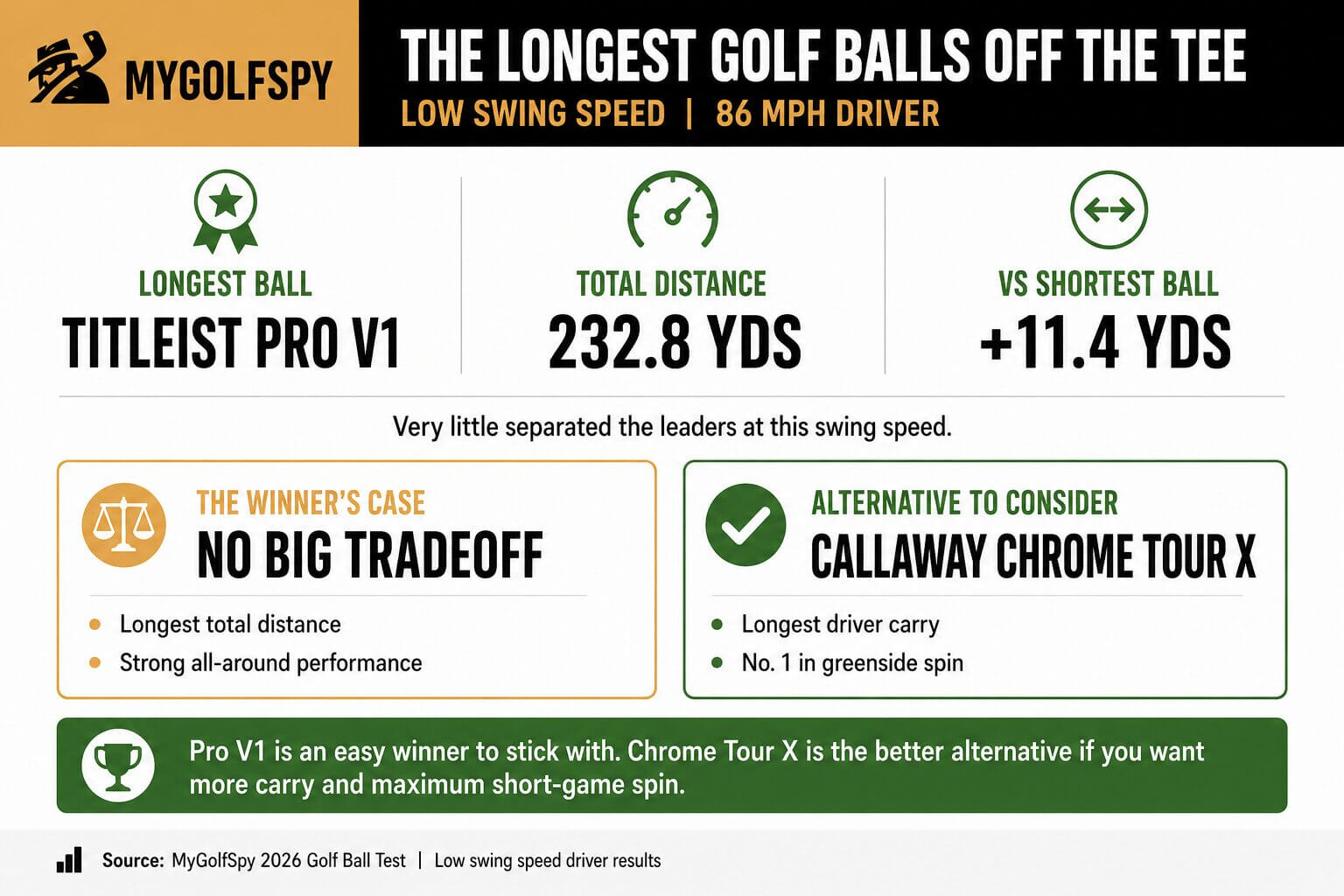
Longest golf ball for low swing speeds: Titleist Pro V1
This is the section where I’m not convinced you need an alternative.
The Pro V1 was the longest ball in the low-speed driver test but the top of the chart was extremely tight. Tour Soft, Mizuno Pro S, TruFeel and Chrome Soft were all within a yard. In total, barely 11 yards separated all 48 balls.
What I like about the Pro V1 result is that there isn’t an obvious distance-at-all-costs story behind it.
Pro V1 was one of the higher-spinning balls that still produced strong driver distance and it was one of the top mid-spin recommendations for slower swing speeds.
When I’d consider Chrome Tour X instead
If you want to prioritize carry distance and short-game spin, the other ball to look at is the Chrome Tour X.
Chrome Tour X produced the longest carry distance at the low-speed condition. It was also one of the fastest balls tested at this speed. Around the green, it led the entire 48-ball field in spin during the 35-yard wedge test.
Pro V1 gives you the best total driver distance with a strong overall performance profile. Chrome Tour X is worth a look if you’d rather maximize how far the ball travels in the air and want as much greenside spin as possible.
Final thoughts
There is nothing wrong with looking for more distance. Always make sure that the distance you are gaining doesn’t come at too large of a cost.
Use the MyGolfSpy Golf Ball Selector to compare 48 golf balls using data from our 2026 robot test. Filter by swing speed and see how each ball performs from driver to wedge to find the best fit for your game.








Cape May Pete
3 days ago
The problem with this whole list of 48 balls is that it is totally redundant. Really only 10 companies. There are many many good balls out there, especially for the average golfer or older golfer who isn’t gonna hit the ball 280 or even 250 and shoot in the low 80s or high 70s. Until this year I’ve played a ProV and loved it. Sure. It’s a great $50 a box ball. And. I play just as well and score just as well (12 handicap) playing balls you’ve never heard of (Tiger Cliff, MG senior, PXG, Wilson Boost, Legato, Honma) all of which are much cheaper than ProV or the Chrome Soft or TM. As we know from clubs, OEMs are always the best clubs. Sub70, Hogan, Tour Edge are often MUCH better than their $600 counterparts. We don’t need to be brand whores. Its just golf.